Sarajevo
Bosnia and Herzegovina Updated Apr 2026
The call to prayer rolls out over Baščaršija at the same moment the cathedral bells answer from two streets away, and you realize Sarajevo, Bosnia and Herzegovina, is the only city where East literally stampedes into West inside a single echo. Stand on the compass rose embedded in Ferhadija pedestrian lane: spin 180° and minarets become Habsburg façades without a seam.
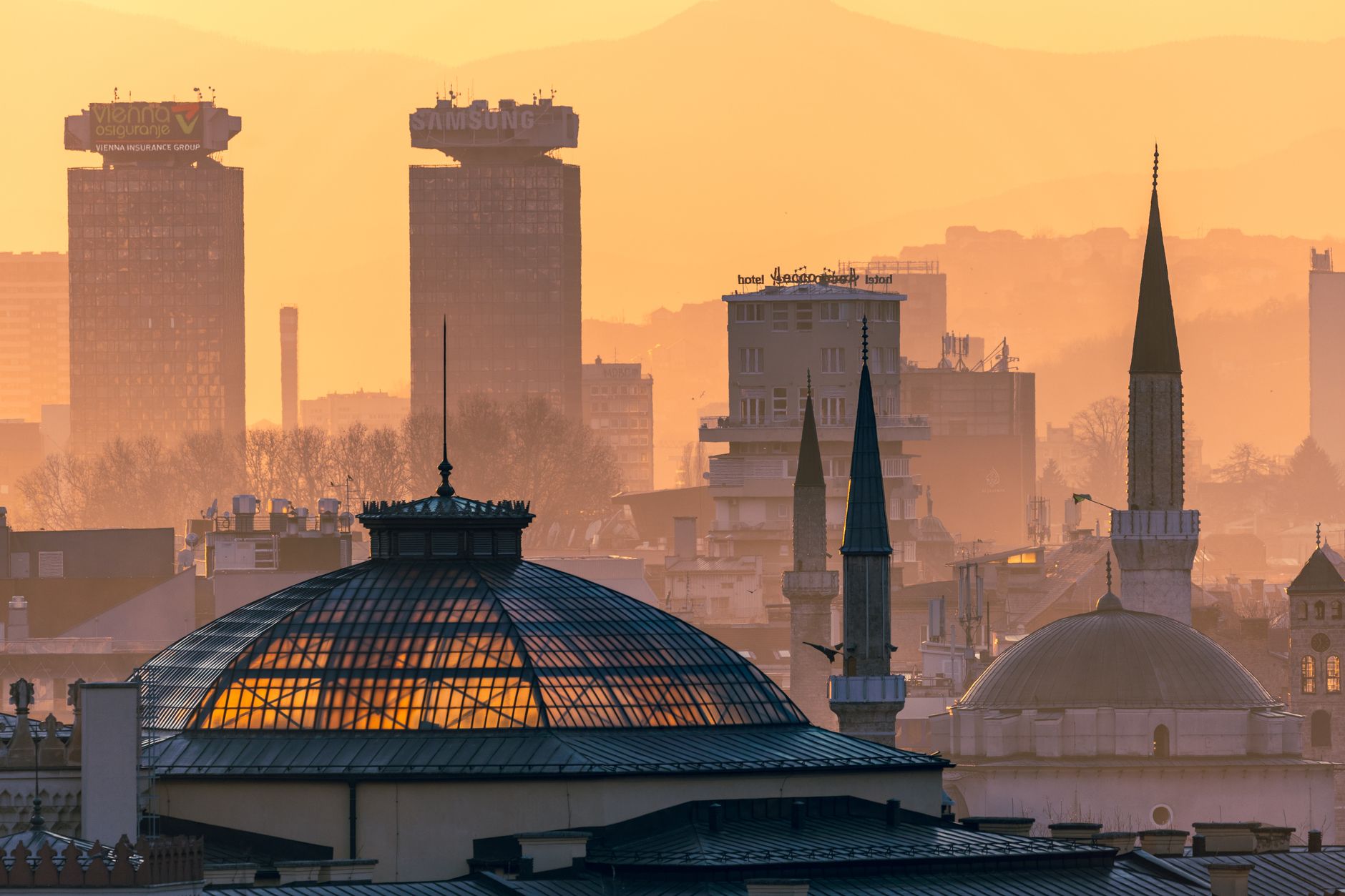 Photo: Amel Uzunovic / Pexels
- Attractions
- 22
- Trip length
- 3–4 days
- Best season
- late spring (May–June) & early autumn (Sept)
Why Sarajevo
Built from cited sources · see the method · How we make our guides →
This is a capital stitched together by stubbornness. Ottoman merchants refused to straighten their lanes, so Austro-Hungarian planners simply built theirs on top, creating double-decker history you can walk in fifteen minutes. The same river that once carried 15th-century copper pots now reflects the yellow concrete of a 1984 Olympic press hotel turned sniper target; both eras feel equally present, like two radio stations bleeding into one signal.
Sarajevo rewards pedestrians who look down. Bronze scars called Sarajevo Roses mark the pavement where mortar shells killed civilians during the 1,425-day siege—no plaques, just resin the color of dried blood holding the cobblestones together. Look up and you’ll see laundry strung between bullet-pocked walls, a woman in sunglasses watering geraniums on a fourth-floor balcony, and somewhere above the red roofs a paraglider launched from Mount Trebević drifting over the city like nothing happened.
Food follows the same collision logic: a single breakfast can start with a fist-sized burek hot from a basement brick oven, slide into slow-brewed Bosnian coffee served in a copper džezva, and finish with rakija poured by someone who’ll toast “to better times” without irony. The bill arrives in marks, the conversation in four languages, and the hangover—if you chase the rakija with Sarajevo craft beer in a former bomb shelter—feels like respect.
The Sound of Sarajevo
Stand on the inlaid compass on Ferhadija Street and you'll hear Catholic bells, Orthodox chimes and the human muezzin from Gazi Husrev-beg's 1531 minaret overlap at noon—live, no loudspeakers. The city engineered the moment so you can't miss how three faiths share one valley.A Library That Burned Twice
Vijećnica's striped façade looks Moorish, but it's pure Austro-Hungarian politics from 1896. Serbian shells torched two million books here in 1992; the 2014 restoration reprinted what could be found and left charred pages under glass so you remember what's lost when ink ignites.Olympic Ruins Above the Siege
Take the rebuilt 2018 cable car to Trebević and walk the 1984 bobsleigh track—concrete curves now tattooed with graffiti and pocked by artillery posts. The same turns that once carried sleds at 140 km/h later aimed mortars downhill at the city.Coffee You Wait For
Bosanska kafa arrives in a copper džezva with a sugar cube and a spoon you use only to pause—letting grounds settle is part of the ritual. Two hours over one cup is standard; the bill will be less than a tram ticket.
Neighborhoods
Where to wander, by quarter — each with its own rhythm.
Baščaršija
The 15th-century bazaar still smells of tallow and cumin because coppersmiths hammer trays inside shops no wider than a train carriage. Pigeon Square’s wooden Sebilj fountain is a prop—locals fill bottles at the stone spout behind Gazi Husrev-beg Mosque where the water is colder. By 22:00 the lanes empty; stay and you’ll hear shutters clang like mis-timed cymbals while cats take over the chessboards.Ferhadija & Austro-Hungarian Quarter
The cultural equator. Step east off the compass rose and you’re on smooth cobblestones under minarets; step west and you’re climbing tram-tracked asphalt past Secessionist façades with wrought-iron balconies. Cafés switch from bosanska kafa to Viennese cappuccino within twenty meters, and the same bartender will serve both depending which side of the sidewalk you sit on.Marijin Dvor
Built in 1886 for the wife of a Habsburg governor, now a grid of calm residential streets where pensioners walk poodles past the National Museum (don’t miss the 14th-century Sarajevo Haggadah). The eternal flame burns at the traffic island’s center—people wait for the bus beside it, unbothered by the bronze Partisan with his rifle pointed at the courthouse.Dolac & Mejdan
Houses cling to the hillside like barnacles; laundry lines bridge the narrow lanes so efficiently you can walk three blocks in shade at noon. Below, the Miljacka river glints through poplars; above, the White Fortress gives you the city’s best sunset with zero tour buses. Locals call the climb “the cardio confession.”Ciglane & Breka
Socialist apartment blocks painted pistachio and peach spill up the slope. Evenings smell of grilled paprika drifting from family balconies; the small open-air market sells tomatoes for half the Baščaršija price. Come here to drink coffee with teachers and taxi drivers who’ll draw siege maps on napkins if you ask.Sniper Alley Strip (Džidžikovac–Skenderija)
The wide boulevard once nicknamed for its kill lines is now just traffic and billboards, but the Holiday Inn’s yellow concrete still shows pockmarks near the eighth floor—journalist rooms. Across the street, the rebuilt Unis skyscraper reflects clouds where Serbian spotters once nested. Jog it at dawn when the city’s only noise is delivery vans and river gulls.
Plan your trip
Before you go
- Getting There
- Sarajevo International Airport (SJJ) sits 11 km west; Centrotrans shuttle reaches Baščaršija in 48 min for 5 BAM. No passenger trains cross the country since 2020—buses from Zagreb (7 h), Belgrade (5 h) and Dubrovnik (4 h) terminate at the central autobuska stanica beside tram stop Latinska Ćuprija. Drivers enter via the A1 motorway from Croatia or M5 from Serbia; both narrow to two-lane mountain roads inside Bosnia.
- Getting Around
- No metro—seven tram lines run east–west every 15 min; Lines 1 and 3 link the old town to the bus station and Ilidža. GRAS buses fill the hills; single tickets 1.60 BAM at kiosks, 1.80 BAM from the driver. Sarajevo Card (check sarajevocard.com for 2026 pricing) bundles unlimited rides with museum discounts. Nextbike gives 30 min free daily; scooters from BeeBee cost 0.20 BAM per minute after unlocking.
- Climate & Best Time
- May and September hover around 21 °C, lilacs or golden linden in the air, and cafés spill onto cobblestones until midnight. July–August hit 27 °C but bring cruise-day crowds; December sits near 4 °C and pours 100 mm of rain, yet the Christmas market glow makes the wet worthwhile. Aim for the last week of August if you want the Sarajevo Film Festival without midsummer heat.
- Language & Currency
- Bosnian uses Latin script in the city—'hvala' (HVAH-lah) covers every thank-you. One euro equals 1.96 BAM, locked and stable; ATMs from BBI or Raiffeisen skip the 10 BAM fee Euronet slaps on. Cash rules transport and bakeries, cards work in hotels and most restaurants.
- Safety
- Center is safe after dark—police walk Ferhadija until 2 a.m. Landmines linger on unmarked hillside trails outside town; stay on signed paths to the fortresses. Airport taxi touts quote 50 BAM; call Crveni Taxi (+387 33 468 728) for the metered 20 BAM ride.
Where Empires Collide and Echo
From Neolithic hearths to a tunnel under the runway
- c. 5200 BCE
Butmir Potters Shape the Valley
On the banks of the Željeznica, villagers fire Europe’s most flamboyant Neolithic pottery—spirals, animals, human faces pressed into wet clay. Their kilns leave lenses of ash that archaeologists will mistake for natural strata until 1893, when an Austro-Hungarian pavilion slices straight into a rubbish pit of painted bowls. The find gives Sarajevo its first named culture and proves the valley has always lured people who like to make beautiful, useful things.
- 9 AD
Rome Marches In
The Daesitiates, last Illyrian tribe still fighting, fall to Tiberius’s legions. A military road hugs the Miljacka gorge, linking the Adriatic salt pans to the Danube granaries. Ilidža’s thermal springs become Aquae Sulphurae, a spa where legionnaires soak away frontier aches. Latin inscriptions will turn up later, reused as doorsteps in Ottoman courtyards.
- 1238
Vrhbosna’s Cathedral Rises
Papal bulls mention a cathedral ‘‘in vrhbosna’’ dedicated to Saint Paul. No trace survives above ground, but Romanesque columns emerge 600 years later while workers dig tram lines along Skenderija. The stones carry masons’ marks identical to ones in coastal Dalmatia, proof that medieval Bosnia traded ideas, not just iron and salt.
- 1461
Isa-Beg Founds Sarajevo
Ottoman governor Isa-Beg Ishaković swaps pastureland with shepherds, moves them to Hrasnica, and stakes out a new town. He plants a mosque, a bridge, a bath, and a palace—‘‘saray’’—on the Miljacka’s left bank. Within twenty years 100 minarets prick the sky; the census of 1489 counts Muslims, Orthodox, Catholics, and the first Sephardic families who carry the Sarajevo Haggadah across the Straits.
- 1531
Gazi Husrev-beg Builds Forever
The city’s greatest patron funds a mosque whose dome is 26 m wide—larger than any in the Balkans outside Istanbul. He adds a clock tower, a library, a madrasa, and a soup kitchen that still feeds the poor every evening. Locals joke that he was so generous even the pigeons in his courtyard eat better than princes elsewhere.
- 1697
Prince Eugene Torches the Town
Habsburg cavalry gallop down the goat paths of Mount Trebević at dawn. By noon 2,000 houses, every mosque, and the covered bazaar are cinders. The fire is so hot it melts the lead on Gazi Husrev-beg’s dome; molten drops harden in the snow like silver hail. The city takes 50 years to regain its pre-burn population.
Show the full timeline (19 moments)
- 1868
Orthodox Cathedral Consecrated
Funded by Sarajevo’s Serb merchants during still-Ottoman rule, the five-domed Nativity of the Theotokos rises 43 m above the Miljacka. Its bells can be heard in Pale, 15 km away. The sultan signs the building permit personally, calculating—correctly—that plural architecture buys plural loyalties.
- 1878
Habsburg Troops Occupy
After the Treaty of Berlin, blue-coated Austro-Hungarian soldiers march in to ‘‘civilize’’ the province. They lay tram tracks, erect neo-Renaissance façades west of the river, and install streetlights so bright that owls abandon Baščaršija. The city’s first photographer sets up shop on Ferhadija; his portraits show men in fezzes standing next to officers in spiked helmets.
- 1891
Sebilj Fountain Reborn
The wooden kiosk at Pigeon Square, burned in 1697, is rebuilt—this time by Austrian architects who have never seen the original. Their neo-Ottoman lattice is prettier, but the water tastes the same. Within a decade the square is so thick with birds that guidebooks claim good luck follows anyone whom a pigeon targets.
- 1894
Gavrilo Princip Born
In the mountain hamlet of Obljaj, a peasant woman gives birth to a boy who will learn to read in Sarajevo, join Young Bosnia, and die in Terezín of tuberculosis, his arm withered by chains. The city later renames the bridge he stood on, then renames it back, unable to decide whether he is hero or villain.
- June 28, 1914
Two Shots on the Latin Bridge
Gavrilo Princip steps forward at 10:45 a.m., a meter from the café where he had just bought a burek. His pistol kills Archduke Franz Ferdinand and Sophie, uncorks four years of war, topples empires, and rewrites maps. The street corner becomes first a shrine, then a shame, then a museum whose plaque wording changes with every regime.
- 1941
Nazi Puppet State Declared
German staff cars roll into town; Bosnia is folded into the Independent State of Croatia. Ustaše militia hang Cyrillic signs upside-down to humiliate Orthodox townsfolk. By 1942 the synagogue stands empty—its Sephardic congregation deported to Jasenovac. The Sarajevo Haggadah is smuggled out in a Koran box by the museum curator and a Muslim imam.
- April 6, 1945
Partisans Liberate the City
Red-starred fighters enter at dawn, greeted by women who have hidden bread under floorboards for weeks. The next day trams run again—drivers hang homemade Yugoslav flags from the windows. Sarajevo becomes capital of the Socialist Republic of Bosnia-Herzegovina, its medieval borders restored inside a federal cage.
- 1962
Dino Merlin Learns Accordion
In the Alifakovac quarter, six-year-old Edin Dervišhalidović borrows his neighbor’s battered accordion and starts playing at weddings. By the late 1980s his band Merlin sells out Zetra Arena; their anthems become the soundtrack to siege cellars. Today his ballads are sung by both Bosniak and Serb teenagers who barely remember the war.
- 1984
Winter Olympics Open
Torch-bearers ski down Mount Trebević while 45,000 spectators cheer inside Koševo Stadium. Cable cars built for the games ferry 2,000 people an hour; journalists call Sarajevo ‘‘the new Innsbruck.’’ For sixteen days the city forgets the cracks in Yugoslavia and believes the world will always come here to celebrate.
- April 5, 1992
Siege Begins
Snipers on the hills turn pedestrian crossings into lotteries. Water pipes freeze; citizens melt snow on living-room books. The morgue installs a walk-in refrigerator that hums like a second heart. Sarajevo’s 1,425-day siege outlasts Leningrad, and every shell crater becomes a planter for petunias.
- July 1993
Tunnel of Hope Dug
Under the airport runway, miners and students hack an 800 m shaft just 1.6 m high. Wheelbarrows carry 400 tons of food, oil, and ammunition each night. The tunnel mouth opens in the Kolar family’s basement; they charge travelers by the kilo and later turn the cellar into a museum where you can still smell wet earth and diesel.
- 1997
Pope John Paul II Prays at Koševo
Fifty thousand pack the stadium where the Olympics once opened. The pontiff kisses a blood-stained handkerchief recovered from Srebrenica and calls Sarajevo ‘‘a city of hope.’’ Rain falls; umbrellas bloom like mushrooms. For the first time since 1991, the tram circuit runs without stopping for checkpoints.
- 2026
EU Candidate Status Pending
Graffiti on the Academy of Fine Arts reads ‘‘Europe is a verb.’’ Cafés along the Miljacka serve oat-milk flat whites next to kafanas brewing Bosnian coffee in copper džezvas. The cable car rebuilt in 2018 climbs Trebević again; from the top you can see Ottoman minarets, Austro-Hungarian chimneys, and the fresh concrete of post-war suburbs—all breathing the same mountain air.
Who lived here
-
Assassin · 1894–1918
Gavrilo Princip
Fired the 1914 shots on Latin Bridge
He waited outside Schiller’s deli, swallowed a cyanide capsule that failed, then watched the world unravel. Today the bridge bears only a small plaque—Sarajevans debate whether he’s hero or harbinger over coffee stronger than the poison he took.
-
Ottoman Governor & Builder · 1480–1541
Gazi Husrev-beg
Financed the city’s first mosque, library, hammam and bezistan
He earmarked his fortune ‘for the benefit of all who reside in Sarajevo’—and they still do, trading copper under the six stone domes he paid for five centuries ago.
-
Composer / Rock guitarist · born 1950
Goran Bregović
Grew up in Koševo neighbourhood, formed Bijelo Dugme
His turbo-folk riffs became the soundtrack to Yugoslavia’s last carefree summer—1984 Olympics. Return in August and you’ll hear brass bands quoting him during late-night bar crawls.
-
Film director · born 1969
Danis Tanović
Shot Oscar-winning ‘No Man’s Land’ on Sarajevo outskirts
He used the city’s real wartime tunnels as sets, proving stories forged here travel further than any passport. Local projectionists still toast him with rakija when the Film Festival rolls.
-
Singer-songwriter · born 1962
Dino Merlin
Born and busking in Baščaršija before Yugoslav pop stardom
His ballads about Sarajevo sevdah echo from cafés at 2 a.m.; even teenagers know the lyrics because the city hums them back to itself.
Where to Eat
Where locals actually book dinner — not the tourist menus.
-
Ćevapi
Grilled fingers of beef and lamb, five to ten per portion, tucked into somun flatbread with raw onion and a smear of ajvar. Eat them at Željo in Baščaršija—half-portion costs 3 BAM and arrives in under three minutes.
-
Bosanski Lonac
A layered cauldron of lamb, beef, potatoes, cabbage and paprika slow-simmered for hours; every family swears by its own order of stacking. Look for it as a daily special at aščinicas like Hadžibajrić—ladled from a dented pot at the counter.
-
Begova Čorba
Creamy chicken and okra soup thickened with egg yolk and lemon, served in a shallow copper bowl. Order it before midday; by afternoon the kitchens switch to stews.
-
Tufahija
A poached apple stuffed with walnut and sugar, floated in syrup and crowned with whipped cream. One is enough for two; the apple collapses into the nuts like autumn on a spoon.
-
Bosanska Kafa
Turkish-style coffee boiled three times in a džezva, poured unfiltered into a fildžan. The grounds tell your fortune; flip the cup onto the saucer when you're done and wait for the pattern to set.
-
Rahat Lokum
Rose-scented Turkish delight served beside coffee—bite first, sip second, let the sugar cut the bitterness. Buy it by weight at the 16th-century Bezistan under its stone domes.
-
Pita
Paper-thin phyllo rolled with spinach (zeljanica), cheese (sirnica) or pumpkin (tikvenica) and baked in wide metal pans. Breakfast slices sell for 1.5 BAM at pekara bakeries before 10 a.m.
-
Inat Kuća
The 'House of Spite' restaurant was moved stone-by-stone across the river in 1895 by Austro-Hungarians after its owner refused to sell. Inside, try the klepe—tiny Bosnian ravioli drowned in garlic yoghurt and paprika butter while you sit under beams that once faced City Hall.
Insider tips
Small things that change how the city treats you.
Carry Cash
Cards often fail outside the absolute centre—keep convertible marks (BAM) for burek stands, taxis and small cafés.Catch the Live Call
Be outside Gazi Husrev-beg Mosque at noon; a human muezzin still climbs the 45 m minaret five times daily.Sunset at Yellow Fortress
Walk 15 minutes uphill from Baščaršija for the best dusk view; vendors sell 1-mark tea you can sip on the ramparts.Share the Grill Plate
Ćevapi portions look personal but are meant for splitting—ask the waiter to divide or you’ll face 20 sausages solo.Look Down for Roses
Red resin-filled mortar scars mark siege fatality spots; find them outside the cathedral and along Ferhadija.Use the Rebuilt Cable Car
Trebević cable car ( reopened 2018) whisks you to Olympic bobsled ruins in 7 min—cheaper than siege-history taxis.
Gallery
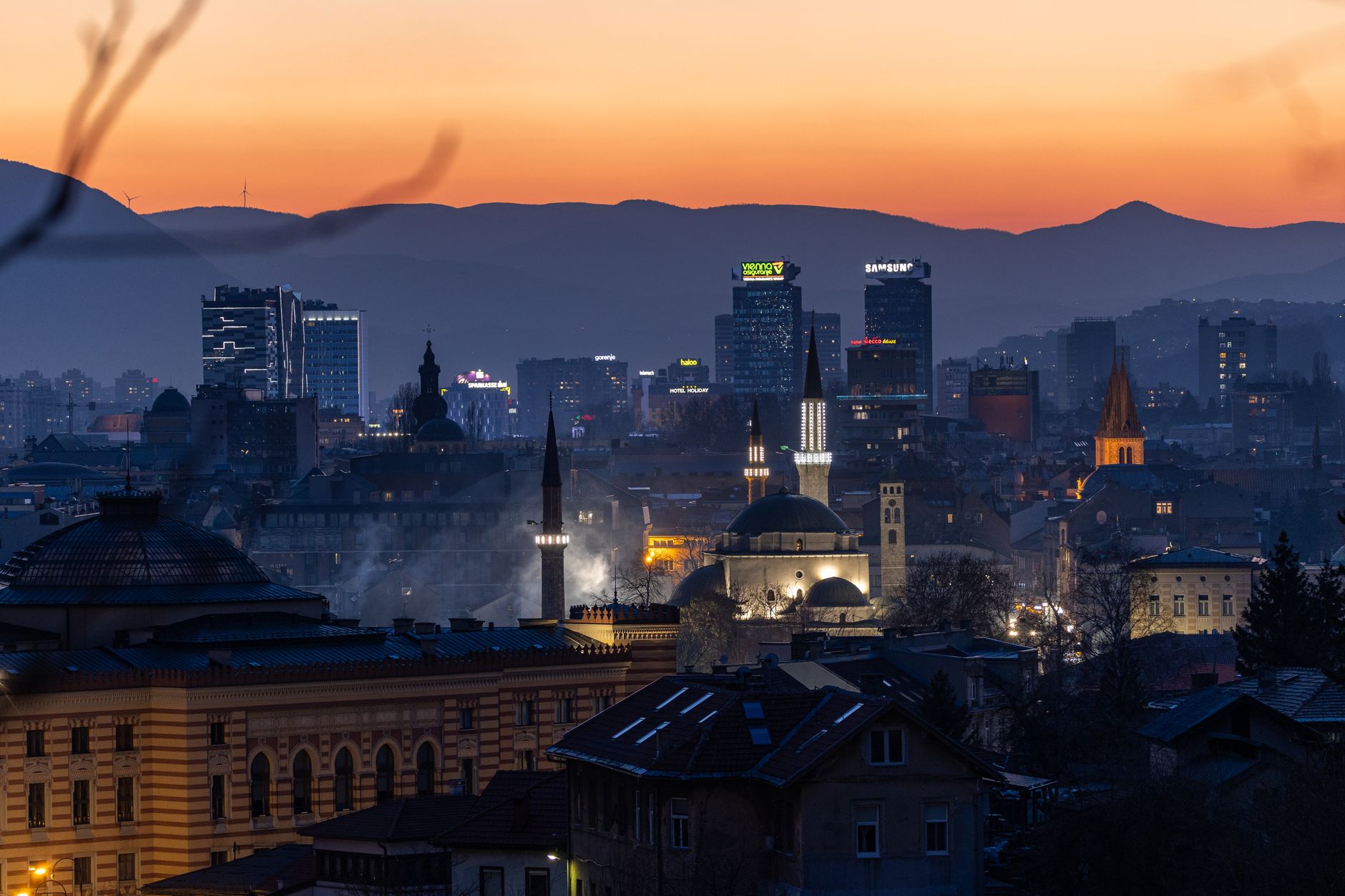
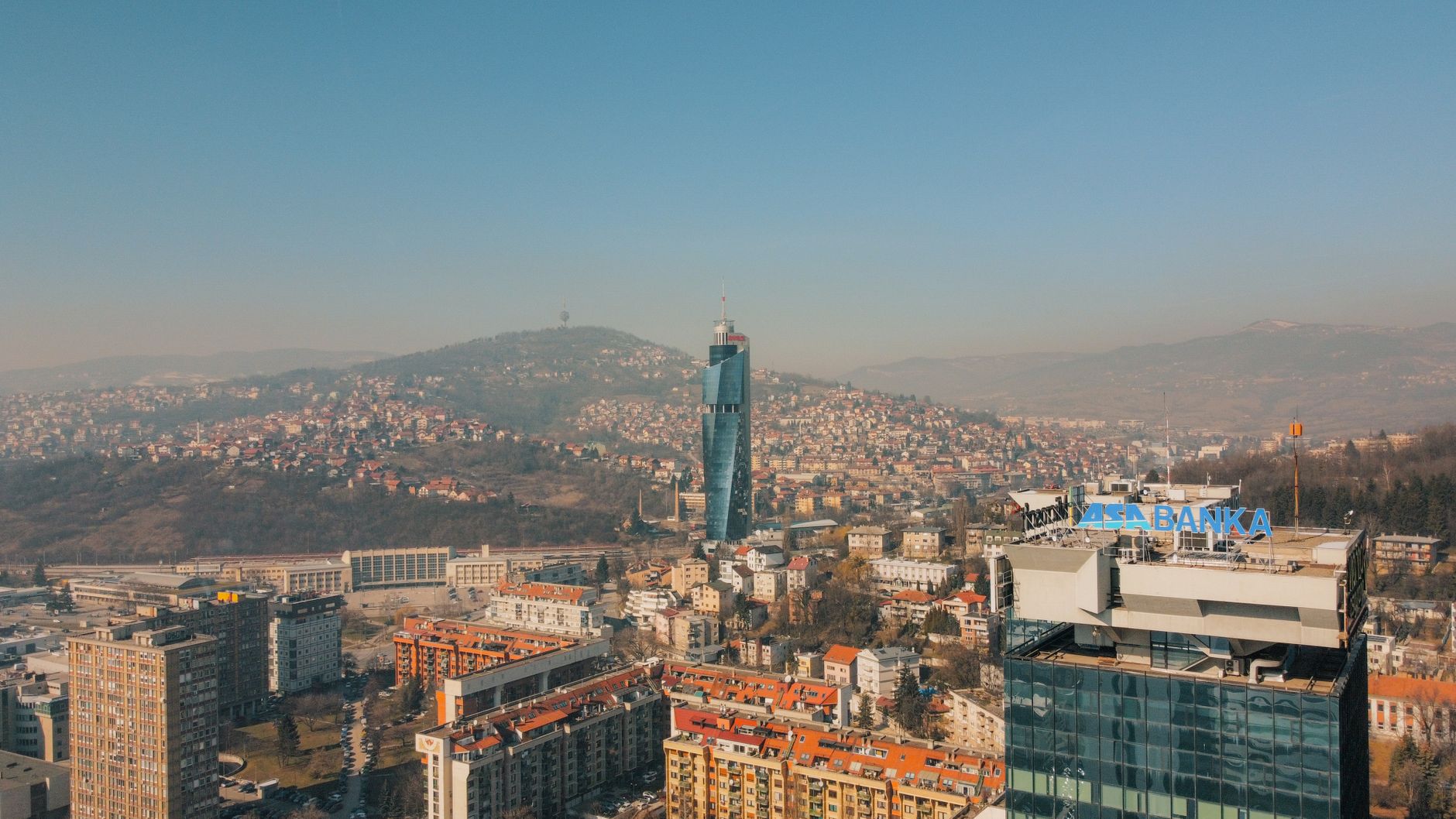
The city, as it actually looks.




Frequently asked
Is Sarajevo worth visiting?
Yes—few cities let you hear Catholic bells, an Orthodox choir and a live muezzin within five minutes. Layers of Ottoman, Habsburg and Yugoslav history are still lived-in, not museumified.
How many days in Sarajevo?
Three full days covers Baščaršija, the tunnel museum, a sunset fortress walk and a day-trip to Konjic or Mostar. Add two more if you want mountain hikes or the film festival.
Is Sarajevo safe for tourists?
Street crime is low; watch for uneven pavements and leftover ordnance if you stray far off marked trails on Trebević. Locals are quick to warn, not wound.
What’s the cheapest way from the airport?
Public trolleybus 103 to Baščaršija costs 1.80 BAM (~€0.90). Taxi meters start at 2 BAM; agree on 25–30 BAM total to the centre.
Do I need to tip?
Tipping is discretionary—round up or leave 5–10 % only if service impressed. Many cafés leave tip jars; coins are appreciated, not expected.
Can I drink the tap water?
Yes—Sarajevo’s mountain-fed supply is safe; bring a bottle and refill at Sebilj fountain for the full Ottoman experience.
Pick up where you left off
Saved and recently read places — kept on this device only.
Photo credits (13)
- Amel Uzunovic — Pexels License (https://www.pexels.com/license/) — Source: https://www.pexels.com/photo/36707002/
- Amel Uzunovic — Pexels License (https://www.pexels.com/license/) — Source: https://www.pexels.com/photo/36707012/
- Sandin Redzo — Pexels License (https://www.pexels.com/license/) — Source: https://www.pexels.com/photo/34870152/
- Necip Duman — Pexels License (https://www.pexels.com/license/) — Source: https://www.pexels.com/photo/34226486/
- Drago Rapovac — Pexels License (https://www.pexels.com/license/) — Source: https://www.pexels.com/photo/20813448/
- Sandin Redzo — Pexels License (https://www.pexels.com/license/) — Source: https://www.pexels.com/photo/34688802/
- Sandin Redzo — Pexels License (https://www.pexels.com/license/) — Source: https://www.pexels.com/photo/28664574/
- Emir Bozkurt — Pexels License (https://www.pexels.com/license/) — Source: https://www.pexels.com/photo/29450686/
- Sandin Redzo — Pexels License (https://www.pexels.com/license/) — Source: https://www.pexels.com/photo/35001151/
- Tahsin Bilgin — Pexels License (https://www.pexels.com/license/) — Source: https://www.pexels.com/photo/18012068/
- Sandin Redzo — Pexels License (https://www.pexels.com/license/) — Source: https://www.pexels.com/photo/34688803/
- Ljubisa Pokrajac — Pexels License (https://www.pexels.com/license/) — Source: https://www.pexels.com/photo/33796477/
- Sandin Redzo — Pexels License (https://www.pexels.com/license/) — Source: https://www.pexels.com/photo/34729774/
Photos may have been resized or cropped.