Mostar
Bosnia and Herzegovina Updated Apr 2026
The Neretva river cuts through Mostar in Bosnia and Herzegovina, and its water looks less like liquid and more like crushed malachite. Step off the bridge. The temperature drops ten degrees instantly.
 Photo: Muhammed Fatih Beki / Pexels
- Attractions
- 14
- Trip length
- 2–3 days
- Best season
- April–May or September–October
Why Mostar
Built from cited sources · see the method · How we make our guides →
Mostar’s real architecture emerges when you look away from the 1566 stone span, and it points instead toward the fractured grid of the west bank. Look closer. Austro-Hungarian planners carved wide boulevards there in 1878, planting neo-Moorish facades beside later socialist blocks.
Locals measure their days by the slow, deliberate pour of Bosnian coffee from a brass džezva, and the steam carries roasted notes across shaded terraces. Find a seat. Copper hammers ring just off Kujundžiluk bazaar.
The reconstructed bridge finally opened in 2004 after engineers assembled 456 hand-cut limestone blocks, and they pulled the originals directly from the riverbed. Watch the divers. They jump from the parapets into the freezing current every July.
Stone Over Water
The 16th-century Stari Most isn’t just a postcard; it’s a single stone arch held together by iron clamps and egg-white mortar. Climb the Koski Mehmed Pasha minaret to see how it slices through Ottoman tile roofs, Austro-Hungarian facades, and socialist concrete.The Copper Alley & Coffee Ritual
Kujundžiluk’s cobbled spine still hums with copper hammers. Stay longer for the Bosnian coffee ceremony at Café de Alma, where the ritual unfolds in heavy brass džezvas while the Neretva runs milky-turquoise below.The West Bank’s Unpolished Memory
Cross the river to Spanish Square’s neo-Moorish school building and the facades around Liska Park. They keep the 1990s siege visible, offering a quiet counterweight to the polished Old Town.
Neighborhoods
Where to wander, by quarter — each with its own rhythm.
Stari Grad
Cobblestones wear smooth under centuries of footsteps, leading past copper-smith stalls to the river’s edge. You will find Koski Mehmed Pasha Mosque here, its 1617 minaret offering a direct sightline to the stone arch. The bazaar feels preserved rather than staged.West Bank
Broad avenues cut through this district in the late 19th century, replacing river alleys with civic grids. The neo-Moorish Old Gymnasium anchors the main plaza, its painted facade contrasting sharply with the Ottoman core. Cafes spill onto the pavement until late evening.Tabhana
Tucked just behind the main tourist corridor, this quarter trades souvenir stalls for local bakeries and unmarked coffee houses. The streets slope gently toward the water, and the noise of the bridge recedes. You will hear more Bosnian than English here.Liska Park
A former frontline zone now hosts sprawling plane trees and quiet walking paths. Concrete bunkers sit half-hidden by ivy near the benches. Local guides use the space to explain how the Neretva once divided neighborhoods for years.Brankovac
The hillside neighborhood climbs steeply away from the river, offering older residential streets and the ruins of the former synagogue. The climb rewards you with a quieter view of the valley’s limestone cliffs. Most visitors never make it past the first switchback.
Plan your trip
Before you go
- Getting There
- Mostar Airport (OMO) runs a 10 KM shuttle from seasonal 2026 flights out of Zagreb, Belgrade, Düsseldorf, and Stuttgart. Most visitors fly into Sarajevo (SJJ) and catch a 2h40 Centrotrans bus for 34 KM, or use the ŽFBH seasonal weekend train to Ploče. From the coast, Dubrovnik Airport (DBV) connects via a €10 Platanus shuttle to the border, where cross-border buses run daily.
- Getting Around
- The Old Town is strictly walkable, but the wider city relies on the Mostar Bus network, which ran 16 local lines with live app tracking in 2026. Single tickets start at 1.50 KM, while a 5 KM day pass covers all urban zones. Nextbike docks and BinBin scooters fill the remaining gaps between the riverbank and the Austro-Hungarian grid.
- Climate & Best Time
- Summers hit 24°C in July with barely 37mm of rain, while November drops to 9°C and delivers 152mm across slick stone streets. Target late April through June or September, when highs hover around 17–21°C and the tourist crush thins. Peak season runs July to August, booking out river-view rooms months in advance.
- Language & Currency
- English handles most hotel and tour interactions, but everyday street life moves in Bosnian/Croatian/Serbian. The currency is the convertible mark (BAM), officially pegged at 1.95583 to the euro, and card terminals remain spotty outside main restaurants. Carry 5 and 10 KM notes for bus fares, bazaar copperware, and coffee counters that still run on cash.
Stone, River, and Memory in the Herzegovinian Valley
From Ottoman toll bridge to divided city and rebuilt icon
- 1452
Ragusan Letter Records Bridge Fortresses
A merchant letter from Dubrovnik mentions two wooden fortresses guarding a river crossing. Timber and rope held the structure together for centuries before limestone ever touched the water. The valley already served as a vital corridor between the Adriatic coast and inland trade routes.
- 1474
Bridge Keepers Give City Its Name
Ottoman tax registers record the settlement’s first official name. Local families earned their living as mostari, the keepers who maintained the wooden crossing and collected tolls from passing caravans. The title stuck long after the timber rotted away.
- 1566
Stone Arch Spans the Neretva
Mimar Hayruddin completed a single limestone arch spanning twenty-eight meters across the river. Sultan Suleiman ordered the crossing to cement Ottoman control over Herzegovina’s trade routes. The structure rose twenty meters above the water without centering. Builders relied on tension and precise mortar joints.
- 1617
Koski Mehmed Pasha Mosque Opens
Koski Mehmed Pasha commissioned a mosque and complex that anchored the eastern riverbank. Minarets and domes began reflecting off the Neretva’s green surface, drawing worshippers and merchants into the surrounding bazaar. The prayer hall still carries the quiet acoustics of its original plasterwork.
- 1664
Evliya Çelebi Praises the Rainbow Arch
Traveler Evliya Çelebi walked into town and called the bridge a rainbow arch. His Ottoman court chronicles spread the crossing’s reputation across three continents. Visitors still trace the same worn stone steps to catch the afternoon light hitting the parapets.
- 1834
First Orthodox Church Raises Bells
The Serbian Orthodox community raised the city’s first stone church under Ottoman rule. Bells rang across the valley for the first time, cutting through the usual call to prayer. The building marked a quiet shift toward religious pluralism in the old quarter.
Show the full timeline (20 moments)
- 1868
Poet Aleksa Šantić Born on Riverbank
Aleksa Šantić arrived in a merchant house overlooking the bazaar. His verses captured the smell of wet cobblestones and the rhythm of copper hammers. He spent his life writing in the shadow of the minarets, giving Mostar a literary voice that outlasted every empire.
- 1878
Imperial Troops March Into Herzegovina
Austro-Hungarian columns marched through the valley, ending centuries of Ottoman administration. Surveyors immediately laid out new streets and imposed standardized building codes. The old čaršija met iron railings, telegraph wires, and military garrisons.
- 1885
Rail Line Links Town to Coast
The railway station opened its doors, linking Herzegovina directly to the Adriatic coast. Steam locomotives hauled timber, tobacco, and bauxite down the valley at speeds locals had only heard in rumors. The whistle changed the city’s rhythm from hoofbeats to steel.
- 1904
Sephardic Synagogue Completed in Stone
Sephardic refugees finished a purpose-built synagogue using local stone and Moorish revival motifs. The congregation gathered beneath painted ceilings that echoed their Iberian past. The building stood as a quiet testament to the Balkans’ layered religious history.
- 1945
Partisan Columns Liberate the Valley
Partisan fighters secured the valley after days of heavy fighting around the bridges. The city carried deep scars, missing buildings, and thousands of displaced families. The war left 810 local fighters dead, their names soon carved into a hillside memorial.
- 1950
Museum of Herzegovina Opens Doors
Curators cataloged centuries of river trade inside a former administrative building. Medieval coins, Ottoman textiles, and wartime photographs shared display cases under one roof. The collection gave residents a physical anchor to a fractured past.
- 1965
Architect Bogdan Bogdanović Designs Memorial
Architect Bogdan Bogdanović unveiled a memorial cemetery designed to resemble a stone amphitheater. Rough concrete blocks rise from the hillside like fragmented tombstones, overlooking the Neretva gorge. The space avoids heroic statues. Silence and shadow do the heavy lifting here.
- 1977
University Honors Statesman Džemal Bijedić
Džemal Bijedić died in a plane crash after rising from the old quarter to lead the Yugoslav federal government. He directed heavy industrial investment into Herzegovina and expanded regional education. The local university adopted his name, cementing his legacy in brick and lecture halls.
- 1992
Artillery Shakes the River Valley
JNA artillery opened fire on residential blocks, sending ninety thousand residents fleeing across the valley. Twelve mosques burned while the Franciscan monastery collapsed. The bridge survived the initial barrage. The city split into armed enclaves almost overnight.
- 9 November 1993
Stari Most Collapses Into the Water
A single artillery shell struck the eastern parapet, sending the limestone arch into the cold river below. The impact echoed through a divided city already starving for winter. Stone fragments washed downstream. Only the riverbanks remained.
- 18 February 1996
Peace Accord Reunites Divided Streets
International mediators forced a reunification agreement that dismantled six competing municipal administrations. Police checkpoints vanished from the main boulevard, though invisible lines persisted in neighborhoods. Freedom of movement returned on paper first. Then on foot.
- 23 July 2004
Rebuilt Bridge Reopens to Crowds
Divers and engineers lowered a reconstructed limestone arch into place using traditional Ottoman techniques. The bridge reopened to pedestrians carrying flowers instead of weapons. Tourists and locals alike stood on the banks to hear footsteps on the newly polished stone.
- July 2005
UNESCO Inscribes Old City Fabric
The Old Bridge Area earned World Heritage status, recognizing its layered cultural history. The designation forced strict restoration standards across the surrounding bazaar and residential mahalas. Preservation became a legal requirement. Nostalgia alone would not save the stone.
- 20 December 2020
First Local Elections in Twelve Years
Residents finally cast ballots for a unified city council after a prolonged electoral deadlock. The vote ended a legal vacuum imposed by competing political factions and international courts. Mostar’s municipal government returned to the ballot box. The recovery remains uneven.
Who lived here
-
Poet · 1868–1924
Aleksa Šantić
Born and lived here
He spent his life chronicling the Neretva’s moods and the quiet dignity of Mostar’s Ottoman streets. If he walked the reconstructed bazaar today, he would likely appreciate the restored stone but mourn the fractured communities he once wrote to bridge.
-
Footballer · born 1971
Sergej Barbarez
Born here
His youth on the cracked pitches of a divided city sharpened a tactical mind that later carried Bosnian football to the Bundesliga. Watching the modern stadium fill with mixed crowds, he would probably see the pitch as one of the few spaces where the old borders finally dissolved.
-
Writer · 1932–2017
Predrag Matvejević
Born here
He grew up tracing the Mediterranean trade routes that once anchored Mostar’s economy, later turning those observations into essays on Adriatic identity. He would likely recognize the city’s reconstructed facades but question whether the deep cultural memory he documented survived the 1990s.
-
Footballer & Coach · born 1948
Dušan Bajević
Born here
Known as the Prince of the Pitch, he learned to control a ball on the dusty lots overlooking the river before leaving for European leagues. He would probably view today’s youth academies with pride, seeing them as proof that talent outlasts political fractures.
Where to Eat
Where locals actually book dinner — not the tourist menus.
-
Bosanska Kafa
Served in a brass džezva with a lump of sugar and a cube of lokum, this isn’t espresso on a timer. You scoop the grounds, sip through the sugar, and watch the ritual unfold slowly while the river runs turquoise below.
-
Ćevapi
Grilled minced-meat sausages served in warm somun bread with raw onions and kajmak. The best versions come from unassuming grills where the meat sizzles over charcoal and the bread arrives wrapped in cloth.
-
Sogan Dolma
Hollowed onions stuffed with spiced minced meat and slow-baked in a creamy tomato sauce. Mostar’s version leans heavy on black pepper and simmers long enough to turn the onion translucent and sweet.
-
Herzegovinian Zilavka
A crisp, high-acid white wine grown on the rocky karst slopes south of the city. It cuts through grilled meats and carries distinct notes of green apple and wet stone from the limestone soil.
-
Tufahija
Whole stewed apples stuffed with a walnut paste and topped with whipped cream. Bakeries near Kujundžiluk serve it warm, balancing the tart fruit against the dense, spiced filling.
-
Klepe
Tiny dumplings filled with minced beef or lamb, boiled and served with yogurt, garlic, and browned butter. They require patience to fold and arrive as a quiet, comforting alternative to heavier Herzegovinian grills.
Insider tips
Small things that change how the city treats you.
Master Bosnian Coffee
Order at Café de Alma or a Kujundžiluk terrace. Let the grounds settle before sipping, and never rush the ritual; it acts as a social anchor here.Carry Convertible Marks
Most shops and cafes in the old town run strictly on cash. ATMs are scattered on the west bank, but keep smaller BAM notes handy for bazaar stalls.Beat the Summer Crowds
Arrive before 9:00 AM or after 5:00 PM in July and August. The midday heat bounces off the limestone, and the bridge terraces fill with day-trippers.Respect the River Currents
The Neretva runs deceptively fast and stays near 8°C year-round. Swimming is strictly for marked zones; the cold causes instant muscle shock.Check Mosque Timings
Koski Mehmed Pasha Mosque remains active. Dress with covered shoulders and knees, and verify opening hours around prayer times to secure the minaret climb.Walk the West Bank
Cross Stari Most and follow the Neretva upstream past Spanish Square. The Austro-Hungarian grid reveals a quieter, less polished side of the city.Hire Resident Guides
For war history walks, book a guide who lived through the 1993 siege. Their firsthand accounts carry more weight than static museum plaques.
Gallery
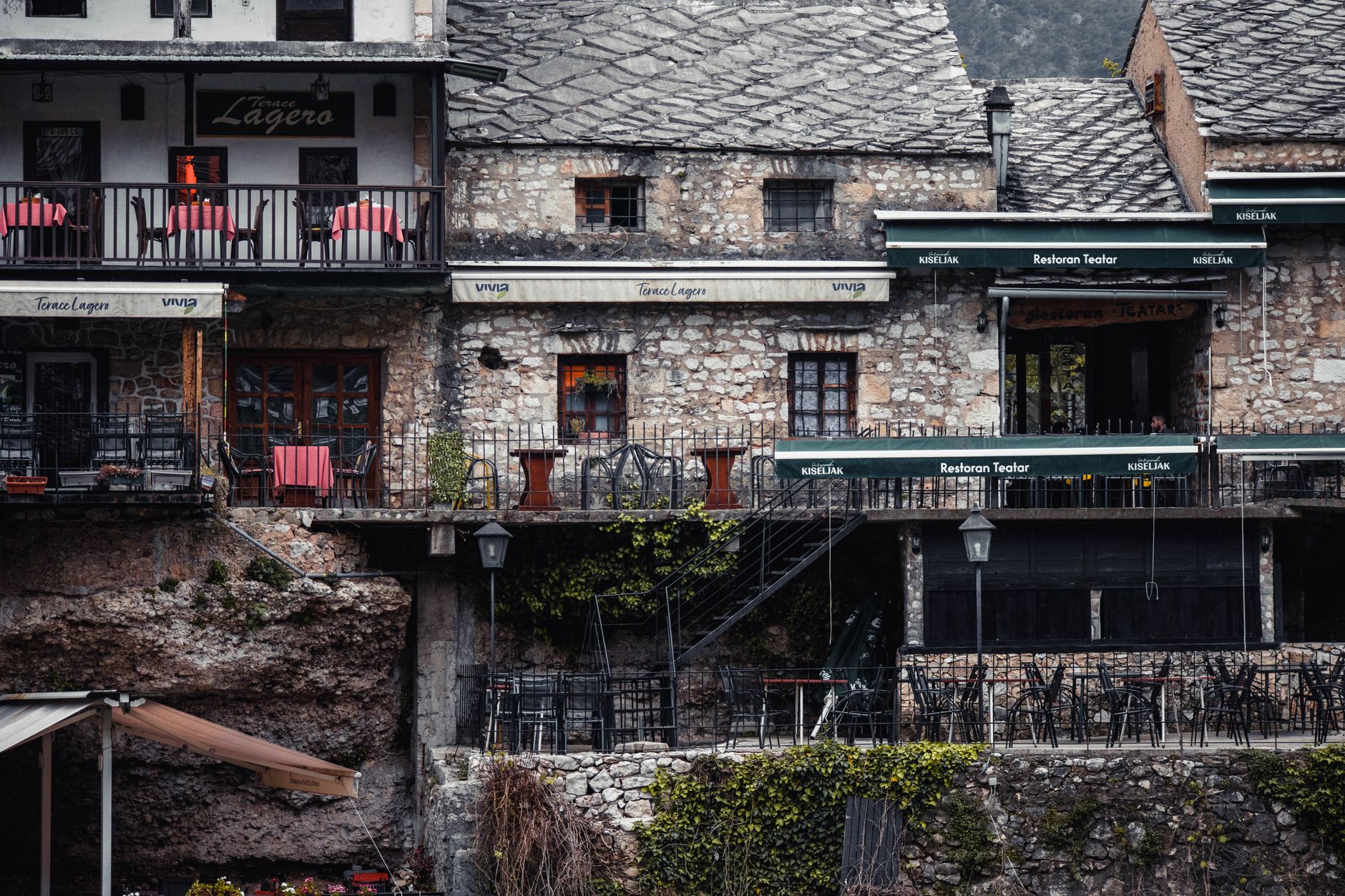
The city, as it actually looks.



Frequently asked
Is Mostar worth visiting for just one day?
You can see the bridge and bazaar in a single afternoon, but you will miss the city’s deeper narrative. Staying two nights lets you explore the west bank, visit the Old Bridge Museum, and take a half-day trip to Blagaj without rushing.
How many days should I spend in Mostar?
Plan two to three full days. One covers the UNESCO core and Koski Mehmed Pasha Mosque, another walks the war-scarred neighborhoods and Partisan Memorial, and a third leaves room for Kravice Falls or Počitelj.
What is the best way to get around Mostar?
The historic center is entirely walkable, though the cobblestones and riverbank stairs demand sturdy shoes. For the west bank or Hum Hill viewpoints, use local taxis; parking near the bridge fills quickly after 10:00 AM.
Is Mostar safe for tourists?
The city sees very little street crime, and the main tourist zones are heavily patrolled. Political tensions exist beneath the surface, but they rarely spill into public spaces; just avoid heated debates about ethnic divisions.
How much does a typical day cost in Mostar?
Budget around 40–60 BAM for lodging, meals, and entry fees. A hearty plate of ćevapi with bread runs 8–12 BAM, while museum tickets rarely exceed 10 BAM.
Pick up where you left off
Saved and recently read places — kept on this device only.
Photo credits (10)
- Muhammed Fatih Beki — Pexels License (https://www.pexels.com/license/) — Source: https://www.pexels.com/photo/32447857/
- Muhammed Fatih Beki — Pexels License (https://www.pexels.com/license/) — Source: https://www.pexels.com/photo/32447869/
- Necip Duman — Pexels License (https://www.pexels.com/license/) — Source: https://www.pexels.com/photo/34422306/
- Ajdin Coric — Pexels License (https://www.pexels.com/license/) — Source: https://www.pexels.com/photo/31667995/
- Muhammed Fatih Beki — Pexels License (https://www.pexels.com/license/) — Source: https://www.pexels.com/photo/32447838/
- Frank van Dijk — Pexels License (https://www.pexels.com/license/) — Source: https://www.pexels.com/photo/37239618/
- Ajdin Coric — Pexels License (https://www.pexels.com/license/) — Source: https://www.pexels.com/photo/31667996/
- Muhammed Fatih Beki — Pexels License (https://www.pexels.com/license/) — Source: https://www.pexels.com/photo/34061629/
- Daciana Cristina Visan — Pexels License (https://www.pexels.com/license/) — Source: https://www.pexels.com/photo/32054771/
- Muhammed Fatih Beki — Pexels License (https://www.pexels.com/license/) — Source: https://www.pexels.com/photo/32447863/
Photos may have been resized or cropped.