An introduction.
Researched by the Audiala editorial team from historical records, architectural archives, and local expertise.
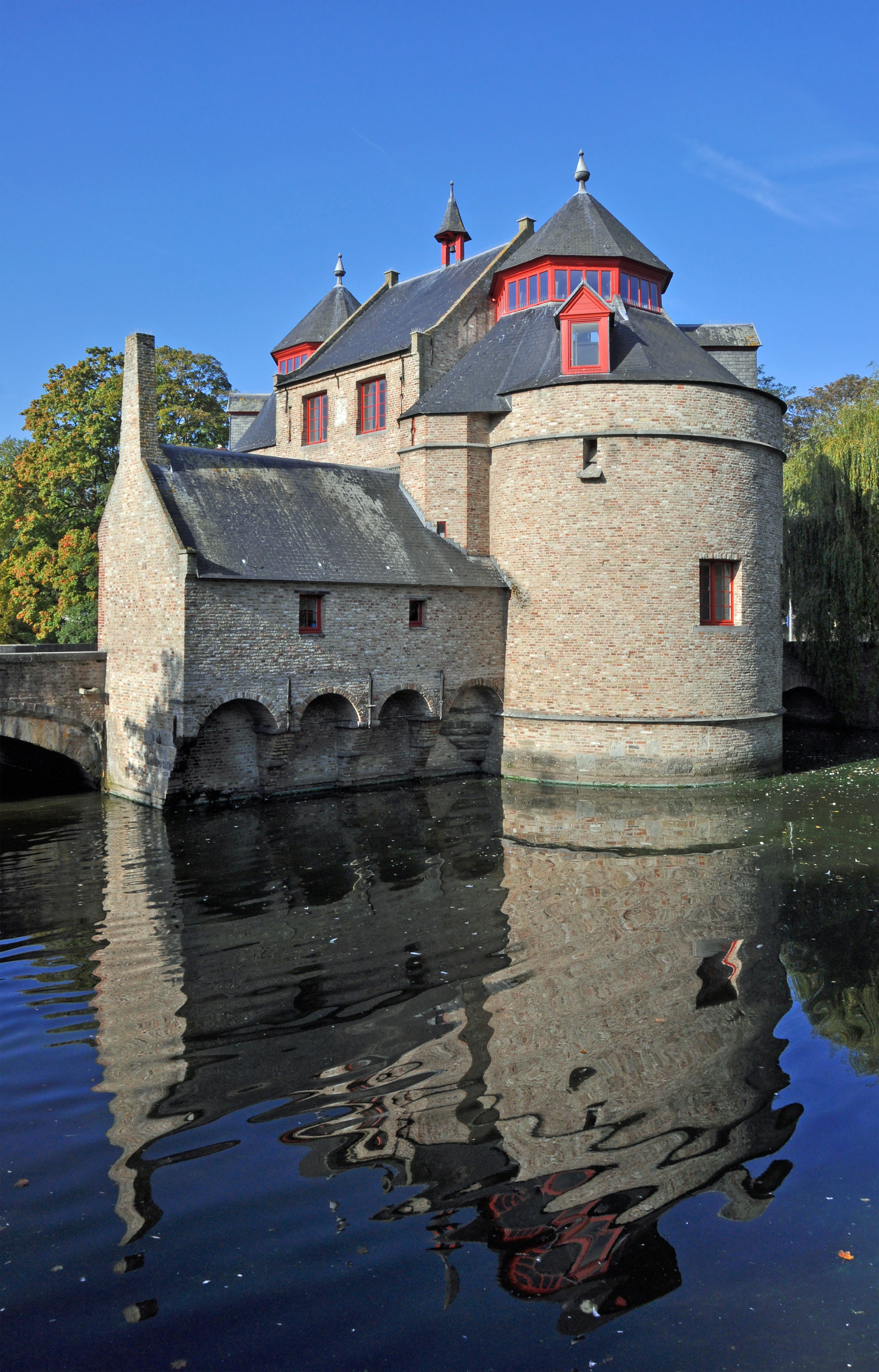
AA city gate named for donkeys now serves as office space, yet Ezelpoort still looks ready to trap intruders in its jaws. In Bruges, Belgium, that tension is exactly why you should come: this is one of the few places where the postcard city drops its lace cuffs and shows you the brick muscle that once kept merchants, soldiers, tax collectors, and emperors in line. Stand by the water at Ezelstraat 122 and the gate reads less like decoration than a machine. Bruges feels older here.
Records show Ezelpoort belongs to Bruges' second ring of defenses, the late-13th-century expansion that turned a rich trading city into a defended one. Most visitors spend their Bruges hours chasing canal reflections and stepped gables. Fair enough. But this gate gives you the harder truth: wealth needed walls, bridges, doors, and a portcullis heavy enough to end an argument fast.
The structure you see now is a layered survivor, not a frozen medieval relic. Records show a gate stood here by 1293, the present form was rebuilt in 1369 by Jan Slabbaerd and Mathias Saghen, then cut down and reshaped in the 17th century, restored again between 1991 and 1993, and left with all that history showing in the brickwork like old scars under thin skin.
Come for the contrast. Water slides past, cyclists flick by, and swans drift through a spot once designed to slow strangers to a crawl between bridge, doorway, and iron grille; if you look closely on the field side, the passage walls still carry the broad stone grooves of that mechanism, cold evidence that this pretty edge of Bruges was built to control who got in.
01 What to see.
Cross the Passage Between the Two Towers
Take the South-Side View from 't Stil Ende
Walk the Gate into the Vesten Ring
02 In pictures.


Plan and listen to Ezelpoort with Audiala.
Audio guide in your pocket, itinerary in your browser. Built for the way you actually visit.
03 Visitor logistics.
The practical scaffolding for a good visit — kept short.
Getting There
Ezelpoort stands at Ezelstraat 122 on the north-west edge of Bruges’ old core. From Markt or Historium, walk northwest through the center and stay on Ezelstraat for about 15-20 minutes; by bus, the nearest stop is 502102 Brugge Ezelpoort, and if you’re driving, Parking Ezelstraat at Hugo Losschaertstraat 5 is the practical choice, a short walk away, with 139 spaces and a 2.2 m height limit.
Opening Hours
As of 2026, Ezelpoort has no posted museum-style opening hours because it functions as a free outdoor monument rather than a staffed attraction. You can view it from the street and waterside at any time, but daylight matters here: the brick mass, canal reflections, and low arches read far better in morning or late-afternoon light, while the interior is not advertised for public visits.
Time Needed
Give it 5-10 minutes for a quick look and a few photos, 15-20 minutes if you want to walk both sides and pause by the water, or 30-45 minutes if you fold it into Ezelstraat, Ezelbrug, and Achiel van Ackerplein. This works best as one stop on a quieter 45-90 minute edge-of-Bruges walk, not as a stand-alone headline sight.
Accessibility
As of 2026, the site is marked child-friendly, stroller-friendly, pet-friendly, and picnic-friendly, but the real issue is the ground under your wheels. Bruges’ historic paving can be uneven, and nearby Ezelbrug is a flat bridge surfaced with cobblestones, so exterior viewing is possible for wheelchair users and rollators, though the terrain may feel more like crossing a rough stone quilt than gliding over smooth pavement.
Cost and Tickets
As of 2026, entry is free and no booking, timed ticket, or skip-the-line option applies because Ezelpoort is an exterior monument. Don’t plan around a public interior visit: the building is used by Anima Eterna Brugge as office space, not as a regular museum.
05 Tips for visitors.
Small things that change the day.
Shoot Outside
Exterior photography is fine from public space, and that’s the point of the stop anyway. For drones, or for any tripod-and-crew setup that takes over public space, Bruges may require a permit or notification in 2026, so keep casual shots handheld unless you’ve checked the film office rules.
Eat On Ezelstraat
Pair the gate with Ezelstraat rather than rushing back to the Markt. Kottee Kaffee works for a budget coffee stop, Spegelaere is the place for Bruges chocolate cobblestones, and Locàle by Kok au Vin is the dinner pick if you want something closer to mid-range or splurge territory.
Go In Daylight
Come in the morning or late afternoon, when the light catches the red brick and the water softens the traffic around it. Midday still works, but daylight matters because this gate is about texture, reflections, and the squat defensive shape you miss once the light goes flat.
Make It A Walk
Ezelpoort makes more sense as the opening move for Ezelstraat, Achiel van Ackerplein, and Sint-Jakobsstraat than as a special detour on its own. Walk inward from the gate and Bruges changes character fast: fewer souvenir-shop theatrics, more cafés, chocolate, bikes, and people who look as if they actually live here.
Mind The Junction
This is not a trouble spot, but it is a traffic spot. Watch for cyclists, buses, and ring-road crossings around the gate, especially if you stop in the roadway for photos or arrive with children.
Know The Limits
Don’t show up expecting a staffed monument, lockers, or an indoor route through the tower. If you need storage, use the railway-station lockers or Historium instead; the gate itself offers none, and that small disappointment is easy to avoid if you know it before you arrive.
Where to Eat
Don't Leave Without Trying
Dining Tips
- check Tipping is not compulsory in Bruges because service is generally included; for especially good service, 5% to 10% is typical, and in cafes rounding up is normal.
- check Lunch usually falls around 12:00 to 2:00 p.m., and dinner around 7:00 to 9:00 p.m.
- check Meals are not rushed; staff may wait until everyone is finished before clearing plates.
- check Many restaurants in Bruges often close on Sunday or Monday, but there is no official citywide closing rule, so check the individual opening hours.
- check Some restaurants serve lunch only on selected days even if they open for dinner more broadly.
- check Businesses in Belgium that sell to consumers must offer at least one electronic payment method.
- check The Market Square food and flower market runs on Wednesday from 8:00 a.m. to 2:00 p.m., and the Saturday market at 't Zand runs from 8:00 a.m. to 1:30 p.m.
- check For seafood shopping, the Fish Market operates Wednesday to Saturday from 8:00 a.m. to 1:30 p.m.
Restaurant data powered by Google
04 A history of reinvention.
The Gate Kept Doing Its Job
Ezelpoort has changed shape more than once, but its basic role barely shifted: it marked the edge of Bruges and forced movement into a narrow, watchable channel. Records show that function begins with the second city enceinte in the late 1200s and survives, in altered form, through rebuilds, demolitions, customs checks, tram traffic, and today's steady flow of walkers and cyclists.
That continuity matters because so much of Bruges' walls have vanished. UNESCO points to the four surviving gates, the ramparts, and the defense waterworks as the reason the lost enceinte can still be read; Ezelpoort is one of the sentences that never got erased, even after the grammar changed.
Charles De Wulf and the Gate He Couldn't Reinvent
Between 1897 and 1902, Bruges city architect Charles De Wulf drew plans to rebuild Ezelpoort into a more theatrical medieval monument, using Marcus Gerards' 1562 map as his guide. For De Wulf, this was personal as well as professional: his reputation rested on whether Bruges should present a cleaned-up heroic past or keep the awkward layers that time had left behind.
The turning point came when that grand reconstruction was not carried out. Records show the scheme stayed on paper, and that failure changed the gate's future; instead of becoming a polished neo-medieval statement, Ezelpoort remained the rough hybrid Bruges had actually inherited, with its 1369 core, 17th-century truncation, and later repairs still legible to anyone willing to look.
I think that rejection did the gate a favor. De Wulf wanted drama. History wanted evidence.
What Changed
What Endured
Listen to the full story in the app
The whole Ezelpoort,
told well.
Audio guides for 1,100+ cities across 96 countries. History, stories, and local insight — offline ready.

06 Frequently asked.
The questions travellers send us most about Ezelpoort.
Is Ezelpoort worth visiting?
Yes, if you want the Bruges that sits just outside the postcard frame. Ezelpoort is one of the city's four surviving medieval gates, and UNESCO points to those gates as the reason Bruges' vanished walls are still readable today. Don't come for a museum visit, though; come for the brick mass over water, the quieter canal edge, and the feeling of crossing a checkpoint instead of admiring a facade.
How long do you need at Ezelpoort?
Most people need 15 to 20 minutes. That gives you time to walk both sides, cross the bridge, look for the broad stone groove in the passage where the gate mechanism once worked, and take a few photos. Give it 30 to 45 minutes if you're pairing it with Ezelstraat, Ezelbrug, or a slow canal-side walk.
How do I get to Ezelpoort from Bruges?
From Bruges' Markt, walk northwest along Ezelstraat for about 15 to 20 minutes and you'll reach the gate at Ezelstraat 122. If you're using public transport, the nearest bus stop is Brugge Ezelpoort, and Visit Bruges also points to Brugge Sint-Pieters as the nearest station. Drivers have the practical option of Parking Ezelstraat on Hugo Losschaertstraat 5, a short walk away.
What is the best time to visit Ezelpoort?
Early morning or late afternoon works best. Low light catches the brick, water, and slate roofs more kindly than flat midday sun, and the place feels calmer because you're already off Bruges' main tourist circuit. Winter has its own edge: archival records tie the waters here to the city's swans during freezing weather, which suits the gate's colder, harder mood.
Can you visit Ezelpoort for free?
Yes, Ezelpoort is free to visit from the outside. It's an outdoor monument rather than a ticketed museum, and the building is now used as office space by Anima Eterna Brugge, so regular interior visits are not part of the standard experience. Think of it as a walk-through landmark, not a booked attraction.
What should I not miss at Ezelpoort?
Don't miss the shift in mood when you cross the water and enter the passage. Inside that short tunnel, look for the wide stone groove in the walls, a plain scar left by the old gate mechanism; it tells you more than any plaque could. Also walk to the south side near 't Stil Ende for the strongest view, where the round towers, bridge, and water make the gate read like a compact fortress.
Verified, and shown.
Researched and written by the Audiala editorial team from historical records, architectural archives, and local expertise.
Primary architectural and historical record for Ezelpoort, including chronology, restoration phases, builders, passage details, and gate mechanism traces.
Context on the Ezelpoort area and its place in Bruges' urban development.
Background on Ezelstraat and the older naming and street context linked to the gate.
Context for nearby Ezelbrug, bridge surface, and surrounding historic fabric.
Official visitor basics, address, free-access status, nearest transport reference, and current presentation of the monument.
Archival image record used for naming history and visual context.
Archival exterior view supporting visual understanding of the gate and its setting.
Historic image record for the south-west side and exterior reading of the monument.
Evidence for the 1991-1993 restoration and the 1994 heritage award.
Source for the importance of Bruges' surviving gates in reading the vanished defensive ring.
Eyewitness-style chronicle used for Joseph II's 1781 entry through Ezelpoort.
Historical study confirming the dates of Joseph II's Bruges visit.
Source on debates over Ezelpoort versus Oostendse Poort naming.
Follow-up source on local naming traditions around the gate.
Research on the etymology and historical naming cluster around Ezelstraat and Ezelpoort.
Historical interpretation of restoration questions and the gate's changing form.
French official page confirming visitor-facing status and local framing.
Dutch official page used to cross-check current visitor information.
Confirmation that the gate building is used by Anima Eterna Brugge as office space.
French local tourism page stating the interior is not open for regular visits and describing the canal-and-tree setting.
Current access context and confirmation of streetworks timing in early 2026.
Confirmation of the March 28, 2026 reopening and neighborhood donkey-themed local identity.
General public transport guidance for Bruges bus services.
Official route-planning source for current bus connections.
Local orientation note with bus suggestions from Bruges station toward Ezelstraat.
Useful wayfinding point on the walk between the center and Ezelpoort.
Secondary orientation source for approximate walking time from central Bruges.
Official parking details, rates, EV charging, height limit, and accessibility features.
City parking overview used to confirm car-park context and 24/7 availability.
Parking policy and practical car-access guidance for visitors.
Source for free bus ticket information from the Bruges P+R.
General accessibility information for the Bruges historic center and uneven paving conditions.
Digital accessibility guide used for mobility context in Bruges.
Secondary source supporting Ezelpoort's fit within quieter canal-side walks.
Recent visitor-summary source used cautiously for timing and stop-length context.
Nearby cafe recommendation on Ezelstraat.
Nearby chocolatier and Bruges cobblestones specialty.
Nearby hostel, bar, and public-toilet context close to Ezelpoort.
Restaurant listing supporting nearby dining recommendations.
Official map and details for nearby public toilets, including Snuffel.
Specific listing for the free public toilet near Ezelpoort.
Fallback practical info for lockers and toilets farther toward the center.
Source for the quieter green setting around the Vesten near Ezelpoort.
General city practical information, including luggage storage references.
Special-access event showing that rare guided interior visits can include tower rooms and roof structure.
Exterior image reference used for visual reading of the gate's asymmetry and massing.
Secondary source supporting the idea of the gate reading as surrounded by water.
Archival image source used for waterside views and winter swan context.
Image record connected to the south-side view and winter swan tradition.
Additional archival view supporting the south-side photo angle and swan context.
Official context for the quiet green ring around Bruges and Ezelpoort's position on it.
Accessibility notes from a special event, including interior stairs and circulation constraints.
Dutch official page used to confirm rampart context.
Nearby bridge context and canal atmosphere close to Ezelpoort.
Third-party audio-guide listing showing limited app-based interpretation exists.
Evidence that Ezelpoort still appears in occasional cultural programming.
Local media framing of the neighborhood as less pressured by tourism.
Nearby local-oriented cafe and cultural hub recommendation.
Press background reinforcing De Republiek's role as a local meeting place.
Evidence that the area features in city heritage walks.
Nearby cultural event listing showing the local social life around the area.
Cultural project linking Anima Eterna and this side of Bruges to overlooked city histories.
Neighborhood livability and traffic context on the edge where Ezelpoort sits.
General public-safety reference for Bruges.
Official nearby dining recommendation on Ezelstraat.
French UNESCO listing used to cross-check the world heritage framing.
Additional city update on recent works affecting the street approach.
Regional news source on streetworks progress in the area.
Regional coverage of the street renewal affecting access feel around Ezelpoort.
City notice about nearby junction works at Ezelpoort.
Recent institutional context around Anima Eterna Brugge, the gate's current occupant.
Source connecting Anima Eterna to Bruges' cultural life.
Official photography and filming rules for larger shoots in public space.
Details on filming, tripods, and drone-related permit considerations.
Official local rules for drone use tied to public space.
City guidance on cobbles and wheelchair movement in Bruges' historic center.
Secondary dining source for Locàle near Ezelstraat.
Nearby coffee option on the broader Ezelstraat-Sint-Jakobsstraat stretch.
Nearby drinks recommendation on the outer Ezelstraat stretch.
Last reviewed
Researched from Wikidata, Wikipedia & official sources · fact-checked · How we make our guides →


