Type 2+ letters to search all countries, cities, and places
/Ctrl KEsc
travel_explore
Type 2+ letters to search all countries, cities, and places
Press Enter to open the top result
Ezelpoort
Bruges·Belgium·51° N · 3° E·
Verified Apr 2026
One of Bruges' four surviving medieval gates, Ezelpoort feels more like a brick fort in the water than a postcard monument, and that's its charm today.
Outdoor viewing only; cobbles and busy crossings can be difficult
A city gate named for donkeys now serves as office space, yet Ezelpoort still looks ready to trap intruders in its jaws. In Bruges, Belgium, that tension is exactly why you should come: this is one of the few places where the postcard city drops its lace cuffs and shows you the brick muscle that once kept merchants, soldiers, tax collectors, and emperors in line. Stand by the water at Ezelstraat 122 and the gate reads less like decoration than a machine. Bruges feels older here.
Records show Ezelpoort belongs to Bruges' second ring of defenses, the late-13th-century expansion that turned a rich trading city into a defended one. Most visitors spend their Bruges hours chasing canal reflections and stepped gables. Fair enough. But this gate gives you the harder truth: wealth needed walls, bridges, doors, and a portcullis heavy enough to end an argument fast.
The structure you see now is a layered survivor, not a frozen medieval relic. Records show a gate stood here by 1293, the present form was rebuilt in 1369 by Jan Slabbaerd and Mathias Saghen, then cut down and reshaped in the 17th century, restored again between 1991 and 1993, and left with all that history showing in the brickwork like old scars under thin skin.
Come for the contrast. Water slides past, cyclists flick by, and swans drift through a spot once designed to slow strangers to a crawl between bridge, doorway, and iron grille; if you look closely on the field side, the passage walls still carry the broad stone grooves of that mechanism, cold evidence that this pretty edge of Bruges was built to control who got in.
Researched by the Audiala editorial team from historical records, architectural archives, and local expertise.
What to see
Cross the Passage Between the Two Towers
Ezelpoort catches you off guard because it feels less like a postcard gate and more like a brick checkpoint dropped in the water at Ezelstraat 122. Records show the site began in 1297, then Jan Slabbaerd and Mathias Saghen rebuilt it in 1369; what you walk through now is squat and stubborn because the taller medieval upper works were cut back in the 17th century, leaving two round towers and a central block that reads like a small fortress. Stand in the passage and look for the broad stone slot in the wall where the gate mechanism once ran. Most people miss it. Bicycle wheels hiss over the paving, voices tighten into a brief tunnel echo, and the whole place stops being decorative medieval Bruges and turns back into what it was: a device for controlling who got in.
Take the South-Side View from 't Stil Ende
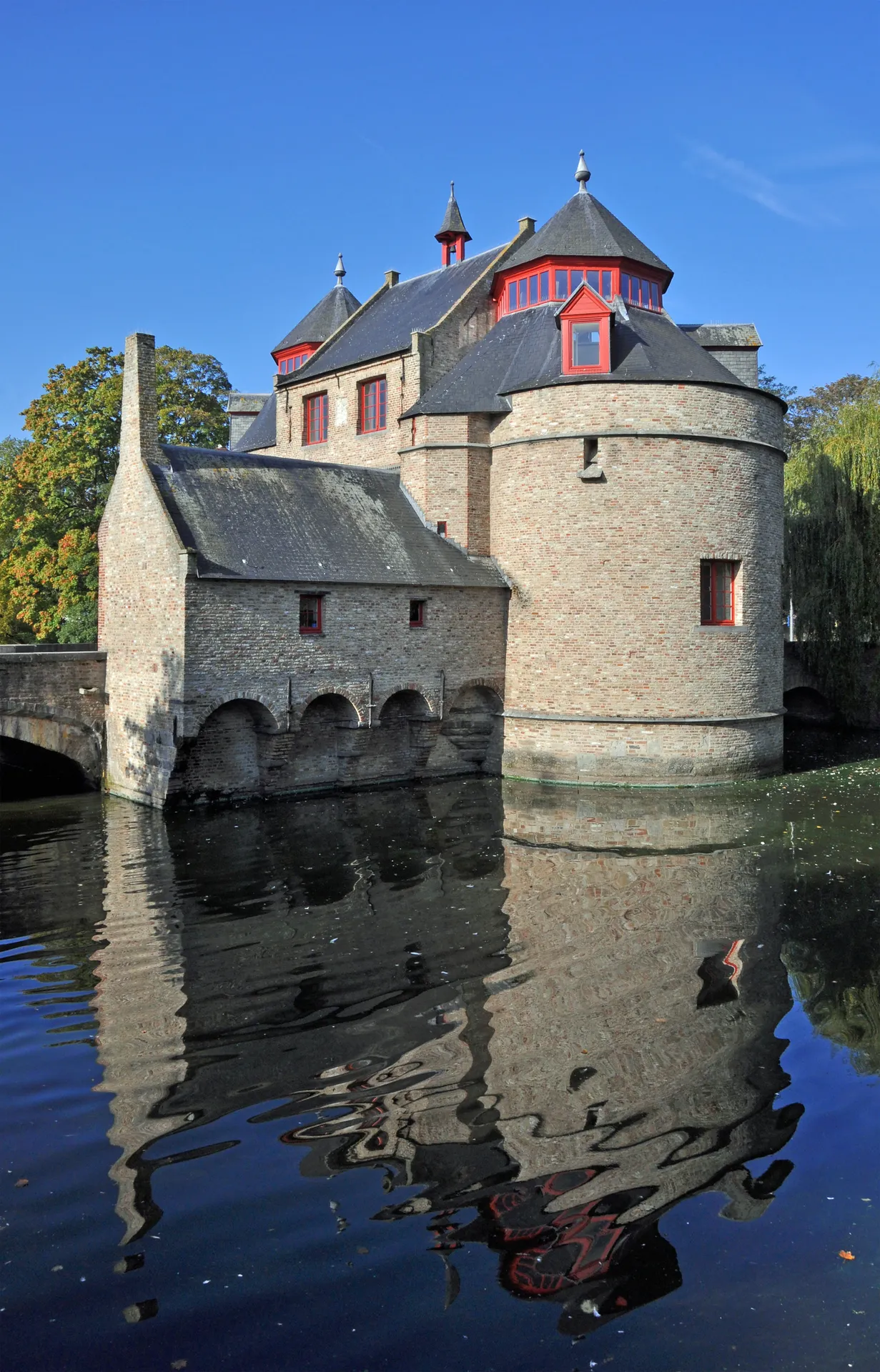
The best angle is not the obvious front view but the south side by 't Stil Ende and Ezelpoortbrug, where the gate sits in water with trees around it and the bridge drawing you in one careful step at a time. From here you see the odd truth of the building: Gothic at its core, restored in 1906 and again in 1991-1993, yet still rough-edged, asymmetrical, and heavier than visitors expect, with the old guardhouse breaking the neat twin-tower composition like a note of bad temper. Come on a cold morning if you can. Bare branches sharpen the brick, reflections hold the towers almost still, and in winter Bruges' swans have historically been gathered near this stretch, which gives the scene a faintly unreal calm.
Walk the Gate into the Vesten Ring
Ezelpoort makes the most sense when you refuse to treat it as a single monument and fold it into a walk along the Vesten, Bruges' 7-kilometer rampart ring lined with more than 3,000 trees. Start at the city-side bridge, cross through the gate, then keep going along the water toward Ezelbrug and the quieter northwest edge of town; traffic murmurs beyond the trees, ducks cut the surface of the canal, and the brick mass behind you keeps shrinking until you understand why UNESCO still reads Bruges' lost walls through these surviving gates. That's the secret here. Ezelpoort changes from an object into a threshold, and Bruges stops looking like a preserved picture and starts feeling like a defended city with an edge.
Plan your visit
Getting There
Ezelpoort stands at Ezelstraat 122 on the north-west edge of Bruges’ old core. From Markt or Historium, walk northwest through the center and stay on Ezelstraat for about 15-20 minutes; by bus, the nearest stop is 502102 Brugge Ezelpoort, and if you’re driving, Parking Ezelstraat at Hugo Losschaertstraat 5 is the practical choice, a short walk away, with 139 spaces and a 2.2 m height limit.
Opening Hours
As of 2026, Ezelpoort has no posted museum-style opening hours because it functions as a free outdoor monument rather than a staffed attraction. You can view it from the street and waterside at any time, but daylight matters here: the brick mass, canal reflections, and low arches read far better in morning or late-afternoon light, while the interior is not advertised for public visits.
Time Needed
Give it 5-10 minutes for a quick look and a few photos, 15-20 minutes if you want to walk both sides and pause by the water, or 30-45 minutes if you fold it into Ezelstraat, Ezelbrug, and Achiel van Ackerplein. This works best as one stop on a quieter 45-90 minute edge-of-Bruges walk, not as a stand-alone headline sight.
Accessibility
As of 2026, the site is marked child-friendly, stroller-friendly, pet-friendly, and picnic-friendly, but the real issue is the ground under your wheels. Bruges’ historic paving can be uneven, and nearby Ezelbrug is a flat bridge surfaced with cobblestones, so exterior viewing is possible for wheelchair users and rollators, though the terrain may feel more like crossing a rough stone quilt than gliding over smooth pavement.
Cost and Tickets
As of 2026, entry is free and no booking, timed ticket, or skip-the-line option applies because Ezelpoort is an exterior monument. Don’t plan around a public interior visit: the building is used by Anima Eterna Brugge as office space, not as a regular museum.
Photo Gallery
Ezelpoort rises above the canal in Bruges, its stone walls and bridges mirrored in still water. Soft daylight and autumn trees give the medieval gate a quiet, almost suspended feel. · VWAmFotEzelpoort rises above the canal in Bruges, its round brick towers and red window frames mirrored in still water under clear daylight. The fortified gate feels both defensive and oddly elegant. · Marc RyckaertEzelpoort rises above the canal in Bruges, its pale brick walls and red accents reflected in calm water under a bright, cloud-streaked sky. · CEphoto, Uwe AranasEzelpoort rises above a canal in Bruges with its rounded brick towers, arched passage, and slate roofs. Clear daylight brings out the contrast between the pale masonry, red window frames, and blue sky. · Marc RyckaertA historic view of Ezelpoort in Bruges shows the fortified stone gate rising beside the canal. Mounted soldiers and carts cross the cobbled street under a pale, overcast sky. · Unknown authorUnknown authorEzelpoort rises above the moat in Bruges with its round brick tower, dark slate roofs, and red-trimmed windows. Spring trees and a waterside path frame the old city gate in clear daylight. · Marc RyckaertEzelpoort, one of Bruges' surviving medieval city gates, rises above the moat with its rounded brick towers and red-painted upper windows. Clear daylight brings out the texture of the masonry and the sharp lines of the roofscape. · Marc Ryckaert
History
The Gate Kept Doing Its Job
Ezelpoort has changed shape more than once, but its basic role barely shifted: it marked the edge of Bruges and forced movement into a narrow, watchable channel. Records show that function begins with the second city enceinte in the late 1200s and survives, in altered form, through rebuilds, demolitions, customs checks, tram traffic, and today's steady flow of walkers and cyclists.
That continuity matters because so much of Bruges' walls have vanished. UNESCO points to the four surviving gates, the ramparts, and the defense waterworks as the reason the lost enceinte can still be read; Ezelpoort is one of the sentences that never got erased, even after the grammar changed.
The turning point
Charles De Wulf and the Gate He Couldn't Reinvent
Between 1897 and 1902, Bruges city architect Charles De Wulf drew plans to rebuild Ezelpoort into a more theatrical medieval monument, using Marcus Gerards' 1562 map as his guide. For De Wulf, this was personal as well as professional: his reputation rested on whether Bruges should present a cleaned-up heroic past or keep the awkward layers that time had left behind.
The turning point came when that grand reconstruction was not carried out. Records show the scheme stayed on paper, and that failure changed the gate's future; instead of becoming a polished neo-medieval statement, Ezelpoort remained the rough hybrid Bruges had actually inherited, with its 1369 core, 17th-century truncation, and later repairs still legible to anyone willing to look.
I think that rejection did the gate a favor. De Wulf wanted drama. History wanted evidence.
What Changed
Records show the first gate connected to this route was not exactly the tidy object visitors imagine today. Scholars date the current structure largely to the 1369 rebuild by Jan Slabbaerd and Mathias Saghen; the taller medieval upper works and foregate were then cut back in the early 17th century, with the official heritage inventory giving 1615 as the key date, though some scholars caution that the exact moment is less certain. The moat north of the gate was altered around 1899 to 1900 for new roads, tram line 3 passed under the arch from 1913 to 1951 according to the heritage inventory, and the building now houses Anima Eterna Brugge rather than soldiers or customs officers.
What Endured
The gate's habit of sorting movement never really stopped. In the 14th century it filtered carts and strangers approaching along the road toward the coast; by the 18th century, according to a Bruges chronicle, Emperor Joseph II himself entered through this pinch-point on 13 June 1781; later it served customs and octroi functions, then let a tram clang through the same narrowed passage, and now it frames the daily choreography of bicycles, footsteps, and water traffic at the edge of the old city. Different users, same idea: Bruges still meets arrivals here on terms set by brick, bridge, and bottleneck.
Tips for visitors
Shoot Outside
Exterior photography is fine from public space, and that’s the point of the stop anyway. For drones, or for any tripod-and-crew setup that takes over public space, Bruges may require a permit or notification in 2026, so keep casual shots handheld unless you’ve checked the film office rules.
Eat On Ezelstraat
Pair the gate with Ezelstraat rather than rushing back to the Markt. Kottee Kaffee works for a budget coffee stop, Spegelaere is the place for Bruges chocolate cobblestones, and Locàle by Kok au Vin is the dinner pick if you want something closer to mid-range or splurge territory.
Go In Daylight
Come in the morning or late afternoon, when the light catches the red brick and the water softens the traffic around it. Midday still works, but daylight matters because this gate is about texture, reflections, and the squat defensive shape you miss once the light goes flat.
Make It A Walk
Ezelpoort makes more sense as the opening move for Ezelstraat, Achiel van Ackerplein, and Sint-Jakobsstraat than as a special detour on its own. Walk inward from the gate and Bruges changes character fast: fewer souvenir-shop theatrics, more cafés, chocolate, bikes, and people who look as if they actually live here.
Mind The Junction
This is not a trouble spot, but it is a traffic spot. Watch for cyclists, buses, and ring-road crossings around the gate, especially if you stop in the roadway for photos or arrive with children.
Know The Limits
Don’t show up expecting a staffed monument, lockers, or an indoor route through the tower. If you need storage, use the railway-station lockers or Historium instead; the gate itself offers none, and that small disappointment is easy to avoid if you know it before you arrive.
Where to Eat
local_dining
Don't Leave Without Trying
Brugse Zot beerBeer-based dishes cooked with local Bruges beersArtisanal pralinesBruges chocolate cobblestonesFresh brown shrimpNorth Sea fish and shellfishFries with sauceBruges waffle
HIDE Breakfast / Lunch
local favorite
Creative brunch cafe€€star4.9(1648)
Order: Go for the shakshuka, and add one of the smoothies if you want the table to look as good as the food tastes.
This is the brunch place people queue for in Bruges, and the reviews make clear why: warm service, polished cooking, and a room that feels more like a well-kept local hangout than a churn-and-burn tourist stop. The gluten-free pancakes also get real praise, which is rarer than menus like to admit.
Wine bar restaurant with refined seasonal tapas€€star4.9(89)
Order: Trust the kitchen and order across the small plates menu with a glass of wine; reviews keep coming back to the creativity of the dishes and the strength of the wine list.
Eight tables, sharp cooking, and the kind of quiet confidence that usually costs more. More than one reviewer describes it as star-level food without the stiffness, which is exactly the sort of place you want in Bruges after a day of beer halls and crowded squares.
Egg-focused breakfast and brunch cafe€€star4.9(551)
Order: Order the three fried eggs with bacon and sausages, then finish with the cake that comes alongside the coffee.
The appeal here is simple: a cozy room, staff who sound genuinely kind, and breakfast plates cooked with more care than the average all-day brunch address. It feels personal rather than performative, which matters in central Bruges.
Specialty coffee shop with pastries and light cafe snacks€€star4.9(142)
Order: Get a coffee with a fresh croissant, or try the strawberry matcha latte if you want something less expected.
This is the coffee stop for people who care about the cup, not just the postcard view outside the window. Reviews mention fast Wi-Fi, friendly owners, and a room that works whether you need a quiet pause or a sugar-and-caffeine reset.
checkTipping is not compulsory in Bruges because service is generally included; for especially good service, 5% to 10% is typical, and in cafes rounding up is normal.
checkLunch usually falls around 12:00 to 2:00 p.m., and dinner around 7:00 to 9:00 p.m.
checkMeals are not rushed; staff may wait until everyone is finished before clearing plates.
checkMany restaurants in Bruges often close on Sunday or Monday, but there is no official citywide closing rule, so check the individual opening hours.
checkSome restaurants serve lunch only on selected days even if they open for dinner more broadly.
checkBusinesses in Belgium that sell to consumers must offer at least one electronic payment method.
checkThe Market Square food and flower market runs on Wednesday from 8:00 a.m. to 2:00 p.m., and the Saturday market at 't Zand runs from 8:00 a.m. to 1:30 p.m.
checkFor seafood shopping, the Fish Market operates Wednesday to Saturday from 8:00 a.m. to 1:30 p.m.
Restaurant data powered by Google
Frequently asked
Is Ezelpoort worth visiting?
Yes, if you want the Bruges that sits just outside the postcard frame. Ezelpoort is one of the city's four surviving medieval gates, and UNESCO points to those gates as the reason Bruges' vanished walls are still readable today. Don't come for a museum visit, though; come for the brick mass over water, the quieter canal edge, and the feeling of crossing a checkpoint instead of admiring a facade.
How long do you need at Ezelpoort?
Most people need 15 to 20 minutes. That gives you time to walk both sides, cross the bridge, look for the broad stone groove in the passage where the gate mechanism once worked, and take a few photos. Give it 30 to 45 minutes if you're pairing it with Ezelstraat, Ezelbrug, or a slow canal-side walk.
How do I get to Ezelpoort from Bruges?
From Bruges' Markt, walk northwest along Ezelstraat for about 15 to 20 minutes and you'll reach the gate at Ezelstraat 122. If you're using public transport, the nearest bus stop is Brugge Ezelpoort, and Visit Bruges also points to Brugge Sint-Pieters as the nearest station. Drivers have the practical option of Parking Ezelstraat on Hugo Losschaertstraat 5, a short walk away.
What is the best time to visit Ezelpoort?
Early morning or late afternoon works best. Low light catches the brick, water, and slate roofs more kindly than flat midday sun, and the place feels calmer because you're already off Bruges' main tourist circuit. Winter has its own edge: archival records tie the waters here to the city's swans during freezing weather, which suits the gate's colder, harder mood.
Can you visit Ezelpoort for free?
Yes, Ezelpoort is free to visit from the outside. It's an outdoor monument rather than a ticketed museum, and the building is now used as office space by Anima Eterna Brugge, so regular interior visits are not part of the standard experience. Think of it as a walk-through landmark, not a booked attraction.
What should I not miss at Ezelpoort?
Don't miss the shift in mood when you cross the water and enter the passage. Inside that short tunnel, look for the wide stone groove in the walls, a plain scar left by the old gate mechanism; it tells you more than any plaque could. Also walk to the south side near 't Stil Ende for the strongest view, where the round towers, bridge, and water make the gate read like a compact fortress.
Sources & attribution79
Researched and written by the Audiala editorial team from historical records, architectural archives, and local expertise. Last reviewed April 2026.
Flemish Heritage Inventory - Ezelpoort — Primary architectural and historical record for Ezelpoort, including chronology, restoration phases, builders, passage details, and gate mechanism traces.
Visit Bruges - Ezelpoort (English) — Official visitor basics, address, free-access status, nearest transport reference, and current presentation of the monument.
Bruges Tourisme - Porte des Anes — French local tourism page stating the interior is not open for regular visits and describing the canal-and-tree setting.
Brugge Ezelpoort R02 — Marc Ryckaert — CC BY 3.0 (https://creativecommons.org/licenses/by/3.0/) — Source: https://commons.wikimedia.org/wiki/File:Brugge_Ezelpoort_R02.jpg
Brugge Ezelpoort R03 — Marc Ryckaert — CC BY-SA 3.0 (https://creativecommons.org/licenses/by-sa/3.0/) — Source: https://commons.wikimedia.org/wiki/File:Brugge_Ezelpoort_R03.jpg
Brugge Ezelpoort R01 — Marc Ryckaert — CC BY 3.0 (https://creativecommons.org/licenses/by/3.0/) — Source: https://commons.wikimedia.org/wiki/File:Brugge_Ezelpoort_R01.jpg
Brugge Ezelpoort R04 — Marc Ryckaert — CC BY 3.0 (https://creativecommons.org/licenses/by/3.0/) — Source: https://commons.wikimedia.org/wiki/File:Brugge_Ezelpoort_R04.jpg
Strictly necessary cookies keep navigation working. Analytics cookies (PostHog, Google Analytics) help us learn which pages work — aggregate only, no ads, no selling. You can change this any time from the footer.
Privacy
Cookie preferences
Pick what you're okay with. You can change this any time from the footer.
Strictly necessary
Always on
Sign-in, language, navigation. Always on.
Product analytics
PostHog and Google Analytics, aggregate usage only. Helps us see which pages work and which need fixing. No selling, no ads.
Marketing
Off today. Reserved if we ever run paid acquisition. We will ask again before turning it on.