Minsk
Belarus Updated Apr 2026
The first thing you notice in Minsk isn't the Stalinist avenues or the glass library that looks like a misplaced spaceship—it's the silence. Belarus's capital speaks in whispers, where Soviet buses still grind their gears past 19th-century gingerbread houses painted bubble-gum pink and lemon yellow. This is a city that survived 80% destruction in World War II only to rebuild itself twice: once with concrete and once with something harder to name.
 Photo: Siarhei Nester / Pexels
- Attractions
- 27
- Trip length
- 3–4 days
- Best season
- Late spring (May–June) for long daylight and outdoor cafés
Why Minsk
Built from cited sources · see the method · How we make our guides →
Walk Independence Square at 7 a.m. and you'll share it with three pensioners feeding pigeons and one KGB officer smoking by the Red Church. By noon, the same square holds couples photographing themselves against the 1934 House of Government, its columns casting shadows exactly 47 meters long in October light. The contrast isn't ironic here—it's Tuesday.
Minsk rewards the patient. Trinity Hill's cobblestones hide a cinema museum in a converted merchant's house where silent Belarusian films flicker against brick walls. The Island of Tears memorial changes color with the Svislach River's mood, angel statues weeping real condensation in April fog. Even the brutalist National Library works twice: by day, 22 floors of books; by night, a discotheque of LED geometry visible from 15 kilometers away.
Soviet Megaliths Meet 19th-Century Streets
Walk from the 38-meter Victory obelisk to Trinity Hill's cobblestones in 20 minutes — the city compresses 150 years of brutalist ambition and pastel merchant houses into a single afternoon.River Island of Mothers' Tears
The Island of Tears memorial stands in the Svislach with statues of grieving mothers whose names are engraved into chapel walls. At dusk, the crying angel appears to weep — legend claims the droplets are real.A Diamond Library That Reads the Sky
The National Library's rhombicuboctahedron shape throws LED constellations across 22 floors. The observation deck at 74 meters gives you the entire Soviet grid in one slow rotation.
Neighborhoods
Where to wander, by quarter — each with its own rhythm.
Trinity Hill (Troitskoye Predmestye)
Painted timber houses lean like old friends along the Svislach's left bank. Push through the turquoise door at #10 and you're in the Belarusian Cinema Museum, where pre-war cameras still smell of acetate. Evening brings guitar music from basement bars where locals argue about films that were banned before they were born.Independence Square District
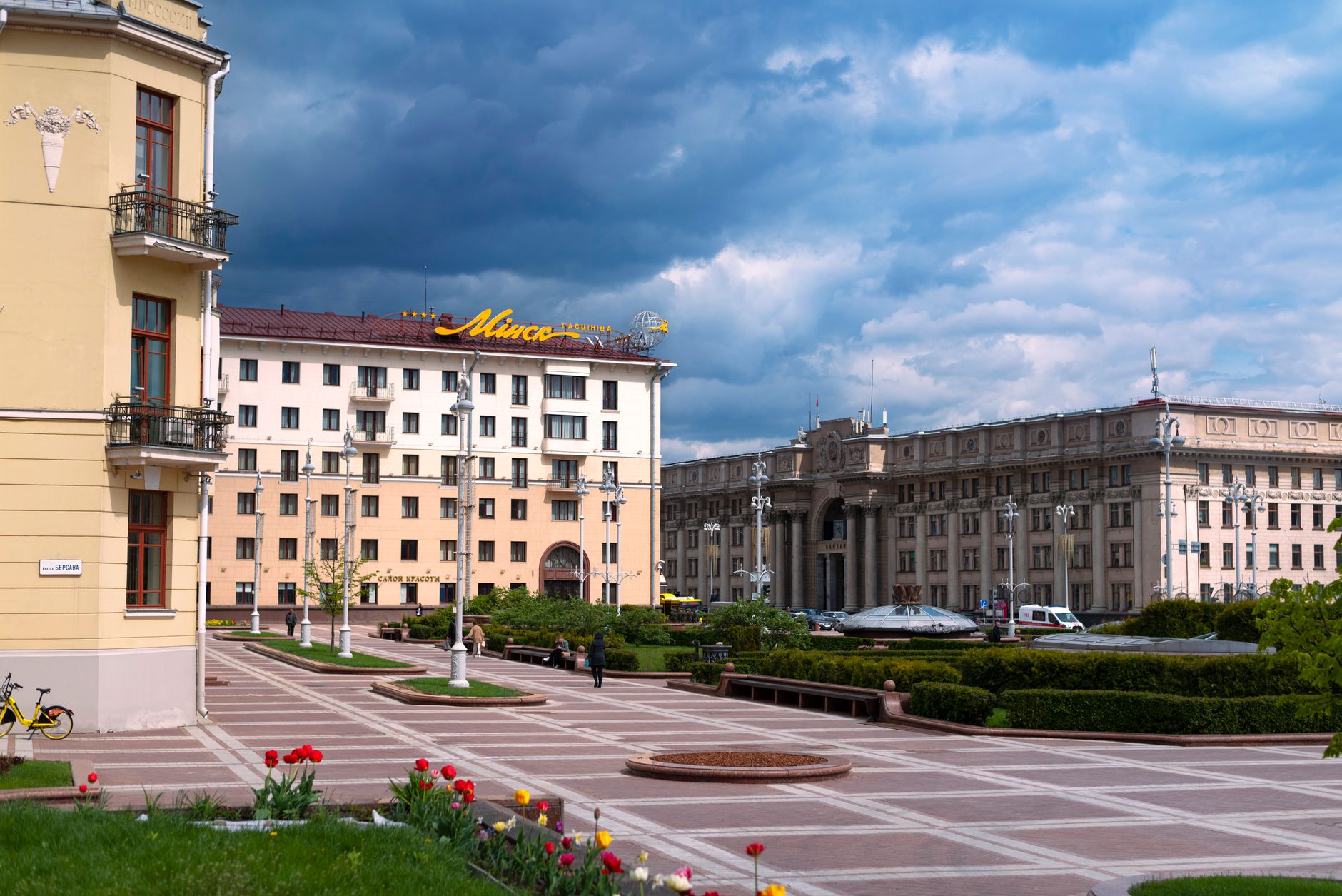
The gravitational center where Stalinist symmetry meets Catholic devotion. The 1910 Red Church anchors the west side while the 1934 Government House glowers from the east. Underground, Stolitsa Mall sells iPhones above a Cold War bunker. Stand here at parade time and you'll feel the ground vibrate from both marching boots and the metro beneath your feet.Upper Town (Old Town remnants)
What locals still call 'Liberty Square' despite three centuries of name changes. The 17th-century town hall foundations sit beneath a 1950s reconstruction that fooled UNESCO. At #5, the Art-Belarus Gallery occupies a former nobleman's house where each floor shows a different decade of repression and release.October Square Quarter
Soviet planning at its most human scale. The 1950s ensemble frames a space that feels like a stage set, especially when the Bolshoi Theatre's opera students practice their scales on the steps. Behind the philharmonic, Oktyabrskaya Street's murals tell the city's real history in spray paint and wheat paste.Komarovka Market Zone
Minsk's stomach beats behind a 1974 concrete shell where babushkas still sell mushrooms they picked at 4 a.m. The market's eastern edge bleeds into a grid of 1930s apartment blocks where each courtyard hosts a different micro-neighborhood: chess players, conspiracy theorists, and teenagers who've never known a border checkpoint.Northern Waterfront
Post-industrial turned post-post-industrial. Former factory buildings house KONKORS food hall—30 stalls where Soviet canteen meets Korean tacos. The lakeside path smells of charcoal and lake weed, where families grill shashlik while watching the National Library's light show reflect in black water.
Plan your trip
Before you go
- Getting There
- Fly into Minsk International Airport (MSQ) 42 km east. Bus 300Э runs hourly to Minsk Railway Station in 24–28 minutes for BYN 1.1. Trains arrive at Minsk-Pasažyrski station from Moscow, Warsaw, and Vilnius daily via Minsk Metro Line 1.
- Getting Around
- Two metro lines (Moskovskaya and Avtozavodskaya) intersect at Ploshcha Lenina, 29 stations total. Surface transport costs BYN 1.10 on buses, trams, and trolleybuses. Rent bikes for the 27 km riverfront path linking Victory Park to Minsk Arena — no confirmed tourist pass exists in 2026.
- Climate & Best Time
- Spring 7–13°C, summer peaks at 18.5°C in July with scattered showers, autumn drops to 6°C, winter holds at -4.5°C. Visit May–September for riverside cycling and outdoor café season. February is driest but requires thermal layers.
- Safety
- US State Dept rates Minsk Level 1, yet Western governments warn of arbitrary detention since 2020. Avoid photographing government buildings and military installations. LGBTQ+ travelers should know public displays of affection are discouraged and carry legal risk.
- Language & Currency
- Russian dominates daily life despite Belarusian being official. Metro signs use Cyrillic with Latin transliteration. Carry Belarusian rubles (BYN) — foreign cash isn't accepted. Since 2022 sanctions, international cards may fail; bring backup cash and exchange at official banks.
A City Erased and Rebuilt Nine Times
Where every stone remembers a different empire
- 1067
First Chronicle Mention
The Primary Chronicle calls it Mensk during a bloody battle on the Nemiga River. The name sticks, but the wooden settlement burns within months. Archaeologists still find charred timbers six meters down.
- 1242
Lithuanian Claim
Grand Duke Gediminas annexes Minsk without a fight. The Lithuanian language replaces Old East Slavic in market transactions. Stone foundations appear beneath the wooden houses for the first time.
- 1499
Magdeburg Rights Granted
Casimir IV gives Minsk the right to self-govern. Merchants can now hold fairs without ducal permission. The town square gets its first proper scale—a rectangle 250 meters long, wide enough for horse-drawn grain wagons to turn.
- 1505
Tatar Raid
Crimean horsemen breach the palisade at dawn. They take 1,400 captives and burn the rest. Survivors rebuild closer to the river, creating the street pattern that still confuses drivers today.
- 1569
Polish-Lithuanian Union
The Union of Lublin merges Minsk into Europe's largest state. Catholic priests arrive, building a wooden church where the Red Church stands now. Tax records switch from Cyrillic to Latin script overnight.
- 1642
Holy Spirit Cathedral Rises
The first stone church in Minsk takes twelve years to finish. Its walls are two meters thick—wide enough for defenders to walk during sieges. The bell can be heard in villages fifteen kilometers away.
Show the full timeline (20 moments)
- 1793
Russian Annexation
The Second Partition hands Minsk to Catherine the Great. Russian becomes mandatory in schools within a year. The main street gets renamed from 'Warsaw Road' to 'Moscow Road,' a change that lasts 124 years.
- 1871
Railway Station Opens
The first train from Moscow arrives at 6:43 AM with 47 passengers. The station clock runs on St. Petersburg time, one hour ahead of local sundials. Within five years, Minsk's population doubles to 90,000.
- 1891
Birth of Maksim Bahdanovič
The father of modern Belarusian literature is born on what is now called Bahdanovič Street. His poems will later be banned in both Polish and Soviet periods. He dies at 25, but every Belarusian schoolchild can recite 'Pahonia.'
- 1898
Revolutionary Congress
The Russian Social Democratic Labour Party holds its founding congress in a baker's basement. There are nine delegates and one police informant. Within three years, the party splits into Bolsheviks and Mensheviks.
- 1919
Soviet Capital
On January 8, Minsk becomes capital of the Byelorussian SSR. The city has 45,000 people and one working streetlight. Polish troops will capture it six months later, then lose it again by 1920.
- 1921
University Founded
Belarusian State University opens with 1,200 students in a former military barracks. The first rector is arrested in 1930 during Stalin's purges. The main building you see today wasn't completed until 1960.
- 1941
Nazi Occupation Begins
German troops enter Minsk on June 28. They establish a ghetto for 80,000 Jews in thirty-six hours. By 1943, only a few dozen survive. The city loses 80% of its pre-war population.
- July 1944
Liberation and Ruin
Soviet artillery fires 200,000 shells in the final assault. When the smoke clears, Minsk is 80% rubble. The population has dropped from 300,000 to 50,000. Rebuilding starts before the war ends.
- 1950s
Stalinist Reconstruction
Prisoners of war pour 400,000 cubic meters of concrete. Independence Avenue becomes Europe's longest Socialist-Realist showcase—11 kilometers of identical facades. The project finishes in 1964, ten years late.
- 1986
Chernobyl Cloud
Radioactive dust reaches Minsk on April 27, the day after the explosion. Authorities wait a week to warn citizens. Kindergarten children still march in May Day parades under falling isotopes.
- 1989
Birth of Aryna Sabalenka
The future world #1 tennis player is born in a Soviet maternity hospital on the outskirts. The city has one indoor court. She practices against boys twice her size in unheated gyms.
- 1991
Independence Declared
The Supreme Soviet votes 263-2 to leave the USSR. Crowds outside chant 'Long live Belarus!' in a language that had been banned from schools for seventy years. The KGB building across the square keeps its lights on all night.
- 2006
Diamond Library Opens
The National Library's rhombicuboctahedron shape contains 8.6 million items. At night, 4,646 LED panels turn it into a giant screen. Locals call it 'the spaceship that never took off.'
- August 2020
Protests Shake the City
100,000 people fill Independence Square demanding new elections. They wave the white-red-white flag that was banned in 1995. Police respond with rubber bullets and flash-bangs. The fountains run pink with diluted blood.
Where to Eat
Where locals actually book dinner — not the tourist menus.
-
Draniki
Belarusian potato pancakes fried in pork fat until they crackle. Order them at Komarovsky Market where the babushkas will insist you need sour cream, then refuse payment when you smile.
-
Machanka with Kalduny
Thick pork stew ladled over meat-filled dumplings — the dish that survived both world wars and Soviet rationing. Trinity Hill's basement taverns serve it in cast-iron bowls that burn your fingers.
-
Kvass from Oak Barrels
Fermented bread drink served ice-cold from wooden casks on summer sidewalks. Tastes like liquid rye bread with a gentle buzz — locals mix it with vodka after 10 pm.
-
Kletsky with Mushroom Sauce
Hand-rolled dumplings swimming in forest mushroom gravy. The grandmother at Café Druzya on Internatsionalnaya makes 400 daily starting at 5 am — when they're gone, she closes.
-
Belarusian Honey Cake (Medovik)
Layered with sour cream and buckwheat honey aged since Soviet times. The version at Lido cafeteria near Victory Square comes in perfect 45-degree slices because they still use the 1974 Soviet dessert cutter.
Insider tips
Small things that change how the city treats you.
Keep small cash
Many cafés and street-food courts on Nezavisimosti don’t accept cards for purchases under 20 BYN. Withdraw small notes at airport ATMs; change booths inside shopping malls give better rates than hotels.Plan dinners early
Most traditional restaurants close kitchens at 21:30 sharp. Book for 18:30–19:00 to have time for the obligatory potato-pancake course and still catch the 22:00 National Library light show.Golden hour on Trinity Hill
Arrive 90 minutes before sunset; the low sun bounces off Svislach water and paints 19th-century façades sherbet orange. Tripods are allowed, but locals will ask you to take their portrait—say yes, they’ll return the favor.Metro escalator rule
Minsk has the longest escalators in Europe—ride takes 3 min. Stand right, walk left; guards whistle at offenders. Use the ride to plan your next stop: free Wi-Fi reaches halfway down.Victory Square silence
The Eternal Flame is guarded 24/7; talking loudly or posing with selfie sticks is discouraged. Visit at 18:00 when the guard changes—brief, wordless, and oddly moving.
Gallery
The city, as it actually looks.


Frequently asked
Is Minsk worth visiting?
Yes—its Soviet-era geometry is intact, prices are half those of Kraków, and you can walk from a 12th-century church to a rhombicuboctahedron library in 15 minutes. Even the metro stations feel like museum halls.
How many days in Minsk do I need?
Three full days cover the memorials, Trinity Hill cafés, and a day-trip to Mir-Nesvizh castles. Add a fourth if you want to catch an opera at the Bolshoi or explore Komarovsky market at weekday tempo.
Do I need a visa for Belarus?
Most western passport holders can enter visa-free for 30 days via Minsk National Airport, but you must show proof of health insurance (buy at the airport desk for €1 per day if you arrive without).
Is Minsk safe to walk at night?
Center is well-lit and patrolled; locals stroll October Square until midnight. Avoid unlit underpasses around the rail station after 01:00—standard big-city caution, not specific risk.
Can I pay with euros or dollars?
No—only Belarusian rubles (BYN) are accepted. Exchange leftover cash before leaving; outside Belarus the currency is worthless. ATMs dispense BYN directly at good rates.
What’s the cheapest way from the airport to the city?
Express bus 300э costs BYN 4 (≈ $1.50) and reaches Centralny bus station in 45 minutes. Taxis quoted at the arrivals desk average €25—agree the price before entering.
Pick up where you left off
Saved and recently read places — kept on this device only.
Photo credits (13)
- Siarhei Nester — Pexels License (https://www.pexels.com/license/) — Source: https://www.pexels.com/photo/19011781/
- Vitali Adutskevich — Pexels License (https://www.pexels.com/license/) — Source: https://www.pexels.com/photo/16180503/
- Egor Kunovsky — Pexels License (https://www.pexels.com/license/) — Source: https://www.pexels.com/photo/2284413/
- Egor Kunovsky — Pexels License (https://www.pexels.com/license/) — Source: https://www.pexels.com/photo/20047176/
- Diana Room — Pexels License (https://www.pexels.com/license/) — Source: https://www.pexels.com/photo/8591591/
- Egor Kunovsky — Pexels License (https://www.pexels.com/license/) — Source: https://www.pexels.com/photo/20517255/
- Vitali Adutskevich — Pexels License (https://www.pexels.com/license/) — Source: https://www.pexels.com/photo/16120537/
- Alexander Fadeev — Pexels License (https://www.pexels.com/license/) — Source: https://www.pexels.com/photo/35460785/
- Олег Заводских — Pexels License (https://www.pexels.com/license/) — Source: https://www.pexels.com/photo/10341993/
- Egor Kunovsky — Pexels License (https://www.pexels.com/license/) — Source: https://www.pexels.com/photo/36141996/
- Egor Kunovsky — Pexels License (https://www.pexels.com/license/) — Source: https://www.pexels.com/photo/16545690/
- Egor Kunovsky — Pexels License (https://www.pexels.com/license/) — Source: https://www.pexels.com/photo/27855082/
- Egor Kunovsky — Pexels License (https://www.pexels.com/license/) — Source: https://www.pexels.com/photo/36142098/
Photos may have been resized or cropped.