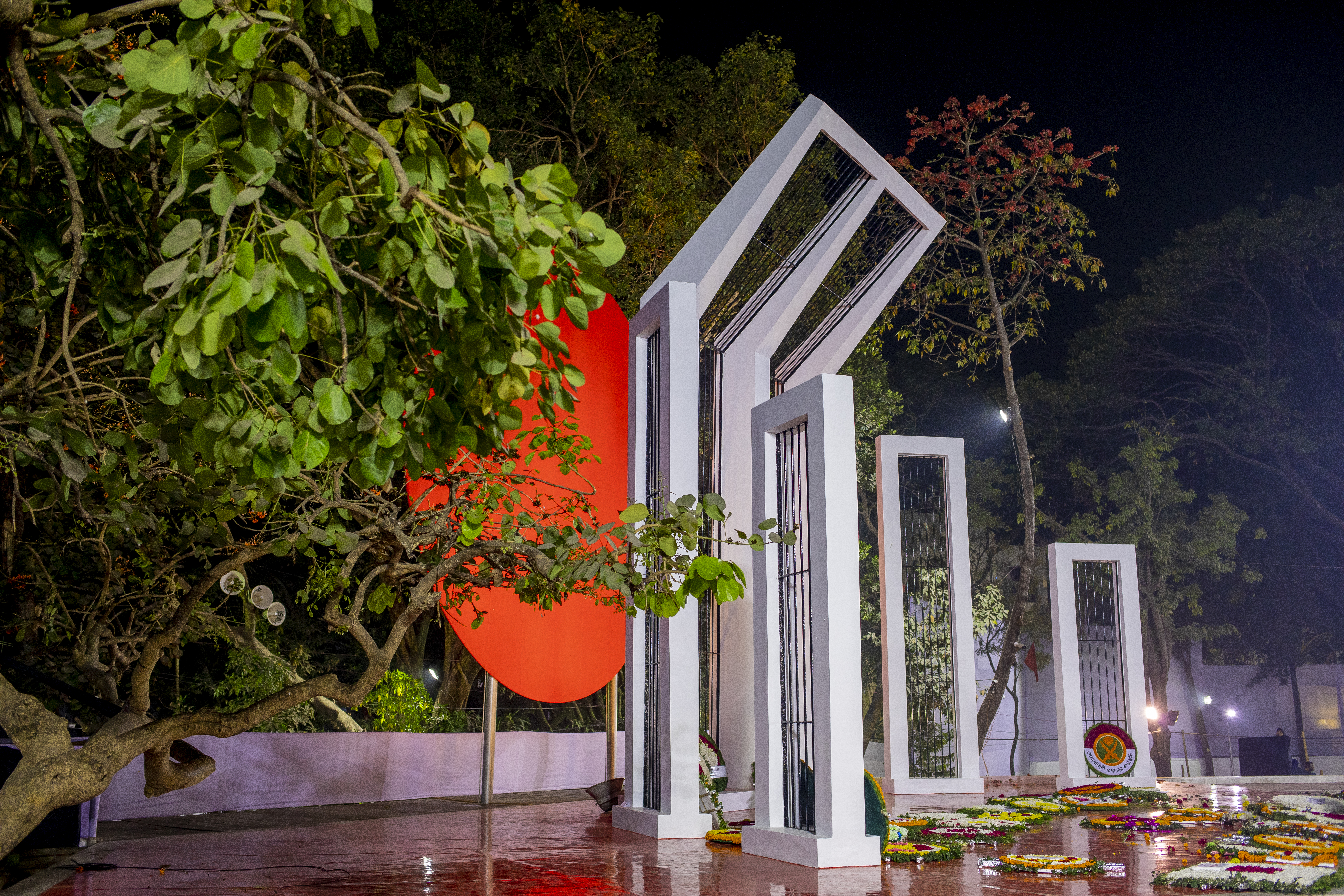
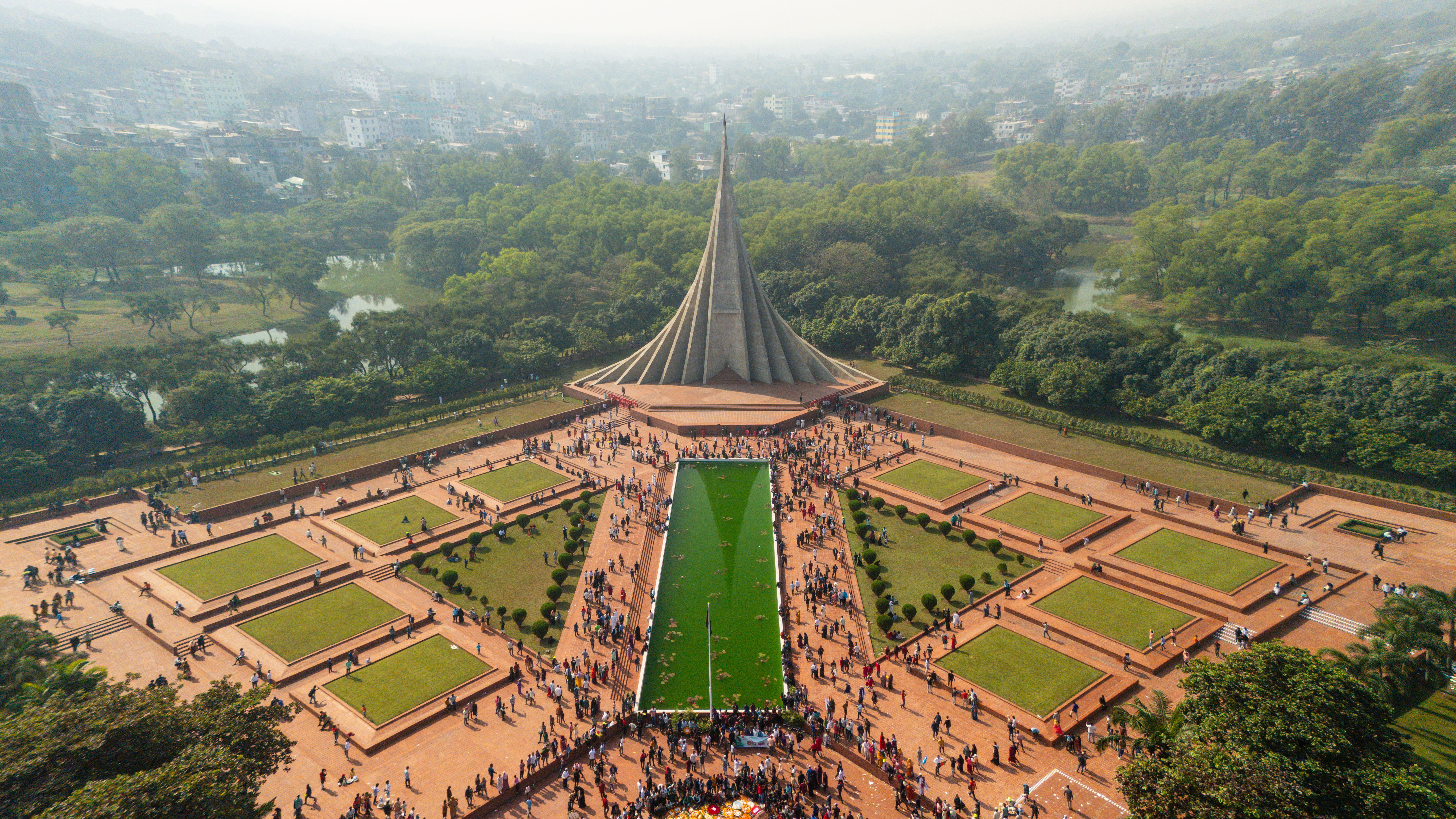
AA language can leave a monument behind, and in Dhaka, Bangladesh, that monument is Shaheed Minar. Visit Shaheed Minar because it marks the ground where words turned political, grief turned public, and a student protest in 1952 helped change the fate of a country. The white columns and red disc look spare at first glance. Stay a minute, and the place starts speaking in a louder register than many grander memorials ever manage.
Shaheed Minar stands beside Dhaka Medical College and Dhaka University, in the charged stretch between Shahbagh and older Dhaka where marches, mourning, and argument have long shared the same pavement. Records show the first memorial rose here within two days of the February 1952 shootings, built fast from nearby construction materials while the city still carried the smell of tear gas and wet cement.
What you see now is not one monument with one clean birth date. It is the survivor of demolition, redesign, wartime destruction, and post-independence rebuilding between 1952 and 1983, which makes it less tidy than a textbook symbol and far more interesting.
Come here if you want the shortest route into modern Bangladesh. A visit to Shaheed Minar makes the wider story of Dhaka feel suddenly physical: the slogans, the blood on the road, the flowers at dawn, and the stubborn fact that public memory sometimes has to be rebuilt brick by brick.
01 What to See
The Central Axis and Red Disc


The Marble Floor, Shadows, and Fence Poetry
Come Before Dawn on 21 February

02 Explore Shaheed Minar in Pictures
 Shaheed Minar Monument in Dhaka, Bangladesh: Iconic Landmark
 Miniature Shaheed Minar Replica Made of Bricks in Bangladesh
 Shaheed Minar Monument in Dhaka, Bangladesh: Iconic Landmark
 Shaheed Minar Monument in Dhaka, Bangladesh - Iconic Landmark
 Shaheed Minar Monument in Dhaka, Bangladesh: Iconic Landmark
 Shaheed Minar Monument in Dhaka, Bangladesh: Iconic Landmark
 Shaheed Minar Monument in Dhaka, Bangladesh - Iconic Landmark
 Shaheed Minar Monument in Dhaka, Bangladesh: Iconic Landmark
 Shaheed Minar Monument in Dhaka, Bangladesh: Iconic Landmark
 Shaheed Minar Monument in Dhaka, Bangladesh
 Shaheed Minar Monument in Dhaka, Bangladesh: Iconic National Landmark
 Shaheed Minar Monument in Dhaka, Bangladesh - Iconic Landmark
Plan and listen to Shaheed Minar with Audiala
Audio guide in your pocket, itinerary in your browser. Built for the way you actually visit.
03 Visitor Logistics
Getting There
Opening Hours
Time Needed
Accessibility
Cost/Tickets
05 Tips for Visitors
Respect The Altar
Photos With Restraint
Day Better Than Night
Go Early Or Late
Eat Nearby, Not Here
Pair It Well
Where to Eat
Don't Leave Without Trying
Dining Tips
- check For a very local meal, order mixed bhorta and bhaji at Nirob Hotel Restaurant.
- check Hazir Biriyani is a Dhaka institution dating to 1939, known for its fragrant mutton biryani.
- check Kolkata Kacchi Ghor specializes in kacchi biryani, a must-try for its lighter Kolkata-style seasoning.
- check Alauddin Sweetmeat is the place to go for traditional Bangladeshi sweets like cham cham and rasgulla.
Restaurant data powered by Google
04 Historical Context
Where Grief Learned to Stand Upright
Shaheed Minar began as an act of refusal. Records show police fired on Bengali language protesters near this site on 21 February 1952 after students defied Section 144, and within forty-eight hours the same ground held a memorial made in haste and anger.
That pattern kept repeating. Public mourning became architecture, the state cut it down or edited it, and people returned anyway with flowers, slogans, and a longer memory than any regime seems to expect.
Pearu Sardar and the Night the Memorial Became Real
The first Shaheed Minar may never have risen without Pearu Sardar, an Old Dhaka panchayet leader and contractor whose name deserves to be spoken on this site. According to memoirs and later reporting, he handed students access to cement, sent masons to help, and did it while curfew and patrols made any open support dangerous; for a man tied to government work, the risk was personal, immediate, and financial.
The turning point came on 23 February 1952, when outrage stopped being only a procession and became a structure. Students used materials lying near the medical college, built through the night, and turned a place of shootings into a place of address.
Police demolished that first Minar on 26 February. Too late. The state knocked down the concrete, but the idea had already found its form, which is why every later version of Shaheed Minar feels less like a replacement than a return.
A Design with Missing Pieces
From Memorial to Civic Altar
Listen to the full story in the app
06 Frequently Asked
Is Shaheed Minar worth visiting? add
Yes, especially if you want to understand Bangladesh through one charged piece of ground. This is where the 1952 Language Movement martyrs are remembered, and the monument still works as a memorial, protest stage, and civic altar rather than a dead piece of stone. On 21 February it changes completely: barefoot lines, black-and-white dress, flowers piled high, and the song "Amar Bhaiyer Rokte Rangano" before dawn.
How long do you need at Shaheed Minar? add
Most visitors need 30 to 45 minutes. That gives you time to see the monument, read the plaza, notice the fence poetry and the shifting shadows on the marble, and connect it to the Dhaka Medical College and university area around it. Give it 60 to 90 minutes if you also want to fold in nearby campus stops on the wider Dhaka circuit.
How do I get to Shaheed Minar from Dhaka? add
The easiest way is MRT Line 6 to Dhaka University station, then a 5 to 10 minute walk from Gate B toward Dhaka Medical College and the memorial. Shahbagh station also works, though the walk is longer, usually 12 to 18 minutes through heavier crossings. On 21 February, follow police-designated entry and exit routes instead of improvising.
What is the best time to visit Shaheed Minar? add
Early morning or late afternoon works best on a normal day because the heat is lighter and the white marble reads better in slanting light. February matters most, above all 21 February, when the site becomes the emotional center of International Mother Language Day. Go then for ceremony, not quiet.
Can you visit Shaheed Minar for free? add
Yes, current visitor listings and local travel references indicate free entry. Shaheed Minar functions as a public memorial rather than a ticketed attraction, and I found no official booking system or timed-entry platform. Access can still tighten on major civic dates because of security and crowd control.
What should I not miss at Shaheed Minar? add
Do not stop at the red disc photo and leave. Stand on the central axis first, then move off to one side so the white columns read as a semicircle; after that, watch the shadows slide across the marble floor and look for the poetry worked into the fence. The deepest part of the site is absence: the monument you see is a cut-down survivor of a larger design with a museum, library, colored-glass details, and symbolic footprints that never fully made it through politics and war.
Why is Shaheed Minar famous? add
Shaheed Minar is famous because it memorializes the Bengali language martyrs of February 1952 and became one of the clearest symbols linking the Language Movement to Bangladesh's later independence struggle. UNESCO's connection runs through the idea, not the monument itself: Bangladesh's campaign led to International Mother Language Day, adopted by UNESCO in 1999 and observed worldwide since 2000. That gives the site a reach far beyond Dhaka.
Is Shaheed Minar a UNESCO World Heritage Site? add
No, Shaheed Minar is not on the UNESCO World Heritage List or Bangladesh's UNESCO Tentative List. The UNESCO link is indirect but important: the memory politics around this site helped inspire International Mother Language Day. So the monument is globally resonant, just not World Heritage-listed.
-
verified
Banglapedia: Shaheed Minar
Core history of the memorial, including the 1952 makeshift monument, the 1956 foundation, later redesigns, symbolism, and the monument's role in Bangladeshi public life.
-
verified
Banglapedia: Language Movement
Background on the February 1952 protests, police firing, and the wider political context that gave Shaheed Minar its meaning.
-
verified
Banglapedia: Rahman, Shafiur
Biographical context for Shafiur Rahman, one of the martyrs tied to the events commemorated at Shaheed Minar.
-
verified
BSS: Central Shaheed Minar: The eternal pride of Amar Ekushey
Recent synthesis of the monument's history, inauguration milestones, and ongoing national significance.
-
verified
UNESCO: International Mother Language Day
Confirms UNESCO's connection through International Mother Language Day rather than World Heritage inscription for the monument itself.
-
verified
Dhaka Tribune: How the Central Shaheed Minar design evolved
Explains how Hamidur Rahman's design changed over time and what elements of the original scheme were cut or altered.
-
verified
The Daily Star: The first Shaheed Minar
Memoir-based reporting on the first 1952 makeshift memorial and the circumstances of its construction.
-
verified
The Daily Star: Amar Ekushey: Pearu Sardar and Dhaka's first Shaheed Minar
Details Pearu Sardar's role in secretly supplying materials and labor for the first memorial.
-
verified
The Daily Star: A new look for Shaheed Minar?
Discusses debates around redesign, reconstruction, and how much today's monument reflects the original concept.
-
verified
The Daily Star: 8 HC directives to protect sanctity, dignity of Shaheed Minar
Reports High Court directives on preserving the monument's dignity, including museum and library provisions.
-
verified
The Daily Star: Execute directives to uphold dignity of Shaheed Minar: HC
Follow-up reporting on court intervention to protect the site and its surroundings.
-
verified
The Daily Star: What steps were taken to preserve Shaheed Minar?
Later preservation update showing unresolved parts of the protection plan.
-
verified
Prothom Alo: 21 February in black and white
Retrospective coverage of 21 February remembrance and visual atmosphere tied to the memorial.
-
verified
Archnet: The Representative Space: Shaheed Minar – the Martyrs Monument Plaza in Dhaka
Architectural interpretation of Shaheed Minar as Dhaka's representative civic and protest space.
-
verified
Cybo: Central Shaheed Minar
Current visitor listing used for practical details such as general access pattern and location.
-
verified
Tourist Places Bangladesh: Central Shaheed Minar
Current visitor listing supporting public access and practical orientation.
-
verified
TripHobo: Central Shaheed Minar
Visitor timing estimates and general practical planning information.
-
verified
HTLBD: Shaheed Minar
Current listing supporting the reading of Shaheed Minar as an always-open public memorial.
-
verified
Dhaka Tribune: DMP issues route guidelines to Central Shaheed Minar visitors
Confirms controlled access routes and security measures on major observance days.
-
verified
The Business Standard: DU metro station to remain shut on Pahela Baishakh, Shahbagh till 12 pm
Shows event-day transit disruptions affecting access to the memorial area.
-
verified
UNB: DU metro station to remain shut on Pahela Baishakh, Shahbagh till 12 pm
Additional reporting on temporary metro closures near the site during major civic events.
-
verified
Bangladesh Tourism Board: Shaheed Minar directory page
Official tourism directory entry with location details for the memorial.
-
verified
Dhaka Metrorail: Dhaka University Station
Confirms the nearest metro station and that Gate B serves Dhaka Medical College and Central Shaheed Minar.
-
verified
DMTCL official route map
Official route map confirming station placement on MRT Line 6.
-
verified
Dhaka Metrorail: Shahbagh Station
Supports the second-best metro approach for visitors coming by rail.
-
verified
Dhaka University: TSC
Used for nearby facilities, rest stops, and wider campus context around the memorial.
-
verified
Prothom Alo: barefoot tribute coverage
Recent reporting on barefoot processions, flowers, and observance etiquette on 21 February.
-
verified
BSS: barefoot tribute coverage
Supports current observance customs such as going barefoot and paying floral tribute.
-
verified
The Daily Star: Honouring the martyrs of 1952
Describes ceremony, atmosphere, and collective mourning at the monument on Language Martyrs' Day.
-
verified
Commonwealth Walkway: Central Shaheed Minar
Useful for physical description of the site, materials, symbolic composition, and the shadow-play on the marble floor.
-
verified
International Journal of Interior Architecture and Spatial Design: Shaheed Minar study
Academic reading of the site as an open civic clearing tied to daily urban movement and protest culture.
-
verified
The Daily Star: International Mother Language Day nation pays homage to language martyrs
Current reporting on ceremony, song, and crowd behavior during the main annual observance.
-
verified
Dhaka Tribune: Shaheed Minar altar covered in flowers as crowds arrive
Supports the sensory description of the altar on 21 February, especially flowers and crowd density.
-
verified
Weather Atlas: Dhaka weather in February
Used for seasonal context when recommending February and explaining why outdoor visits are easier then.
-
verified
Prothom Alo: Shaheed Minar as protest symbol
Shows the monument's ongoing role as a rally point and civic symbol beyond memorial ritual.
-
verified
Dhaka Tribune: Shaheed Minar is a symbol of resistance
Recent evidence that the site remains politically active and symbolically alive in Dhaka.
-
verified
Dhaka Tribune: Nation pays homage to language martyrs
Recent coverage of tribute patterns, dress, and national observance at the site.
Last reviewed: