castle
Dilmun Layers
Qal'at al-Bahrain is not a staged ruin. It is a 4,000-year mound of ports, walls and settlements that makes Bahrain's ancient trade story feel immediate.
Bahrain is the rare Gulf trip where the big draw is compression: Dilmun archaeology, pearling history, serious food and modern city life packed into one island kingdom you can cross in a day.
 Bahrain
EntryeVisa or visa on arrival for many nationalities
BBahrain travel guide: a Gulf archipelago where Bronze Age trade routes, pearl houses and late-night shawarma counters sit within a short drive.
Bahrain works best when you stop expecting sprawl. The country is compact, the history is not. In Manama, glass towers rise behind Bab Al Bahrain and the old souq, while a 15-minute drive away in Muharraq, the Pearling Path threads through merchant houses, courtyards and alleys built on a maritime economy that once fed half the island. This is one of the few places in the Gulf where a weekend can hold UNESCO archaeology, coffee in a majlis-style setting and a dinner of machboos or grilled hammour without spending half your trip in transit.
The headline site is Qal'at al-Bahrain, where archaeological layers reach back to around 2300 BCE and turn the island's Dilmun story into something physical: walls, harbor logic, sea light, broken pottery underfoot. But Bahrain is not only an antiquities stop. Drive south toward Sakhir for the desert edge and the Formula 1 circuit, swing through Riffa for forts and older neighborhoods, then head to A'ali where burial mounds and pottery workshops show how much of the country's memory sits outside the capital.
Dilmun Age, c. 2300 BCE-600 BCE
Morning light falls on a low mound at Qal'at al-Bahrain, and the place looks almost modest until you remember what lay beneath it: storehouses, walls, workshops, and a harbor tied to one of the great trade systems of the Bronze Age. Records from Mesopotamia name Dilmun as a prized stop between Sumer and the Indus world, which tells you exactly what mattered here: water, position, and the talent for making other people's goods pass through your hands.
What many visitors miss is that Bahrain's first wealth did not begin with oil or even with pearls. It began with fresh springs rising in a salty world, dates growing where they had no right to, and ships carrying copper from Oman northward through the Gulf. A kingdom can start from a crown. Bahrain seems to have started from logistics.
The burial mounds of A'ali give this early age its most haunting aftertaste. Thousands of tombs spread across the island like a second landscape, less a cemetery than a declaration that this small archipelago mattered enough for generations to bury their dead with ceremony and permanence. The dead were numerous. So, one suspects, were the ambitions of the living.
Later rulers would build forts, ministries, and palaces, but the pattern was already there at Qal'at al-Bahrain: whoever controlled the island controlled an exchange point far larger than the island itself. That ancient habit of living from the sea, the warehouse, and the threshold never quite left Bahrain. It merely changed costume.
Thomas Geoffrey Bibby, the Danish archaeologist who helped give Dilmun back its name and shape, turned a dusty mound into one of the Gulf's grand historical revelations.
Local guides long repeated Eden stories around Bahrain's springs; archaeologists preferred pottery, seals, and trade routes, but one can see why paradise entered the conversation.
From Tylos to the Islamic Gulf, c. 600 BCE-1521 CE
Imagine a merchant on the quay with a ledger in one hand and salt on his robe hem. Assyrians, Babylonians, Greeks, Persians, and then Muslim rulers all looked toward these islands because Bahrain sat where commerce could be taxed, watched, and redirected. Names changed. The maritime logic did not.
In classical antiquity, Bahrain appears under the name Tylos, known for trade and for a cultivated life that surprised outsiders who expected the Gulf to be empty space between greater empires. That old imperial habit of underestimating islands is a familiar one. The islands usually have the last word.
Then came Islam, not as an abstraction but as a social fact carried by allegiance, taxation, law, and prayer. Eastern Arabia converted early, and Bahrain entered the Islamic world with all the opportunities and upheavals that followed. Ce que l'on ignore souvent, c'est que this was never a remote backwater: it was a connected province in a sea of arguments, sects, trade, and ambition.
The Carmatian movement, which rose in eastern Arabia in the 9th and 10th centuries, gave Bahrain one of the most unsettling chapters in its history. Their challenge to Abbasid authority was not a minor local quarrel; it shook the region and made the Gulf politically dangerous in a new way. The islands had become more than a harbor. They had become an idea, and ideas are always harder to govern than ports.
Abu Sa'id al-Jannabi, founder of the Carmatian state in eastern Arabia, remains a reminder that Bahrain's history includes revolution as well as trade.
Much of early Bahrain's story survives in fragments from outsiders' records, which means the island often enters the archive when it has become too rich, too troublesome, or too strategic to ignore.
Pearls, Forts, and Dynasties, 1521-1869
One can begin with a fort wall in sea glare at Qal'at al-Bahrain. The Portuguese arrived in 1521 with artillery, imperial confidence, and a simple instinct shared by every maritime power: seize the choke point, then charge for access. The fort they left behind still carries that harsh geometry of cannon age empire, all angle and command.
Yet Bahrain was never easy to keep. Persian power returned, Arab tribes contested control, and the islands passed through the hands of rulers who understood that the true prize was not stone but the revenues of pearling and Gulf trade. In this period, Muharraq grew into a dynastic seat, while Manama matured as a mercantile town whose horizon was always more commercial than ceremonial.
The decisive turn came in 1783, when Ahmed al-Fateh and the Al Khalifa took Bahrain. Dynasties are often remembered as if they descend in one clean line. They do not. They arrive through alliances, naval skill, family calculation, and, very often, the weakness of someone else.
Under the Al Khalifa, the pearling economy reached extraordinary importance. Fortunes were made by merchants, divers, captains, and financiers, though the most brutal work fell to the men who disappeared beneath the surface with a nose clip, a rope, and lungs that had to bargain with death. Royal history likes palaces. Bahrain's older wealth came from bodies in the water.
Ahmed al-Fateh is remembered as a conqueror, but behind the title stood a tribal leader who understood that controlling Bahrain meant commanding both sea lanes and allegiances.
Before oil transformed the state, a single fine Gulf pearl could pass through more social worlds than most nobles ever did: diver, captain, merchant, broker, ruler, and then a buyer in Bombay or Paris.
Treaty State, Oil State, Kingdom, 1869-present
Picture a ledger on a desk in Muharraq, then a treaty folded beside it. From the late 19th century onward, Bahrain entered a tighter British orbit, and politics became a negotiation between local rule, imperial protection, and the growing demands of a commercial society. Sheikh Isa bin Ali Al Khalifa presided over a long reign in which old structures survived, but only just.
Then, in 1932, oil was struck. A date that simple can hide the human shock of it: the old pearl economy was already being battered by the global depression and cultured pearls, and suddenly a new subterranean fortune arrived to replace the one wrested from the sea. Bahrain became the first place on the Arab side of the Gulf to discover oil. One era ended almost with a hiss.
Modern Bahrain took shape quickly after that, with roads, schools, ministries, labor politics, and sharper public debate. Independence came in 1971, and the country then had to perform the delicate Gulf art of being small, strategic, wealthy, and visible. Manama became a financial and administrative capital. Muharraq kept more of the older fabric. The contrast tells its own story.
Since 2002 Bahrain has been a kingdom, and since 2011 no serious account can pretend the island's history is only one of smooth modernization. Protesters, police, reformers, loyalists, migrant workers, merchants, and royal institutions all belong to the same national drama. Never flatter the regime; never flatten the people. Bahrain's story is richer, prouder, and more troubled than propaganda on either side will admit.
Sheikh Isa bin Ali Al Khalifa lived long enough to embody the old pearling order even as the ground beneath Bahrain was preparing an entirely different fortune.
The Pearling Path in Muharraq preserves merchant houses and shore buildings, but the real archive of that age once sat in divers' chests and damaged lungs, not in museums.
In Bahrain, Arabic does not behave like a fortress. It behaves like a port. A sentence begins in Gulf Arabic, accepts an English business noun without blushing, then lands on a Persian or Indian inheritance so old nobody bothers to interrogate it. The result is not confusion. It is elegance with sea salt on it.
You hear this most clearly in Manama taxis and in the old lanes of Muharraq, where greetings still take precedence over content. First peace, then health, then family, then the matter at hand. Europe calls this delay. Bahrain knows better. Ritual is the price of speaking without violence.
Certain words refuse translation. Majlis is not a sitting room; that would be like calling an orchestra a box of wood. Inshallah is not indecision either. It is intention made modest. A country reveals itself by the words it will not flatten.
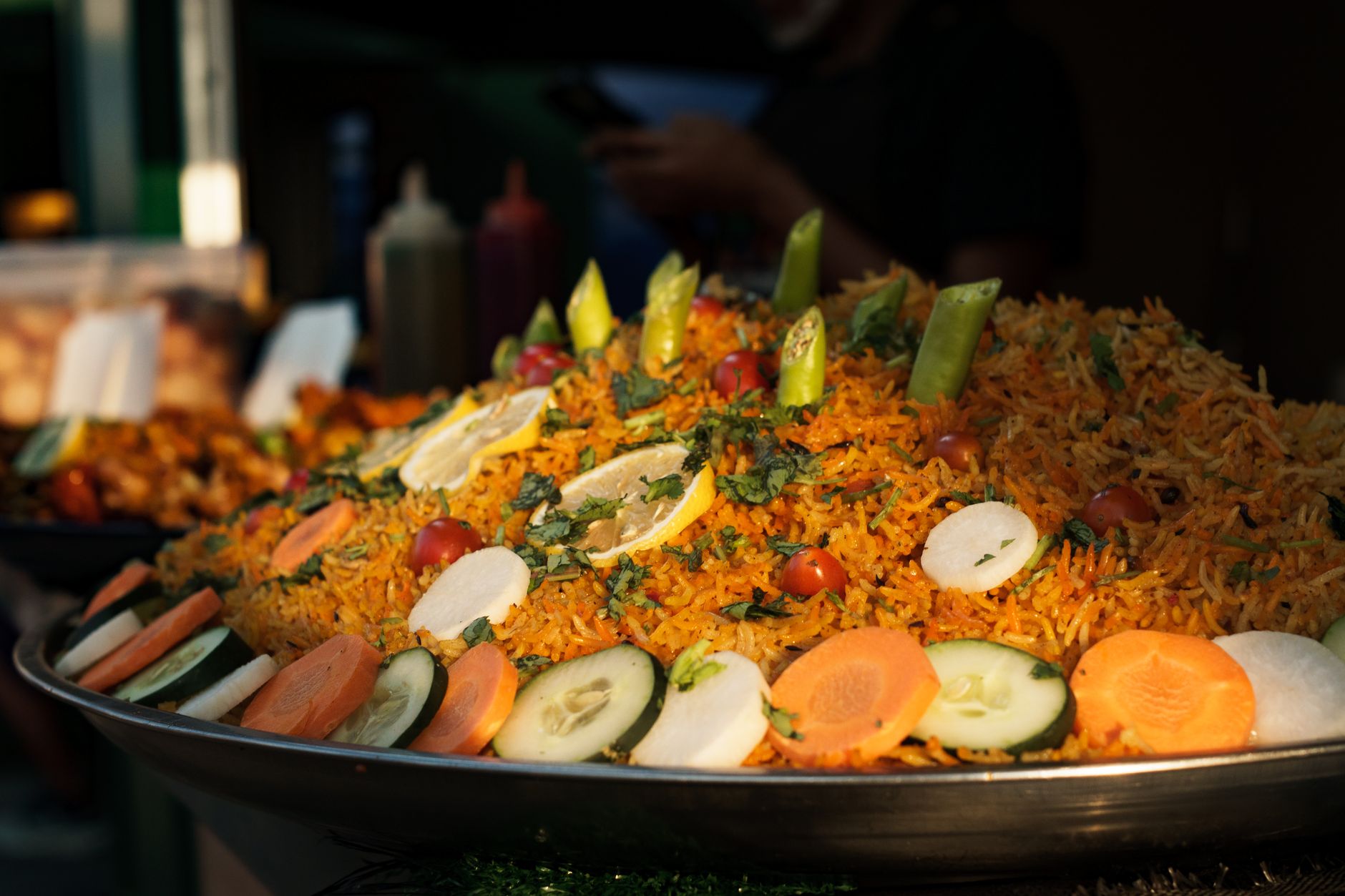
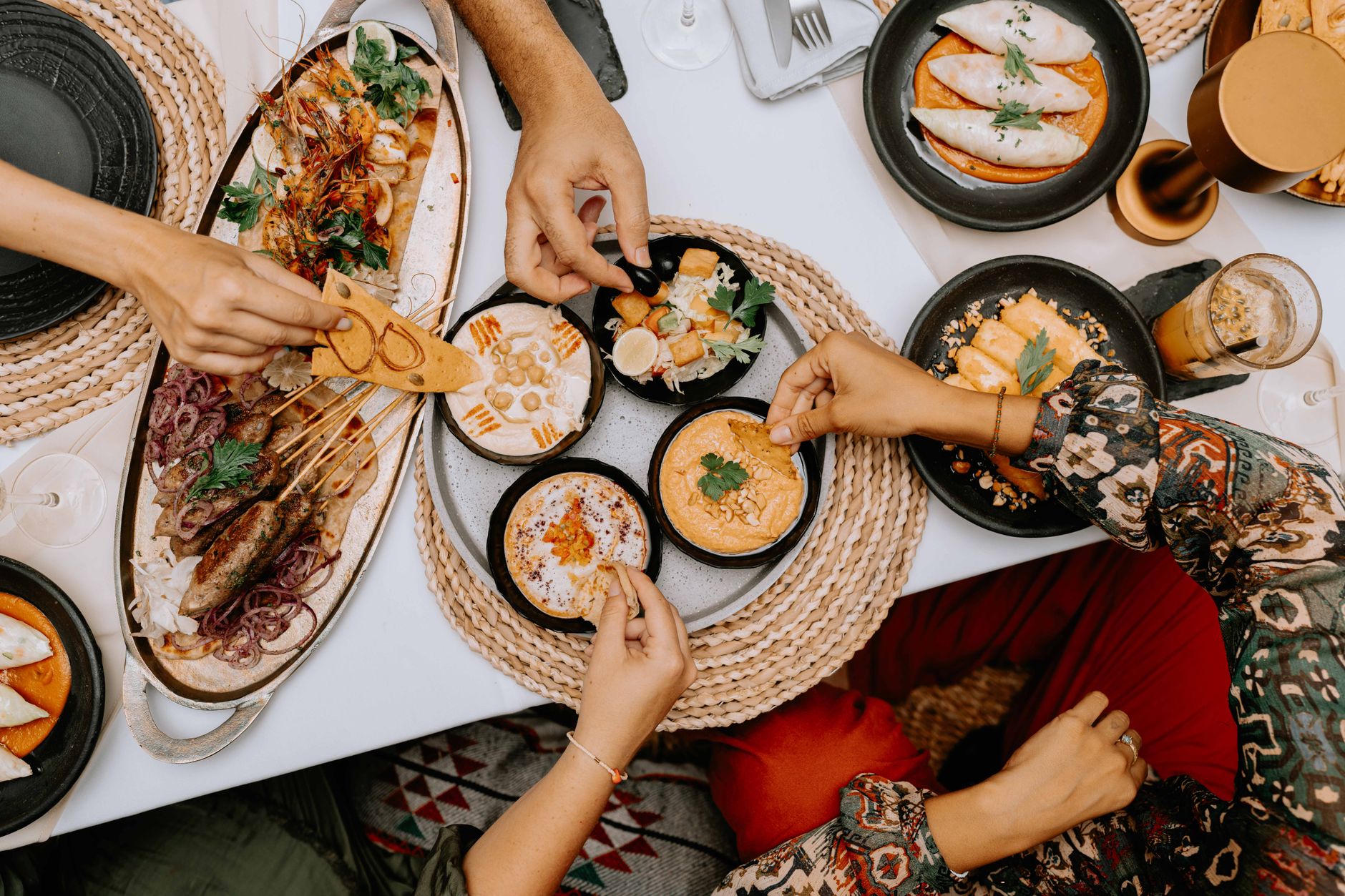
Bahraini food has the intelligence of a trading port and the appetite of an island. Sweetness appears where a stranger expects salt. Dried black lime cuts through rice like a line of ink. Rose water enters a dish with such authority that one realizes Europe has treated perfume and dinner as two unrelated disciplines for far too long.
At table, contrast reigns. Muhammar brings sweet brown rice to the side of fried safi, and suddenly the fish tastes more marine, the sugar more grain-like, the entire plate more exact. Balaleet performs the same ambush at breakfast: vermicelli with sugar, cardamom, saffron, and then an omelet on top, as if someone had decided the morning should include a theological dispute between dessert and eggs.
In Manama, a pot of gahwa and a dish of dates can say everything hospitality needs to say. In Muharraq, harees still carries the dignity of long cooking and patient hunger. A country is a table set for strangers, but Bahrain adds a condition: you will be fed until refusal becomes a philosophical position.
Bahraini politeness is warm, but warmth here has bones. You do not march into the practical matter as if efficiency were a moral virtue. You greet. You ask after health. You ask after the family. Only then does the real conversation appear, and by then it has already been improved by having waited.
Coffee teaches the rule better than any lecture. Gahwa arrives in a small cup that pretends modesty while planning repetition. Someone pours for you in the majlis, often standing, often attentive to a movement of the wrist more subtle than many diplomatic signals. If you want no more, you shake the cup lightly. Fail to do this and the stream continues, which is less a trap than a lesson in how generosity can become architecture.
Visitors sometimes mistake insistence for pressure. It is closer to reassurance. Take another date. Have more rice. Accept the fruit. The offer says: you are safe enough here to eat beyond strategy. That is not a small thing.
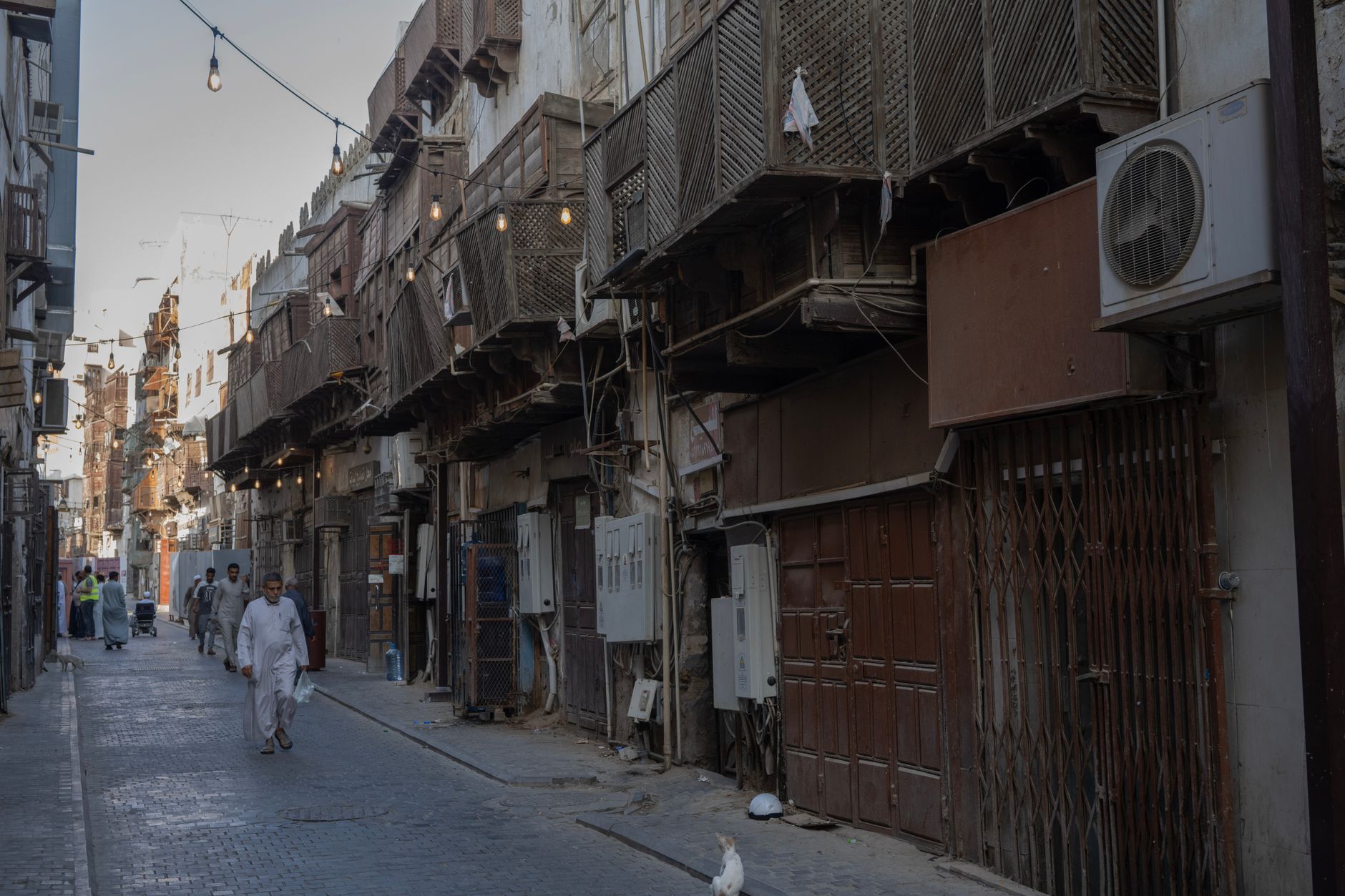
Bahrain's old architecture begins with a refusal to fight the climate head-on. Thick walls, shaded courtyards, carved doors, wind towers drawing air downward with the patience of people who understood heat before air-conditioning turned discomfort into a technical problem. In Muharraq, the older houses do not beg for admiration. They perform survival with style.
The best lesson comes from the houses of the pearling era, where wealth did not always mean bulk. It meant ventilation, privacy, proportion, and the social intelligence to separate public reception from domestic life. A courtyard is never just empty space. It is light edited into livable form.
Then you arrive at Qal'at al-Bahrain and time changes texture. The tell carries around 4,500 years of occupation, layer on layer, as if the island kept rewriting the same sentence with different empires. Fort, harbor, administrative core, memory device. Sand and stone can be far more articulate than glass.
Religion in Bahrain is public without always becoming theatrical. You hear the call to prayer across traffic, towers, office blocks, and supermarket parking lots, and the sound does something simple and immense: it reminds the city that clocks are not the only way to divide a day. Faith here coexists with commerce in the old Gulf manner, not as contradiction but as rhythm.
The island's religious life is also marked by difference lived close together. Sunni and Shia histories shape neighborhoods, commemorations, speech, even the emotional weather of certain months. Ashura, in particular, alters the atmosphere with black banners, lament, procession, and a seriousness no outsider should treat as spectacle. Grief, when ritualized, becomes a form of urban design.
Yet Bahrain rarely presents itself as doctrinal in daily gesture. It appears instead in the repeated courtesies, the patience with forms, the calibration of hospitality, the refusal to detach the material from the spiritual. Even the meal understands this. Bread, coffee, prayer, conversation: each teaches the others how to proceed.
Qal'at al-Bahrain is not a staged ruin. It is a 4,000-year mound of ports, walls and settlements that makes Bahrain's ancient trade story feel immediate.
Muharraq holds Bahrain's most moving urban heritage: pearl merchants' houses, narrow lanes and the Pearling Path, a UNESCO route built from labor, money and sea risk.
Bahraini cooking tastes like a trading port with memory. Order machboos, muhammar with fish, harees and halwa, then pay attention to the dried lime, saffron and rose water.
From October to April, Bahrain is made for walking forts, souqs and waterfronts. The heat eases, the evenings lengthen, and the island finally invites long days outside.
Distances are short enough to stack experiences fast: breakfast in Manama, heritage houses in Muharraq, archaeology at Qal'at al-Bahrain, then sunset near Sakhir or Zallaq.
12 cities — start with the ones we'd send you to first.
The capital layers a souk where gold is sold by the gram next to a financial district that financed half the Gulf's expansion — sometimes on the same block.
The old pearl-diving capital where UNESCO-listed merchants' houses still have wind-towers designed to pull sea air through rooms that once held more wealth per square metre than almost anywhere on earth.
Home to the Al-Riffa Fort that once marked the boundary between the Al Khalifa heartland and the rest of the island, and today to a racecourse where Bahrainis actually go on weekends rather than just tourists.
A planned city built from scratch in the 1960s that tells you more about what Bahrain's rulers thought modernity should look like than any museum exhibit could.
The suburban grid where a third of Bahrain's Bahraini population actually lives, far from the heritage trail, which is precisely why arriving here recalibrates every assumption made in Manama.
A near-empty desert plateau for most of the year, then briefly the loudest place in the Gulf when the Bahrain Grand Prix fills the circuit carved into its limestone.
The village that sits inside the largest Bronze Age burial mound field in the world — over 85,000 burial mounds — and where potters still work in the same neighbourhood their ancestors occupied.
A coastal strip on the northwest where old agricultural estates backed by freshwater springs once fed the whole island, and where a few remaining farm gardens survive between the new villas.
The southwestern shore where the sea turns shallow for hundreds of metres at low tide, exposing a tidal flat that flamingos read as a feeding ground and developers read as a building opportunity — the tension between the
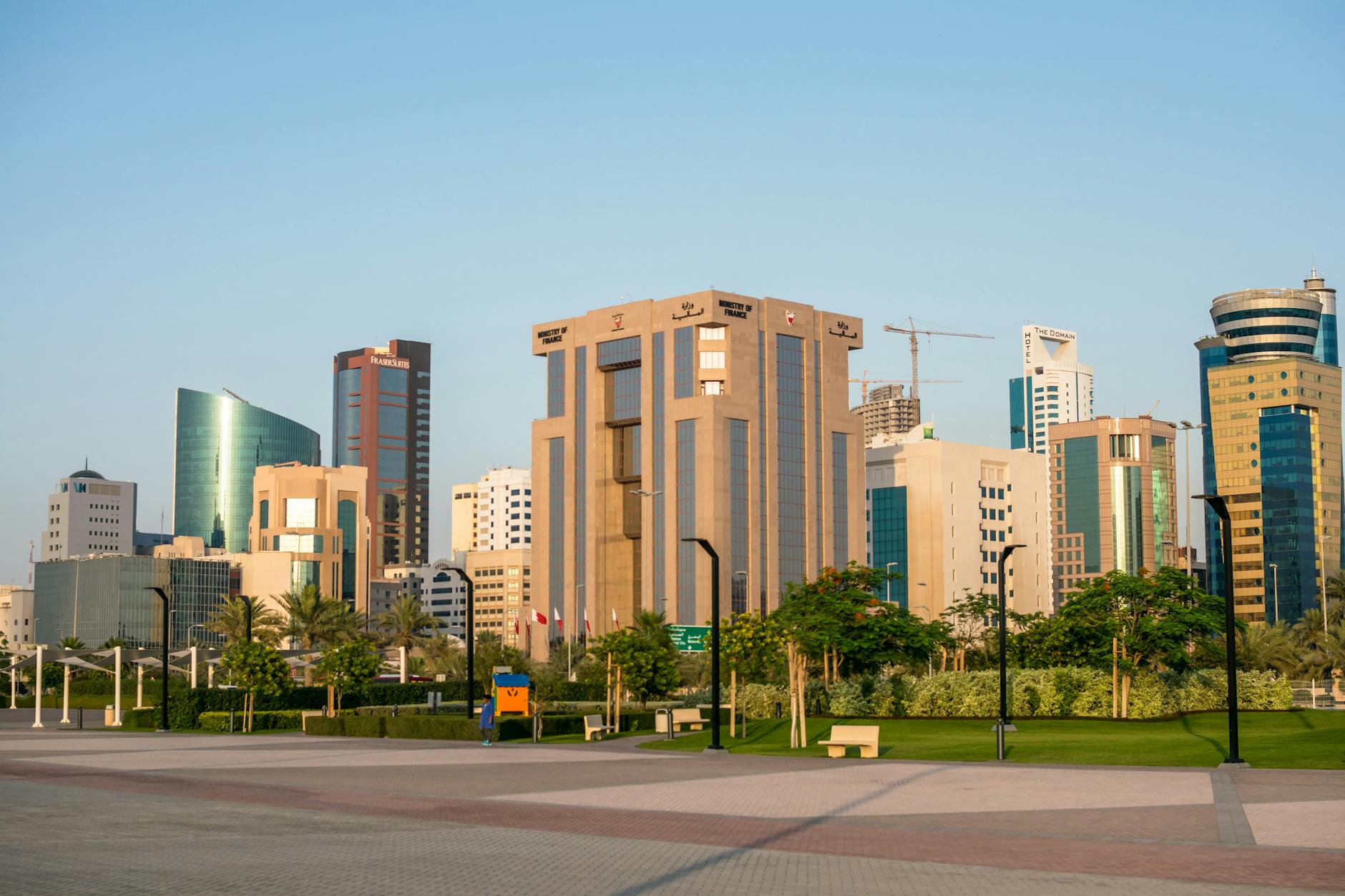
Manama is where Bahrain shows its compressed scale best: glass towers, old souq lanes, embassy traffic, and museum-grade history within short drives. Use it for the Bahrain National Museum, Bab Al Bahrain, and evenings that can swing from shawarma counters to hotel bars without much ceremony.
Muharraq carries the island's pre-oil memory more clearly than anywhere else in Bahrain. The Pearling Path runs about 3 kilometers through houses, warehouses, and lanes tied to the old pearl trade, while nearby Hidd keeps a tougher, working-waterfront feel than polished central Manama.
A'ali, Isa Town, and Hamad Town show the island away from the postcard circuit. This is a useful region for pottery workshops, burial mound landscapes, stadium-side local traffic, and the everyday Bahrain that sits between the capital and the desert south.
Sakhir is Bahrain at its widest and driest, with long roads, open desert light, and the country's best-known modern spectacle at the Bahrain International Circuit. Riffa adds royal-era architecture and older settlement depth, while Zallaq gives the south a sea edge that matters once the afternoon heat drops.
Budaiya and Qal'at al-Bahrain make sense together: one is the greener northern coast of farms, compounds, and old village traces, the other is the archaeological core that explains why this small island mattered for so long. Tubli adds marshland and creek geography, which turns the map from abstract outline into something physical.
Bab Al Bahrain once faced the sea; now it opens into Manama's old souq, where gold, spice, coffee, and the city's trading memory crowd the lanes.
From Dilmun's copper routes to a modern Gulf kingdom
Occupation begins on the mound now known as Qal'at al-Bahrain, the archaeological heart of ancient Bahrain. What looks like a rise in the earth is in fact a stacked city, built and rebuilt over centuries of trade.
Mesopotamian records describe Dilmun as a major exchange point between Sumer, Oman, and the Indus world. Bahrain's first great fortune grows from fresh water, copper traffic, and a position merchants could not easily avoid.
Bahrain enters the documentary shadow of Near Eastern empires as Assyrian references point to Gulf control and tribute networks. The islands are now visible not only to traders but to rulers who want their share.
Later Mesopotamian records suggest renewed imperial claims over Dilmun. Bahrain is small in territory, but by now no longer small in strategic meaning.
In the Hellenistic age, Bahrain is known as Tylos, a place of trade and cultivated life in the Gulf. Outside powers rename it, but the islands continue doing what they have always done: mediating exchange.
Eastern Arabia converts early to Islam, and Bahrain becomes part of a new religious and political order stretching far beyond the Gulf. Trade remains central, but law, allegiance, and belief now frame public life differently.
The Carmatian movement establishes a radical state in the wider Bahrain region, challenging Abbasid authority and unsettling the Gulf. Bahrain's history here is not placid commerce but ideological upheaval.
Portuguese fleets take control of Bahrain and fortify the islands as part of their Indian Ocean empire. At Qal'at al-Bahrain, cannon age geometry is laid over far older layers of settlement.
Persian forces remove the Portuguese, and Bahrain enters a new phase under Safavid influence. Gulf politics remain maritime, commercial, and intensely contested.
Ahmed al-Fateh leads the Al Khalifa takeover of Bahrain, establishing the ruling dynasty that endures into the present. Power shifts decisively, but the prize is still the same: trade, pearling, and command of the islands.
A remarkably long reign opens, spanning the last great decades of the pearling world and the threshold of the oil age. Muharraq remains the political heart, while commerce thickens around Manama.
Bahrain becomes the first state on the Arab side of the Gulf to discover oil. The timing is almost theatrical: the pearl economy is faltering, and a new subterranean wealth arrives just as the old marine one declines.
Bahrain becomes an independent state after the end of British protection. The island now has to balance sovereignty, security, finance, and regional diplomacy on a much more exposed stage.
Bahrain formally becomes a kingdom under Hamad bin Isa Al Khalifa. The new title carries the promise of constitutional modernity, though the years ahead would test how far that promise could stretch.
Inspired by regional uprisings, large protests erupt, centered in Manama and beyond, exposing deep grievances over representation, power, and belonging. No honest modern history of Bahrain can leave this chapter in the margins.
The inscription of the Pearling Path in Muharraq preserves houses, shoreline buildings, and the memory of a marine economy that once defined Bahrain. Heritage here is not just architecture; it is labor, risk, and social rank made visible.
Dilmun Age
Thomas Geoffrey Bibby, the Danish archaeologist who helped give Dilmun back its name and shape, turned a dusty mound into one of the Gulf's grand historical revelations.
Morning light falls on a low mound at Qal'at al-Bahrain, and the place looks almost modest until you remember what lay beneath it: storehouses, walls, workshops, and a harbor tied to one of the great trade systems of the Bronze Age. Records from Mesopotamia name Dilmun as a prized stop between Sumer and the Indus world, which tells you exactly what mattered here: water, position, and the talent for making other people's goods pass through your hands.
What many visitors miss is that Bahrain's first wealth did not begin with oil or even with pearls. It began with fresh springs rising in a salty world, dates growing where they had no right to, and ships carrying copper from Oman northward through the Gulf. A kingdom can start from a crown. Bahrain seems to have started from logistics.
The burial mounds of A'ali give this early age its most haunting aftertaste. Thousands of tombs spread across the island like a second landscape, less a cemetery than a declaration that this small archipelago mattered enough for generations to bury their dead with ceremony and permanence. The dead were numerous. So, one suspects, were the ambitions of the living.
Later rulers would build forts, ministries, and palaces, but the pattern was already there at Qal'at al-Bahrain: whoever controlled the island controlled an exchange point far larger than the island itself. That ancient habit of living from the sea, the warehouse, and the threshold never quite left Bahrain. It merely changed costume.
Local guides long repeated Eden stories around Bahrain's springs; archaeologists preferred pottery, seals, and trade routes, but one can see why paradise entered the conversation.
From Tylos to the Islamic Gulf
Abu Sa'id al-Jannabi, founder of the Carmatian state in eastern Arabia, remains a reminder that Bahrain's history includes revolution as well as trade.
Imagine a merchant on the quay with a ledger in one hand and salt on his robe hem. Assyrians, Babylonians, Greeks, Persians, and then Muslim rulers all looked toward these islands because Bahrain sat where commerce could be taxed, watched, and redirected. Names changed. The maritime logic did not.
In classical antiquity, Bahrain appears under the name Tylos, known for trade and for a cultivated life that surprised outsiders who expected the Gulf to be empty space between greater empires. That old imperial habit of underestimating islands is a familiar one. The islands usually have the last word.
Then came Islam, not as an abstraction but as a social fact carried by allegiance, taxation, law, and prayer. Eastern Arabia converted early, and Bahrain entered the Islamic world with all the opportunities and upheavals that followed. Ce que l'on ignore souvent, c'est que this was never a remote backwater: it was a connected province in a sea of arguments, sects, trade, and ambition.
The Carmatian movement, which rose in eastern Arabia in the 9th and 10th centuries, gave Bahrain one of the most unsettling chapters in its history. Their challenge to Abbasid authority was not a minor local quarrel; it shook the region and made the Gulf politically dangerous in a new way. The islands had become more than a harbor. They had become an idea, and ideas are always harder to govern than ports.
Much of early Bahrain's story survives in fragments from outsiders' records, which means the island often enters the archive when it has become too rich, too troublesome, or too strategic to ignore.
Pearls, Forts, and Dynasties
Ahmed al-Fateh is remembered as a conqueror, but behind the title stood a tribal leader who understood that controlling Bahrain meant commanding both sea lanes and allegiances.
One can begin with a fort wall in sea glare at Qal'at al-Bahrain. The Portuguese arrived in 1521 with artillery, imperial confidence, and a simple instinct shared by every maritime power: seize the choke point, then charge for access. The fort they left behind still carries that harsh geometry of cannon age empire, all angle and command.
Yet Bahrain was never easy to keep. Persian power returned, Arab tribes contested control, and the islands passed through the hands of rulers who understood that the true prize was not stone but the revenues of pearling and Gulf trade. In this period, Muharraq grew into a dynastic seat, while Manama matured as a mercantile town whose horizon was always more commercial than ceremonial.
The decisive turn came in 1783, when Ahmed al-Fateh and the Al Khalifa took Bahrain. Dynasties are often remembered as if they descend in one clean line. They do not. They arrive through alliances, naval skill, family calculation, and, very often, the weakness of someone else.
Under the Al Khalifa, the pearling economy reached extraordinary importance. Fortunes were made by merchants, divers, captains, and financiers, though the most brutal work fell to the men who disappeared beneath the surface with a nose clip, a rope, and lungs that had to bargain with death. Royal history likes palaces. Bahrain's older wealth came from bodies in the water.
Before oil transformed the state, a single fine Gulf pearl could pass through more social worlds than most nobles ever did: diver, captain, merchant, broker, ruler, and then a buyer in Bombay or Paris.
Treaty State, Oil State, Kingdom
Sheikh Isa bin Ali Al Khalifa lived long enough to embody the old pearling order even as the ground beneath Bahrain was preparing an entirely different fortune.
Picture a ledger on a desk in Muharraq, then a treaty folded beside it. From the late 19th century onward, Bahrain entered a tighter British orbit, and politics became a negotiation between local rule, imperial protection, and the growing demands of a commercial society. Sheikh Isa bin Ali Al Khalifa presided over a long reign in which old structures survived, but only just.
Then, in 1932, oil was struck. A date that simple can hide the human shock of it: the old pearl economy was already being battered by the global depression and cultured pearls, and suddenly a new subterranean fortune arrived to replace the one wrested from the sea. Bahrain became the first place on the Arab side of the Gulf to discover oil. One era ended almost with a hiss.
Modern Bahrain took shape quickly after that, with roads, schools, ministries, labor politics, and sharper public debate. Independence came in 1971, and the country then had to perform the delicate Gulf art of being small, strategic, wealthy, and visible. Manama became a financial and administrative capital. Muharraq kept more of the older fabric. The contrast tells its own story.
Since 2002 Bahrain has been a kingdom, and since 2011 no serious account can pretend the island's history is only one of smooth modernization. Protesters, police, reformers, loyalists, migrant workers, merchants, and royal institutions all belong to the same national drama. Never flatter the regime; never flatten the people. Bahrain's story is richer, prouder, and more troubled than propaganda on either side will admit.
The Pearling Path in Muharraq preserves merchant houses and shore buildings, but the real archive of that age once sat in divers' chests and damaged lungs, not in museums.
In Bahrain, Arabic does not behave like a fortress. It behaves like a port. A sentence begins in Gulf Arabic, accepts an English business noun without blushing, then lands on a Persian or Indian inheritance so old nobody bothers to interrogate it. The result is not confusion. It is elegance with sea salt on it.
You hear this most clearly in Manama taxis and in the old lanes of Muharraq, where greetings still take precedence over content. First peace, then health, then family, then the matter at hand. Europe calls this delay. Bahrain knows better. Ritual is the price of speaking without violence.
Certain words refuse translation. Majlis is not a sitting room; that would be like calling an orchestra a box of wood. Inshallah is not indecision either. It is intention made modest. A country reveals itself by the words it will not flatten.
Bahraini food has the intelligence of a trading port and the appetite of an island. Sweetness appears where a stranger expects salt. Dried black lime cuts through rice like a line of ink. Rose water enters a dish with such authority that one realizes Europe has treated perfume and dinner as two unrelated disciplines for far too long.
At table, contrast reigns. Muhammar brings sweet brown rice to the side of fried safi, and suddenly the fish tastes more marine, the sugar more grain-like, the entire plate more exact. Balaleet performs the same ambush at breakfast: vermicelli with sugar, cardamom, saffron, and then an omelet on top, as if someone had decided the morning should include a theological dispute between dessert and eggs.
In Manama, a pot of gahwa and a dish of dates can say everything hospitality needs to say. In Muharraq, harees still carries the dignity of long cooking and patient hunger. A country is a table set for strangers, but Bahrain adds a condition: you will be fed until refusal becomes a philosophical position.
Bahraini politeness is warm, but warmth here has bones. You do not march into the practical matter as if efficiency were a moral virtue. You greet. You ask after health. You ask after the family. Only then does the real conversation appear, and by then it has already been improved by having waited.
Coffee teaches the rule better than any lecture. Gahwa arrives in a small cup that pretends modesty while planning repetition. Someone pours for you in the majlis, often standing, often attentive to a movement of the wrist more subtle than many diplomatic signals. If you want no more, you shake the cup lightly. Fail to do this and the stream continues, which is less a trap than a lesson in how generosity can become architecture.
Visitors sometimes mistake insistence for pressure. It is closer to reassurance. Take another date. Have more rice. Accept the fruit. The offer says: you are safe enough here to eat beyond strategy. That is not a small thing.
Bahrain's old architecture begins with a refusal to fight the climate head-on. Thick walls, shaded courtyards, carved doors, wind towers drawing air downward with the patience of people who understood heat before air-conditioning turned discomfort into a technical problem. In Muharraq, the older houses do not beg for admiration. They perform survival with style.
The best lesson comes from the houses of the pearling era, where wealth did not always mean bulk. It meant ventilation, privacy, proportion, and the social intelligence to separate public reception from domestic life. A courtyard is never just empty space. It is light edited into livable form.
Then you arrive at Qal'at al-Bahrain and time changes texture. The tell carries around 4,500 years of occupation, layer on layer, as if the island kept rewriting the same sentence with different empires. Fort, harbor, administrative core, memory device. Sand and stone can be far more articulate than glass.
Religion in Bahrain is public without always becoming theatrical. You hear the call to prayer across traffic, towers, office blocks, and supermarket parking lots, and the sound does something simple and immense: it reminds the city that clocks are not the only way to divide a day. Faith here coexists with commerce in the old Gulf manner, not as contradiction but as rhythm.
The island's religious life is also marked by difference lived close together. Sunni and Shia histories shape neighborhoods, commemorations, speech, even the emotional weather of certain months. Ashura, in particular, alters the atmosphere with black banners, lament, procession, and a seriousness no outsider should treat as spectacle. Grief, when ritualized, becomes a form of urban design.
Yet Bahrain rarely presents itself as doctrinal in daily gesture. It appears instead in the repeated courtesies, the patience with forms, the calibration of hospitality, the refusal to detach the material from the spiritual. Even the meal understands this. Bread, coffee, prayer, conversation: each teaches the others how to proceed.
Ahmed al-Fateh is the man who changed Bahrain's political script in one bold movement, taking the islands and establishing the Al Khalifa dynasty that still rules today. The title means "Ahmed the Conqueror," but conquest here was not pageantry; it was control of harbors, loyalties, and revenue.
Sheikh Isa bin Ali reigned for 63 years, long enough to watch Bahrain move from a pearling polity into the first moments of the oil age. His house in Muharraq still carries the atmosphere of a world built on courtyards, sea wealth, and careful hierarchy.
Hamad bin Isa Al Khalifa oversaw the transition from emirate to kingdom, a symbolic shift loaded with constitutional ambition and regional calculation. His reign also carries the harder chapters of modern Bahrain, especially the unresolved tensions exposed in 2011.
Bibby was one of the scholars who made the ancient mound at Qal'at al-Bahrain speak again. Without him and the teams around him, Dilmun might have remained a half-mythical name in Mesopotamian texts instead of a place you can stand in and read layer by layer.
Belgrave arrived as an imperial fixer and became one of the most influential men on the island, shaping administration, policing, and reform with a confidence only empire could produce. Bahrain modernized under his watch, but never innocently; his career is a neat reminder that bureaucratic reform can also be a form of control.
Al-Arrayedh gave Bahrain a cultural voice equal to its commercial one, writing poetry and prose that belonged to a wider Arab world without losing the island's own accent. His house in Muharraq now feels like the salon of a Bahrain that argued elegantly with itself.
If you want the sound of old Bahrain, start with Mohammed bin Faris. He carried the sorrow, swagger, and sea-stained refinement of pearl-diving society into song, which is another way of saying he preserved an entire emotional economy after the economy itself began to fade.
Munira Fakhro matters because she represents a Bahrain that insists on thinking aloud. Academic, candidate, critic, and witness to the strains of public life, she stands for the island's educated dissenting tradition, which is just as much a part of national history as any palace.
This is the cleanest first trip: modern Bahrain in Manama, older trade memory in Muharraq, then a quieter eastern edge in Hidd. It works well without over-planning, and the short hops leave time for museums, souqs, and long meals rather than constant transfers.
This inland route shifts away from the airport-and-waterfront version of Bahrain and into the island's lived middle. Riffa gives you forts and family compounds, Isa Town adds markets and sports infrastructure, A'ali brings burial mounds and pottery, and Hamad Town slows the pace enough to see everyday Bahrain.
Base this trip around big skies, motorsport country, and the sea-facing west. Sakhir gives you the Bahrain International Circuit and desert edges, Zallaq brings beach time and access to the southwest coast, and Budaiya adds date gardens, old villages, and a softer northern rhythm.
Two weeks in Bahrain is enough to stop treating it as a weekend add-on and start reading its layers. Begin in Tubli for creek-side geography, move west to Qal'at al-Bahrain for the deepest historical frame, continue through Budaiya's northern settlements, and finish in Hidd where the island still feels tied to labor, docks, and the sea.
Lunch or dinner, shared, never pecked at. Rice, meat or fish, dried lime, tomato sauce on the side, right hand or spoon, family or colleagues gathered close enough to argue.
Sweet brown rice beside fried rabbitfish, often at midday. The fish brings salt and bones; the rice brings sugar and cardamom. Contrast as table manners.
Breakfast after dawn prayers, Eid mornings, late family breakfasts. Sweet vermicelli under a thin omelet, fork cutting through two opposing doctrines at once.
Ramadan evenings, iftar tables, patient households. Wheat and meat cooked for hours into a soft mass, butter on top, conversation reduced to gratitude.
Offered on arrival in a majlis, before business, before explanation. Small cup, repeated pours, dates first, cup shaken gently when you mean enough.
Served with Arabic coffee after meals, at visits, during festivals, in bright spoonfuls. Saffron, rose water, nuts, sugar, and no interest in moderation.





Most visitors need a visa unless they are GCC citizens. Bahrain's official tourism portal says many nationalities can get a visa on arrival at Bahrain International Airport, while others should apply through the eVisa system before departure; check your passport on the official eligibility tool because rules and lengths of stay vary by nationality.
Bahrain uses the Bahraini dinar, or BHD, divided into 1,000 fils. The dinar is pegged to the US dollar at about 1 BHD = 2.659 USD, cards are widely accepted in Manama and Muharraq, and a little cash still helps in souqs, small cafes, and for low-value taxi fares.
Nearly all international arrivals come through Bahrain International Airport in Muharraq, about 10 km from central Manama. The airport has been operating since 1927, and Bahrain is also linked by road to Saudi Arabia via the King Fahd Causeway, which matters more for regional traffic than for most first-time visitors.
Bahrain is compact, but the heat makes walking a poor default outside short old-city stretches in Manama or Muharraq. Official guidance points travelers toward metered taxis, app-based rides, public buses, and rental cars; buses run on main routes, cash fare is 275 fils, and a reusable GO Card costs 500 fils.
Expect a hot desert climate. Official tourism guidance puts winter and early spring in the comfort zone, with fall and winter around 25°C, while summer often reaches 45°C, which turns midday sightseeing in places like Sakhir or Qal'at al-Bahrain into a short, strategic operation.
Bahrain has strong mobile coverage and was an early nationwide 5G adopter. Free Wi-Fi is common in malls, cafes, and the airport, and tourist SIM or eSIM plans are easy to buy from Batelco, STC, or Zain with your passport.
Bahrain is generally an easy country to travel in, with low levels of street crime by regional standards. For emergencies dial 999, keep an eye on official local guidance if political tension flares, and treat heat, dehydration, and late-afternoon sun as the practical risks you are most likely to feel.
Use cards for hotels, malls, and most restaurants, but keep a few dinars in cash for souqs, bakeries, and short taxi rides. Bahrain is not a bargain destination by Gulf standards, so the easy savings come from lunch deals, local cafes, and booking hotels outside peak Formula 1 dates.
Bahrain has no passenger rail network. If you are comparing transport options, think in terms of taxi, ride-hailing, bus, or rental car rather than waiting for a metro line that does not exist.
Public buses are cheap and usable on main routes, especially between Manama, Muharraq, and larger town centers. They are less useful for time-sensitive days in Sakhir, Zallaq, or scattered archaeological stops, where a car or app ride saves hours.
Ride-hailing is the least stressful option after dark or when leaving malls and hotels. Official guidance notes metered taxis, but app booking cuts down on fare ambiguity and works better when the weather makes waiting outside unpleasant.
From May through September, do outdoor sites early, retreat indoors from late morning to late afternoon, then go out again after sunset. Even in winter, Qal'at al-Bahrain and the open areas around Sakhir feel hotter than the temperature suggests because shade is scarce.
Check the bill before adding a tip. Many hotels and polished restaurants already include service, so a second automatic 10 percent is generous rather than necessary.
If your dates touch the Bahrain Grand Prix in Sakhir, reserve flights, hotels, and car rental months ahead. Room rates jump fast, and even travelers who do not care about Formula 1 will feel the crunch.
Explore Bahrain with a personal guide in your pocket
Audio guides for 1,100+ cities across 96 countries. History, stories, and local insight — offline ready.
Usually yes, unless you are a GCC citizen. Many passports qualify for a visa on arrival or an eVisa, but the exact rule depends on nationality, so check Bahrain's official visa eligibility page before you book nonrefundable flights.
Bahrain is mid-range by Gulf standards, not ruinous but rarely cheap. You can keep costs down with local food and business hotels in Manama, while beach resorts, alcohol, and Grand Prix-period rates push the budget up quickly.
Three to four days is enough for a solid first trip covering Manama, Muharraq, and one southern or western excursion. A week lets you slow down and add places like A'ali, Riffa, Budaiya, or Sakhir without turning the trip into a checklist.
Yes, if you stay focused on Manama and Muharraq. Once you start adding Sakhir, Zallaq, or scattered heritage sites, a rental car or repeated app rides become far more efficient than relying on buses.
December through March is the easiest window for most travelers. Official tourism guidance points to winter, early spring, and late fall as the most comfortable seasons, with milder temperatures and far better conditions for walking older districts or visiting outdoor sites.
Generally yes, Bahrain is one of the easier Gulf destinations for solo travel. The main travel discipline is not fear of street crime so much as practical caution with heat, late-night transport planning, and dressing with local context in mind outside resort settings.
Yes, alcohol is legal in Bahrain, but not everywhere. You will usually find it in licensed hotels, bars, and some restaurants, while public drunkenness and drinking in public spaces will cause problems fast.
Most hotels, malls, and established restaurants do, but smaller businesses do not always. Carrying a little BHD still saves friction in old souqs, corner shops, and with drivers who prefer cash for short fares.
Yes, if you like places where history and daily life still sit close together. Bahrain is at its best when you give it time for Manama's old quarter, Muharraq's pearling streets, and at least one day for forts, desert edges, or the northern coast.
Last reviewed