apartment
Baku and the Caspian
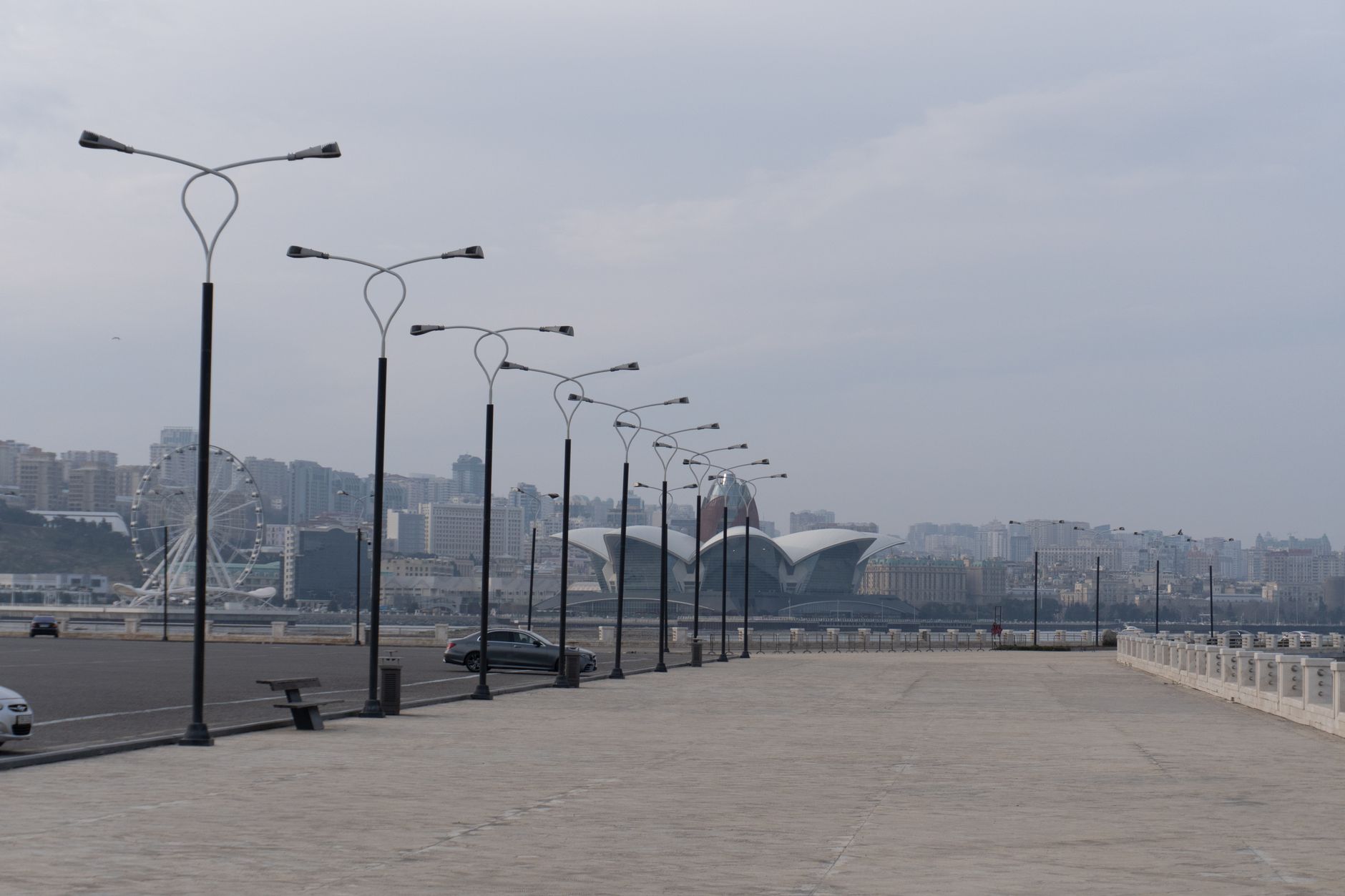
Baku is where oil-boom stone facades, Shirvanshah history, and futuristic towers meet the Caspian wind. Few capitals shift from caravanserai to starchitect skyline this quickly.
Azerbaijan feels like three or four countries compressed into one: a Caspian capital, a Silk Road interior, mountain villages older than empires, and a table that tells the whole story in saffron, tea, and sour plum.
 Azerbaijan
EntryMost EU/US/UK/CA/AU travelers need an ASAN e-visa.
AAn Azerbaijan travel guide starts with a surprise: this is a country where mud volcanoes, medieval caravan routes, and Baku’s flame-shaped towers belong in the same trip.
Azerbaijan works best when you stop trying to fit it into one neat category. The Caspian shore gives you Baku, where the old walls of Icherisheher sit a short drive from oil-boom mansions, Soviet avenues, and the glass curves of the Flame Towers. Head west and the mood changes fast: Sheki still carries the Silk Road in its caravanserais and sweet shops, while Ganja brings the country’s literary weight into focus through Nizami and a city plan that feels older than its traffic. This is the appeal. One route, several civilizations talking over each other.
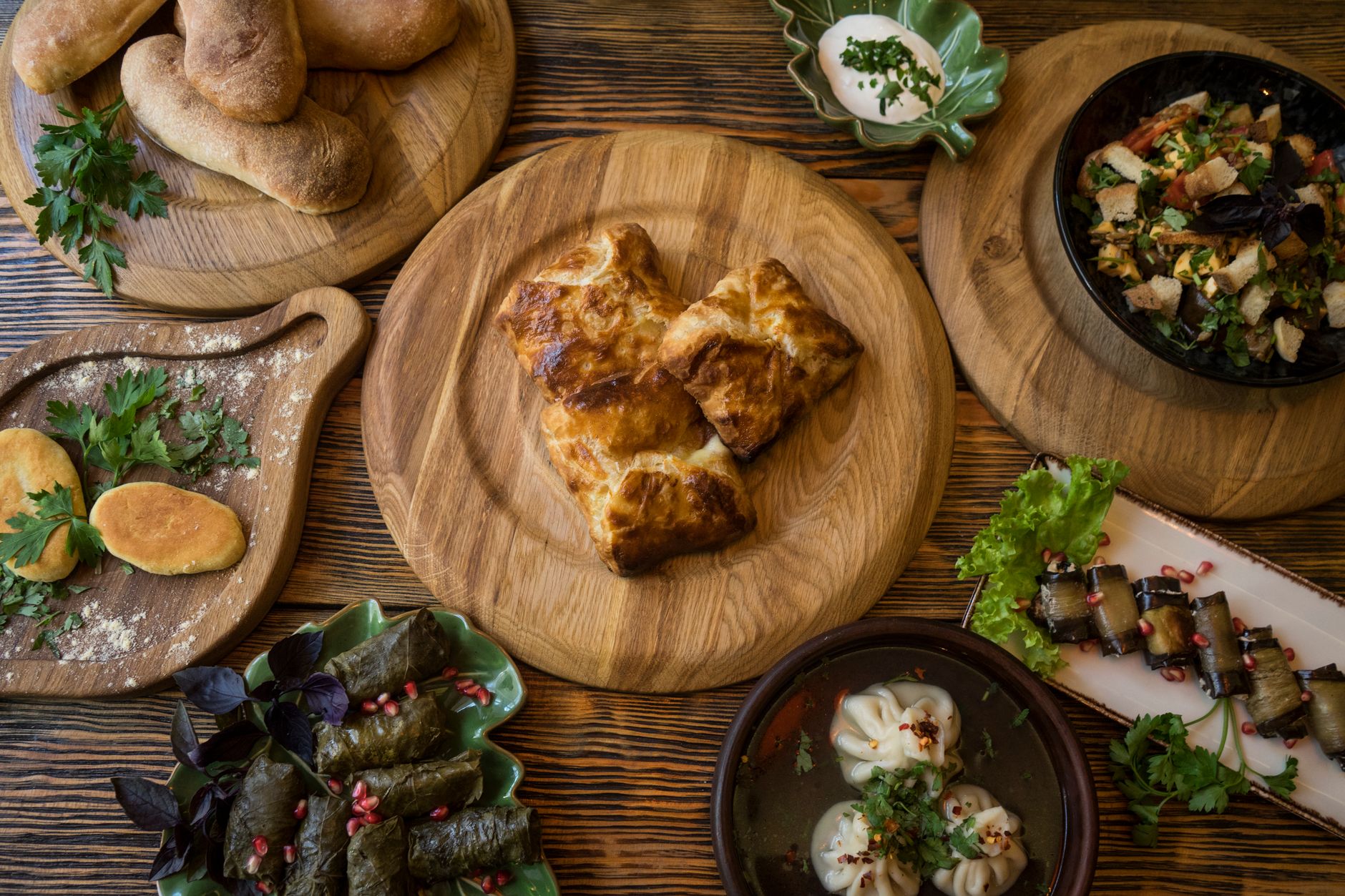
Food explains the country faster than any museum label. Tea arrives in pear-shaped armudu glasses before almost anything else, less a drink than a social contract. In Sheki, piti comes in individual clay pots and demands a proper ritual with bread and broth; in Lankaran, lavangi stuffs chicken or fish with walnuts and tart fruit paste until the whole dish tastes dark and autumnal. Baku does its own version of finesse with dushbara, dumplings so small they turn soup into a point of pride. The table is where Persian, Turkic, and Caucasian habits stop being theory.
Fire Sanctuaries and Caucasian Albania, c. 300000 BCE-705 CE
A Roman soldier once stood among the rocks of Gobustan, looked at carvings already ancient beyond counting, and scratched his own presence into stone. His Latin inscription, left by Legio XII Fulminata under Domitian between 84 and 96 CE, is still there: a small act of vanity on a Caspian shore where hunters, boats, bulls, and dancing figures had been cut into the rock across millennia. Ce que l'on ignore souvent, c'est que Azerbaijan enters history not with a dynasty, but with fire itself: gas pushing through stone, flames licking from the earth, and pilgrims reading theology in geology.
That fire shaped belief long before it shaped postcards. Near modern Baku, at Surakhani, the Ateshgah drew worshippers who came for the eternal flame, while Yanar Dag kept burning on the Absheron Peninsula as if the soil had forgotten how to stop. The old Persian name Aturpātakān, linked to the keeping of sacred fire, was not poetic decoration. It was observation. A land where hills could ignite deserved reverence, and perhaps a little fear.
Then came Caucasian Albania, one of those kingdoms that sound invented until the documents begin to pile up. Its rulers balanced Rome, Parthia, and Persia with the nimbleness of people who knew they lived between appetites. King Urnayr, in the 4th century, converted to Christianity around 313 CE, making his realm one of the earliest Christian polities anywhere. That choice was not only pious. It was political, intimate, dangerous, and costly; Urnayr would die fighting the Sasanian Persians.
The capital at Qabala, near modern Gabala, impressed foreign envoys, yet the kingdom's afterlife is quieter than its neighbors'. Its alphabet, 52 letters strong, survived in fragments and scholarly detective work. Its church was gradually absorbed after the Arab advance, but not entirely erased. In the village of Nij, the Udi community kept echoes of that world alive, a reminder that empires conquer faster than memory yields.
And this is the first great Azerbaijani pattern: nothing arrives alone. Fire becomes ritual. Ritual becomes politics. Politics becomes survival. By the time Arab armies came through the Caucasus in the 7th century, this land already knew how to live with layered loyalties, and that talent would define everything that followed.
King Urnayr was not a marble saint but a ruler making a risky conversion in a neighborhood where every empire expected obedience.
The Roman inscription at Gobustan was carved beside petroglyphs thousands of years older, as if one bored legionary insisted on joining a conversation already 35,000 years in progress.
Shirvanshahs, Poets, and Silk Road Courts, 8th century-1501
Picture Shamakhi on a trading day: bolts of silk, caravan dust, a money changer weighing silver, and somewhere behind a courtyard wall a court secretary drafting letters that might calm one neighbor and provoke another. This was no provincial backwater. It was a city of merchants and shocks, rich enough to tempt invaders and refined enough to produce poets who still rearrange the emotional furniture of the Persianate world.
The Shirvanshah dynasty understood duration better than spectacle. They ruled much of northern Azerbaijan for roughly nine centuries, which is a polite way of saying they survived what should have destroyed them: Arab rule, Seljuk pressure, Mongol thunder, Timurid violence, and the general bad manners of medieval geopolitics. In Baku, the Palace of the Shirvanshahs still carries that memory in stone. Audience halls, mosque, mausoleum, bathhouse: government, prayer, burial, and comfort all gathered within one courtly grammar.
But dynasties are not the whole story. Ganja gave the wider world Nizami Ganjavi, born around 1141, who wrote some of the greatest narrative poetry in Persian and appears to have lived a life almost comically unsuited to literary celebrity. He did not spend decades fluttering from court to court. He stayed close to home. He wrote of lovers, kings, and Alexander the Great, and when his wife Afaq died young, grief entered the poems with him. That is often the truth beneath literary grandeur: a man alone with loss and an ink pot.
Ce que l'on ignore souvent, c'est that the region's brilliance was made in rooms, not battlefields. Scribes, poets, patrons, craftsmen, scholars, and merchants gave medieval Azerbaijan its texture. Even the great courts depended on such private labor. A ruler could commission a mausoleum. Only an artisan could make it memorable.
The end came with theatrical force. In 1500, Farrukh Yassar, the last Shirvanshah of real consequence, was defeated and killed by Shah Ismail I. One world of cautious local monarchy yielded to another, fiercer one: charismatic, messianic, imperial, and unmistakably Azerbaijani in its own origins.
Nizami Ganjavi, so often treated as a monument, was in truth a private man whose greatest epics carry the bruise of personal bereavement.
A persistent literary tradition claims Nizami once agreed to dedicate a poem only after a local lord freed an enslaved man he had singled out by name.
Safavid Splendor, Khanates, and Imperial Encirclement, 1501-1828
He was barely fourteen when he entered Tabriz in 1501, victorious, adored, and frighteningly certain of his destiny. Shah Ismail I, founder of the Safavid Empire, did not merely win a throne; he recast the political and religious fate of the region. Azerbaijani Turkic was the language of his household and poetry, Persian the language of administration, Shi'i devotion the creed of state. In his person, one sees Azerbaijan's old habit of holding several worlds at once, though never gently.
The Safavid centuries left marks in doctrine, trade, and taste. Shi'ism deepened as public identity. Court culture flourished. Yet imperial grandeur always had a local underside: taxes, rival clans, ambitious governors, and the exhaustion that follows military glory. When the Safavid structure weakened in the 18th century, Azerbaijan did what fractured frontiers often do. It multiplied into khanates. Baku, Sheki, Quba, Ganja, Karabakh, Nakhchivan: each became a court, a fortress, a bargaining table.
This is where the story becomes deliciously human. Khanates were not abstract territorial units. They were families with grudges, cousins with claims, mothers arranging alliances, treasuries running low, and rulers pretending confidence they did not always feel. In Sheki, the khans built a summer palace whose stained glass and painted walls still suggest a life of cultivated pleasure lived under permanent threat. Beauty, here, was not innocence. It was defiance.
Then the Russian Empire arrived with maps, artillery, and treaties designed to settle what armies had made messy. The wars with Qajar Iran ended in two decisive documents, Gulistan in 1813 and Turkmenchay in 1828, which transferred large parts of the South Caucasus north of the Aras into Russian control. Borders hardened. Families found themselves on the wrong side of new lines. Old loyalties did not vanish, but empire now had a bureaucracy.
And so another Azerbaijani era closed the way these eras often do: not with a clean replacement, but with overlap. Persian memory remained. Turkic speech remained. Shi'i ritual remained. Yet Russian power set the stage for oil, modern nationalism, and the astonishing reinvention of Baku.
Shah Ismail I was the sort of founder history adores and ordinary people must endure: poet, conqueror, mystic, and architect of a state too large to stay tender.
Ismail wrote lyric poetry under the pen name Khatai, which means the empire's fearsome founder also left behind verses intimate enough to be whispered rather than proclaimed.
Oil Barons, Republics, and Soviet Shadows, 1828-1991
Stand in Baku in the late 19th century and imagine the smell first. Not roses. Oil. Kerosene, salt air, hot metal, wet stone, and money arriving at vulgar speed. By 1901, the city produced more than half the world's oil. Fortunes exploded almost overnight, and with them came mansions, theatres, schools, philanthropy, vanity, and scandal in the proper proportions. The Taghiyevs, the Nobel brothers, the Rothschild interests, Armenian and Azerbaijani industrial families, imperial officials, European engineers: Baku became a boomtown dressed as a capital before it was one.
One man embodied the age better than most. Haji Zeynalabdin Taghiyev began with almost nothing, made a colossal fortune in oil, and then spent it with a princely instinct for legacy. He financed schools, including a pioneering Muslim girls' school in Baku, and supported newspapers, theatres, and charitable work. He also built himself a palace. Naturally. Philanthropy and self-display are old companions.
The empire that housed this splendor did not last. After the Russian Revolution, Azerbaijan declared the Azerbaijan Democratic Republic on 28 May 1918, the first secular parliamentary republic in the Muslim world. It lasted less than two years. But what years. Universal suffrage, including for women before several European states managed the same, a parliament of multiple parties and communities, and the intoxicating belief that a new political language might be possible between empire and dogma.
The Red Army ended that experiment in April 1920. Soviet rule remade the country with the usual mixture of literacy campaigns, industrial might, censorship, terror, careerism, and social mobility. Azerbaijan became essential again during the Second World War, when Baku's oil fed the Soviet war machine. Hitler wanted the city. Stalin needed it. The people who lived there, one suspects, would have preferred less attention from history.
Yet Soviet power, for all its monuments and ministries, never erased the deeper grain. Old urban identities survived in courtyards and kitchens. In Ganja, Sheki, Lankaran, and Baku, family memory kept running beneath official slogans. When the Soviet Union weakened, the old question returned with fresh urgency: what should Azerbaijan be when nobody else names it first?
Haji Zeynalabdin Taghiyev knew money alone never wins affection, so he spent his oil fortune turning Baku into a city that could educate its daughters as well as flatter its millionaires.
The Azerbaijan Democratic Republic granted women the vote in 1918, ahead of France, Italy, and several other European countries that later liked to lecture the region on modernity.
Independence, War, and the State of Contrasts, 1991-present
Independence in 1991 did not arrive with champagne serenity. It arrived amid collapse, war, confusion, and the violent unmaking of Soviet certainties. The conflict over Nagorno-Karabakh quickly became the wound through which everything else was felt: grief, displacement, humiliation, rage, and the hardening of statehood. Whole communities were pushed into motion. Policy became personal because nearly every family knew someone missing, uprooted, or buried.
Heydar Aliyev, the former Soviet strongman who returned to power in 1993, brought a language of stability that many accepted because the alternatives looked worse. His presidency and the succession of Ilham Aliyev in 2003 shaped the state that now presents itself to the world: centralized, polished, ambitious, and deeply invested in image. Ce que l'on ignore souvent, c'est how much of modern Baku is a stage set built on very real insecurity. The Flame Towers glitter. The old wounds do not.
Oil and gas funded that new confidence. Boulevards widened. Museums rose. International events arrived. The skyline changed so quickly that parts of Baku can feel like three cities arguing at once: medieval limestone, Soviet geometry, and 21st-century spectacle. But travel beyond the capital to Sheki, Quba, Lahij, Khinalig, or Lankaran and another Azerbaijan appears, one less interested in performance and more in continuity, where tea, craft, orchard, shrine, and mountain road still carry the weight of belonging.
The 2020 war altered the national mood again, bringing military victory, mourning, and a fresh chapter of reconstruction and dispute. Official triumph sits beside private loss. That tension matters. A serious history cannot flatter the regime, but neither can it pretend the people's emotions are simple. Pride and sorrow often share the same table here.
What comes next will not be written by pipelines alone. It will be written in how Azerbaijan balances memory with power, and in whether the country can allow its many inheritances to coexist without forcing one to silence the others. That has always been the real drama.
Heydar Aliyev grasped earlier than most that post-Soviet power would depend as much on choreography and control as on ideology.
Modern Baku's most futuristic skyline rises within easy reach of districts where tea is still served in armudu glasses according to habits older than the oil boom.
Azerbaijani does not enter the room alone. It brings Turkic syntax, Persian memory, Russian habits, and a talent for politeness that can make a simple greeting feel upholstered. In Baku, you hear this at once: a sentence with soft vowels, then a Russian loanword standing in it like a Soviet sideboard nobody threw away because it was too useful.
The distinction between "sən" and "siz" matters because grammar here still believes in ceremony. Use "siz" with elders, strangers, shopkeepers, anyone whose name you do not yet deserve; add "bəy" or "xanım" and the sentence straightens its back. A country is a table set for strangers.
Then come the words that refuse export. "Qonaqpərvərlik" gets translated as hospitality, which is insulting in its thinness: the Azerbaijani word contains duty, vanity, household honor, and the fierce pleasure of feeding someone until they stop pretending they are full. "Həsrət" is longing without opera. "Pir" is shrine, vow, hillside, rumor, and hope condensed into one noun. Languages reveal what a people decided was too important to leave vague.
Azerbaijani cuisine distrusts chaos. The great lesson arrives with plov, where saffron rice and garnish are cooked apart and served apart, as if the table were a place for diplomacy rather than conquest. In Ganja or Sheki, you understand this in one spoonful: lamb, chestnuts, dried apricots, sour plum, separate grains, each component keeping its dignity until your mouth performs the union.
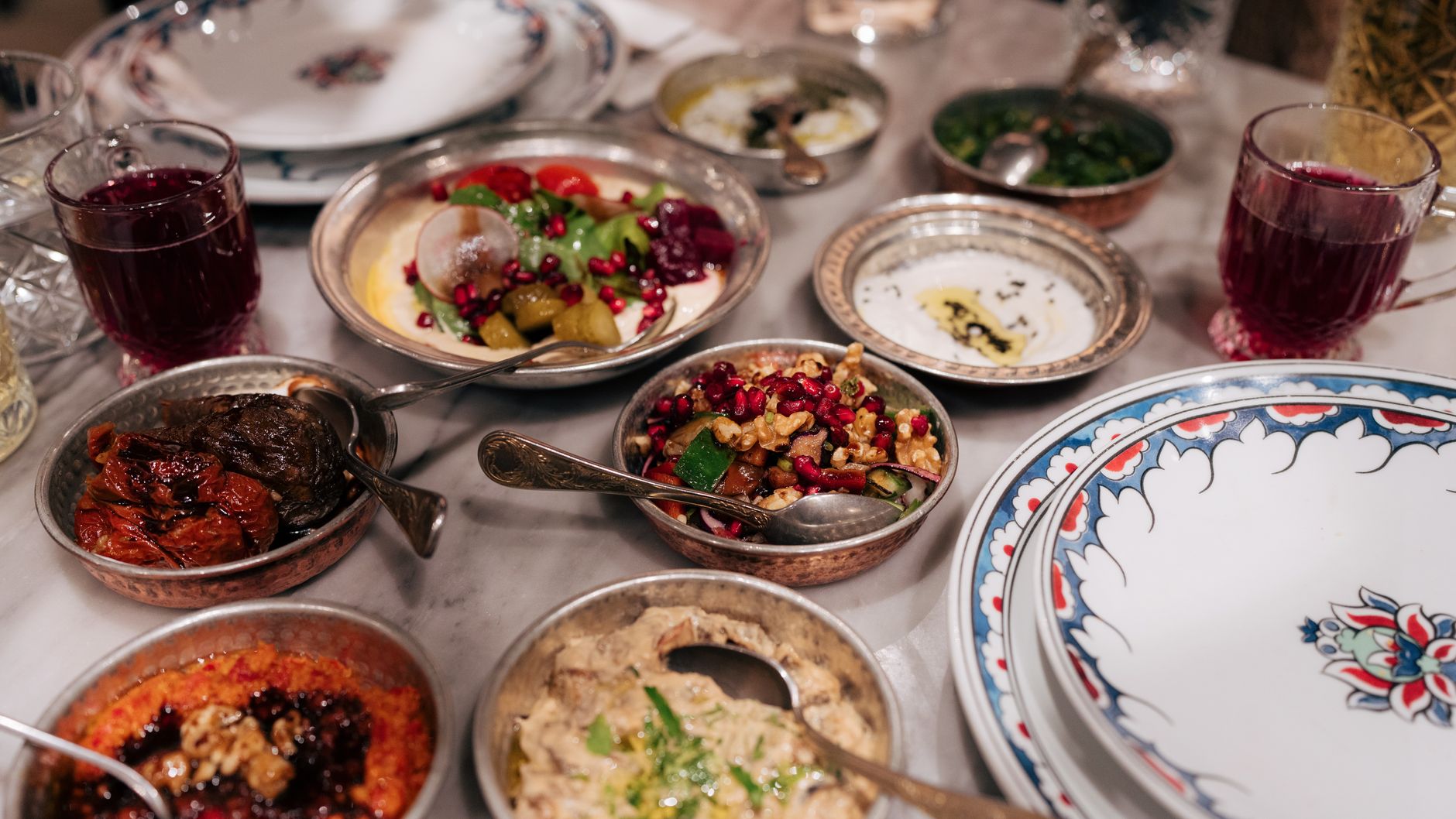
Sourness is treated here with the respect other countries reserve for butter. Dried cornelian cherry, plum paste, pomegranate, yogurt, sumac, green herbs by the fistful: these are not accents but arguments. Even comfort has an edge. Especially comfort.
And then the south changes the register. In Lankaran, lavangi stuffs chicken or fish with walnuts, onion, and tart fruit paste until dinner tastes like an autumn orchard that learned to speak Persian. In Baku, dushbara turns domestic labor into bragging rights, each tiny dumpling floating in broth like a piece of edible calligraphy. Good food here does not shout. It arranges its evidence.
Azerbaijan inherited a literary culture that likes silk and blade in the same hand. The patron saint of this temperament is Nizami of Ganja, who wrote in Persian, stayed close to home, and managed to produce epics grand enough for kings without sounding impressed by kings. His stories adore love, but never the simple version; desire in Nizami is always intelligent enough to suffer from its own intelligence.
That old prestige of language never quite disappeared. Even outside libraries, people quote verse with less embarrassment than Western Europe now permits itself, and mugham singers still handle text as if words possessed temperature. In a tea house in Baku, a line of poetry can appear between two remarks about traffic and be accepted as perfectly practical. It is practical. It tells you what mood the room has chosen.
This is what I like most: literature here does not sit on a shelf pretending purity. It leaks into toasts, laments, songs, school memory, family pride, and the way longing gets spoken aloud. In many countries, poetry survives despite daily life. In Azerbaijan, it survives by contaminating it.
Mugham is what happens when music decides that a scale is too small for sorrow. The form is modal, improvised within discipline, and carried by a singer whose job is not to decorate emotion but to interrogate it until it confesses. Listen in Baku and the first sensation is not melody. It is tension, a line held so long it begins to feel architectural.
The instruments are accomplices. The tar glitters and cuts. The kamancha weeps without self-pity. The daf keeps time the way a pulse keeps faith. UNESCO can classify mugham if it wishes; classification is one of the things bureaucracies do when they encounter mystery and need to file it before going home.
Yet the strange miracle is how naturally this music coexists with everyday life. One minute you are in traffic on Neftchilar Avenue, watching glass towers reflect the Caspian like expensive lies; the next, a singer bends a phrase that seems older than oil, older than empires, older perhaps than the vanity of thinking a country has one soul instead of several. Mugham does not resolve a nation. It makes the contradiction audible.
Hospitality in Azerbaijan begins before conversation and, in a sense, replaces part of it. Tea arrives first in an armudu glass, pear-shaped and elegant enough to make your fingers behave. Sugar may be bitten, jam may appear, dried fruit may follow, and only after this choreography has begun does the meeting become real.
The important detail is pace. You do not rush tea, and you do not hurry toward the point as if human company were an administrative error. In Baku business offices, in homes in Sheki, in roadside stops on the way to Quba, this remains true with impressive stubbornness. Modernity came. The kettle stayed.
Refusal also has manners. A blunt no exists, of course, but social life often prefers softer instruments: delay, diversion, another pour, a smile that changes the subject without humiliating anybody. This can puzzle visitors trained in northern European directness. They mistake courtesy for vagueness. It is the opposite, actually. The form protects the people inside it.
Azerbaijani architecture behaves like a family archive with poor self-control. In Baku, a 19th-century oil baron mansion in honey-colored limestone may stand a few minutes from a hard Soviet facade, while the Flame Towers rise above both like a futuristic joke told with a straight face. The city has not chosen one century to love. It courts all of them at once.
This layering becomes more intimate outside the capital. In Sheki, carved wooden shebeke screens turn light into geometry and privacy into ornament, proving that a window can be both wall and lace. In Lahij, stone lanes and coppersmith workshops still share the same choreography of craft, each threshold seeming to understand exactly how many centuries of hammering it has heard.
Then Azerbaijan remembers fire. Gobustan keeps its prehistoric marks scratched into stone south of Baku, while the Absheron peninsula preserves the old marriage between geology and belief that made flames sacred long before energy firms learned to monetize them. Architecture here is not only about buildings. It includes the mountain village of Khinalig clinging to altitude, the shrine, the caravan route, the courtyard, the oil boom balcony, the Soviet staircase, the gas-fed horizon at dusk. A nation built on seepage was never going to be tidy.
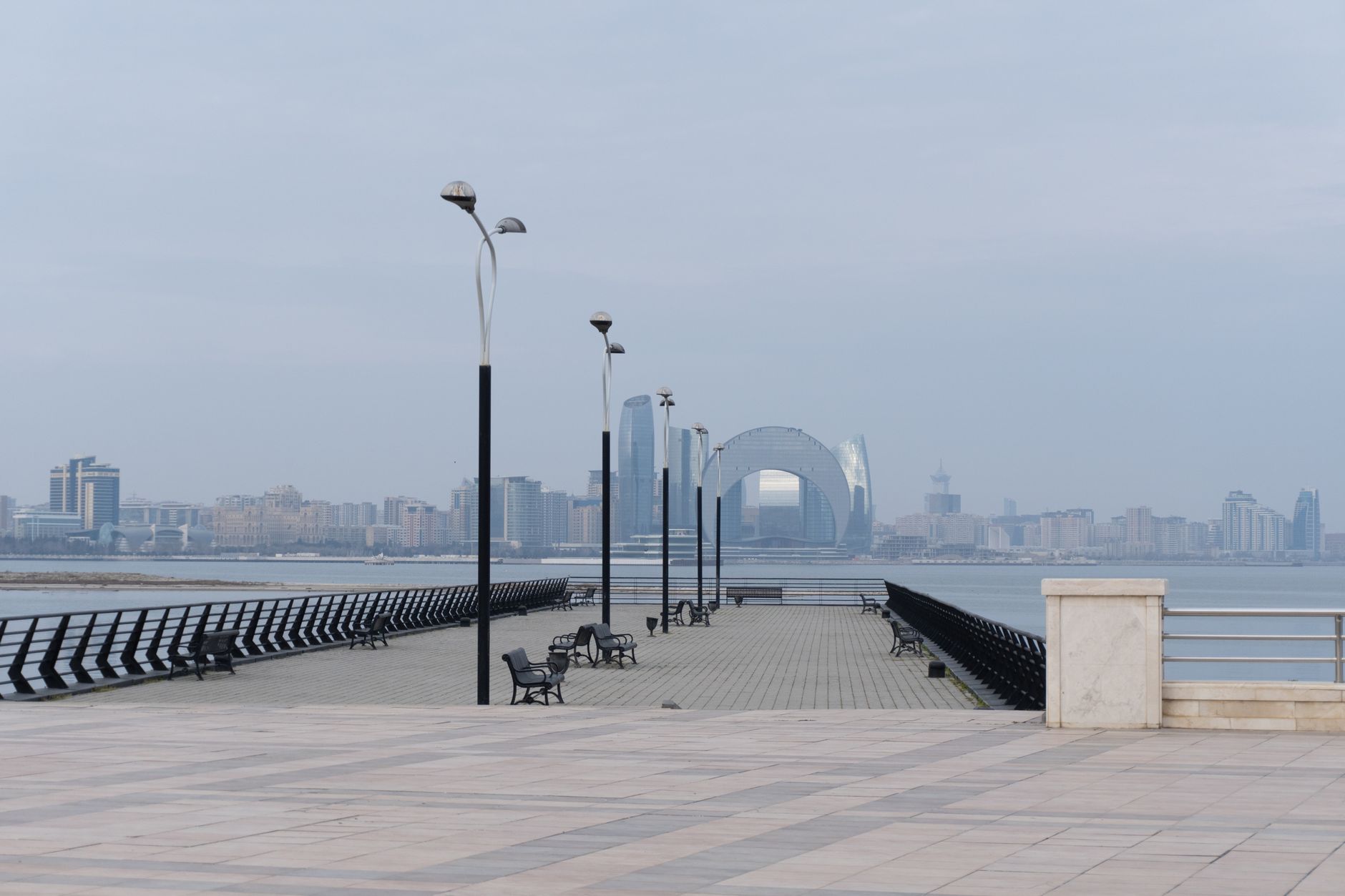
Baku is where oil-boom stone facades, Shirvanshah history, and futuristic towers meet the Caspian wind. Few capitals shift from caravanserai to starchitect skyline this quickly.
Sheki, Ganja, and Shamakhi carry the merchant routes, dynasties, and literary memory that shaped the Caucasus. You feel the old trade networks in caravanserais, palace walls, and market streets.
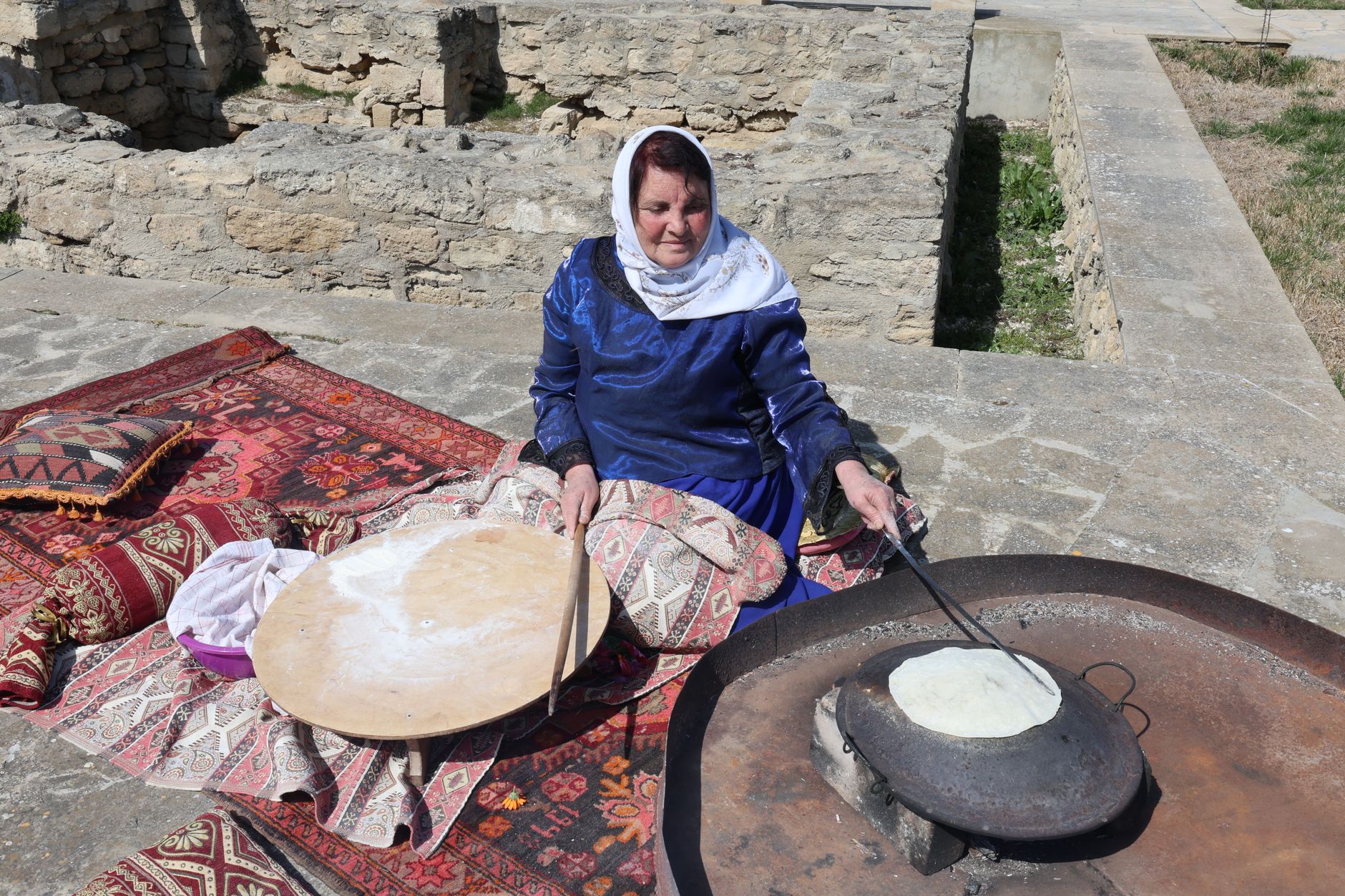
Azerbaijani cooking prefers contrast over brute force: saffron rice, sour plum, herbs, yogurt, walnuts, smoke. Tea is not an accessory here; it is how hospitality begins.
Quba, Khinalig, Ilisu, and Lahij pull you into mountain Azerbaijan, where roads twist upward into stone villages, workshops, and sharp changes in climate. The scenery earns the detour.
Gobustan makes the country’s oldest layers visible through petroglyphs, mud volcanoes, and a landscape that still feels geologically unfinished. Azerbaijan’s nickname, the Land of Fire, starts to make sense here.
12 cities — start with the ones we'd send you to first.
A medieval walled city, a Soviet boulevard, and three flame-shaped towers that burn at night — all within walking distance of each other on the Caspian shore.
Caravanserai walls thick enough to muffle the 21st century, stained-glass windows called shebeke fitted without glue or nails, and a piti stew that arrives in two acts.
Azerbaijan's second city carries a quieter pride: the poet Nizami was born here in the 12th century, and the plane-tree avenues still feel like they belong to a place that considers itself a literary capital.
A town split by the Qudyalçay River, with a Jewish settlement called Qırmızı Qəsəbə on one bank — the largest rural Jewish community in the former Soviet Union, still intact and largely unvisited.
Subtropical lowland pressed between the Talysh Mountains and the Caspian, where the tea plantations are real and the bazaar smells of fresh coriander and salted fish at seven in the morning.
The old Albanian capital Qabala sat somewhere under these forested hills; today the town is a base for reaching waterfalls and the kind of mountain air that makes lowlanders feel mildly fraudulent.
Six thousand petroglyphs on a plateau south of Baku, including a Latin inscription left by a soldier of the Twelfth Thunderbolt Legion under Domitian — a Roman graffito at the edge of the known world.
A cobblestone village in a river gorge where coppersmiths still work the same alloys their ancestors traded along the Silk Road, and the smell of hot metal follows you down every lane.
An exclave cut off from the rest of Azerbaijan by Armenia, with a mausoleum for the prophet Noah that locals will point to with complete seriousness, and a alabaster tomb for the poet Imadaddin Nasimi.
Baku is where Azerbaijan shows its contradictions without apology: medieval walls, oil-boom mansions, Soviet mass, and flame-shaped towers staring at the Caspian. The wider Absheron Peninsula adds fire temples, salt air, and wind that can turn a short walk into a wrestling match with your coat.
Sheki sits in the green fold below the Greater Caucasus and still feels like a trading town that never quite stopped receiving caravans. This is the Azerbaijan of palace stained glass, earthen-pot stews, walnut sweets, and road trips that end with a guesthouse table instead of a checklist.
Ganja has weight. Nizami Ganjavi's name is everywhere, and the city carries itself with the confidence of a place that knows it mattered long before modern Baku took the spotlight. West of the capital, distances open out, parks get larger, and the rhythm becomes less Caspian, more inland Caucasus.
Quba is the practical base for the dramatic northeast, where orchards, river valleys, and mountain roads climb toward Khinalig. The appeal here is not polish. It is the feeling of leaving the smooth national story behind and entering a landscape where weather, language, and transport all become more local.
Lankaran belongs to a different Azerbaijan: humid, subtropical, and scented with tea rather than dust. The food turns darker and richer here, especially lavangi, and the road south feels closer to northern Iran than to the stone-and-wind mood of Baku.
Nakhchivan is cut off from the rest of Azerbaijan and feels that way in the best possible sense. Mausoleums rise from bare ground, medieval brickwork survives in improbable condition, and the whole region has the spare, self-contained character of a place forced to invent its own center.
From prehistoric rock art to post-Soviet statehood, a history written in flame, poetry, oil, and contested borders.
The cave complex near today's Karabakh region preserves evidence of very early human presence, later made famous by Paleolithic finds and a Neanderthal jaw fragment. Azerbaijan begins not with a palace but with deep habitation and difficult stone.
Across thousands of years, people carved hunters, boats, animals, and dancers into the rock south of modern Baku. Those images still make Gobustan feel less like an archaeological site than a conversation nobody ever really ended.
An inscription from Legio XII Fulminata appears on the Caspian rocks during the reign of Domitian. Rome reached the edge of this world, looked around, and did what empires do: it wrote its name into the landscape.
Caucasian Albania becomes one of the earliest Christian realms in the region under King Urnayr. Faith here was never only private belief; it was diplomacy, alignment, and a wager on survival.
Arab power folds the old kingdom into a new political and religious order. Yet older languages and Christian communities do not vanish at once, which is why the region's past remains layered rather than replaced.
A local dynasty emerges in Shirvan and will endure, in one form or another, for centuries. Their longevity matters almost more than any single battle; they became specialists in surviving stronger neighbors.
One of the great poets of the Persian literary world is born in Ganja. His work would give the region cultural prestige that outlasted dynasties, invasions, and ideological campaigns.
With this retelling of doomed love, Nizami turns an Arabic legend into one of the classic texts of Persian literature. The emotional authority of the work still clings to Ganja's name.
The Mongol advance tears through the Caucasus and forces local rulers into submission, negotiation, or ruin. Azerbaijan learns again that survival often belongs to those who bend before they break.
The court complex in Baku takes shape as a seat of ceremony, devotion, and dynastic memory. Its stone still carries the confidence of rulers who understood architecture as political theater.
The teenage conqueror enters Tabriz and creates a new imperial order that reshapes the region's religious and political identity. Azerbaijan moves from local dynastic patience into the furnace of Safavid ambition.
As central authority fragments, regional khanates such as Baku, Sheki, Quba, Ganja, and Nakhchivan assert themselves. Power becomes personal again, measured in fortresses, marriages, and hurried alliances.
In Sheki, stained glass, painted walls, and courtly elegance survive as proof that refinement can flourish in a dangerous century. The palace is lovely, but it was never built in innocence.
After war with Qajar Iran, Russia gains major territories in the South Caucasus. Borders begin hardening into imperial fact, though families and memories remain inconveniently fluid.
A second treaty confirms Russian dominance north of the Aras and fixes a frontier whose emotional consequences outlast its diplomats. Azerbaijan's modern geopolitical shape begins to emerge under outside pressure.
Reforms in the oil sector unleash a spectacular rush of capital, labor, and speculation. Baku becomes one of the great petroleum cities of the world, smelling of fuel and possibility.
By the start of the 20th century, Baku produces more than half of global oil. Mansions, philanthropy, worker unrest, and urban swagger all follow, because money of that scale never travels alone.
Azerbaijan declares independence and becomes the first secular parliamentary republic in the Muslim world. Its life will be brief, but its symbolism remains stubbornly alive.
The republic extends suffrage to women before several European states do the same. For a short moment, political modernity in Baku outruns the complacent certainties of the continent.
Soviet power ends the first republic and folds Azerbaijan into a new ideological empire. Dreams of parliamentary pluralism yield to party rule, central planning, and a different style of political theater.
During the Second World War, Azerbaijan's petroleum becomes indispensable to the Soviet Union. Hitler wants the fields; Stalin cannot afford to lose them; the city becomes strategic destiny in industrial form.
As the Soviet Union collapses, Azerbaijan re-emerges as a sovereign state. Independence arrives with elation, but also with war, institutional fragility, and the sudden weight of unfinished national questions.
A major energy agreement with international companies anchors the post-Soviet state in global petroleum markets. Wealth, diplomacy, and political centralization begin to move together with new intensity.
Military victory brings official celebration, private mourning, and a new map of control. The war changes not only territory, but the emotional weather of the country.
Fire Sanctuaries and Caucasian Albania
King Urnayr was not a marble saint but a ruler making a risky conversion in a neighborhood where every empire expected obedience.
A Roman soldier once stood among the rocks of Gobustan, looked at carvings already ancient beyond counting, and scratched his own presence into stone. His Latin inscription, left by Legio XII Fulminata under Domitian between 84 and 96 CE, is still there: a small act of vanity on a Caspian shore where hunters, boats, bulls, and dancing figures had been cut into the rock across millennia. Ce que l'on ignore souvent, c'est que Azerbaijan enters history not with a dynasty, but with fire itself: gas pushing through stone, flames licking from the earth, and pilgrims reading theology in geology.
That fire shaped belief long before it shaped postcards. Near modern Baku, at Surakhani, the Ateshgah drew worshippers who came for the eternal flame, while Yanar Dag kept burning on the Absheron Peninsula as if the soil had forgotten how to stop. The old Persian name Aturpātakān, linked to the keeping of sacred fire, was not poetic decoration. It was observation. A land where hills could ignite deserved reverence, and perhaps a little fear.
Then came Caucasian Albania, one of those kingdoms that sound invented until the documents begin to pile up. Its rulers balanced Rome, Parthia, and Persia with the nimbleness of people who knew they lived between appetites. King Urnayr, in the 4th century, converted to Christianity around 313 CE, making his realm one of the earliest Christian polities anywhere. That choice was not only pious. It was political, intimate, dangerous, and costly; Urnayr would die fighting the Sasanian Persians.
The capital at Qabala, near modern Gabala, impressed foreign envoys, yet the kingdom's afterlife is quieter than its neighbors'. Its alphabet, 52 letters strong, survived in fragments and scholarly detective work. Its church was gradually absorbed after the Arab advance, but not entirely erased. In the village of Nij, the Udi community kept echoes of that world alive, a reminder that empires conquer faster than memory yields.
And this is the first great Azerbaijani pattern: nothing arrives alone. Fire becomes ritual. Ritual becomes politics. Politics becomes survival. By the time Arab armies came through the Caucasus in the 7th century, this land already knew how to live with layered loyalties, and that talent would define everything that followed.
The Roman inscription at Gobustan was carved beside petroglyphs thousands of years older, as if one bored legionary insisted on joining a conversation already 35,000 years in progress.
Shirvanshahs, Poets, and Silk Road Courts
Nizami Ganjavi, so often treated as a monument, was in truth a private man whose greatest epics carry the bruise of personal bereavement.
Picture Shamakhi on a trading day: bolts of silk, caravan dust, a money changer weighing silver, and somewhere behind a courtyard wall a court secretary drafting letters that might calm one neighbor and provoke another. This was no provincial backwater. It was a city of merchants and shocks, rich enough to tempt invaders and refined enough to produce poets who still rearrange the emotional furniture of the Persianate world.
The Shirvanshah dynasty understood duration better than spectacle. They ruled much of northern Azerbaijan for roughly nine centuries, which is a polite way of saying they survived what should have destroyed them: Arab rule, Seljuk pressure, Mongol thunder, Timurid violence, and the general bad manners of medieval geopolitics. In Baku, the Palace of the Shirvanshahs still carries that memory in stone. Audience halls, mosque, mausoleum, bathhouse: government, prayer, burial, and comfort all gathered within one courtly grammar.
But dynasties are not the whole story. Ganja gave the wider world Nizami Ganjavi, born around 1141, who wrote some of the greatest narrative poetry in Persian and appears to have lived a life almost comically unsuited to literary celebrity. He did not spend decades fluttering from court to court. He stayed close to home. He wrote of lovers, kings, and Alexander the Great, and when his wife Afaq died young, grief entered the poems with him. That is often the truth beneath literary grandeur: a man alone with loss and an ink pot.
Ce que l'on ignore souvent, c'est that the region's brilliance was made in rooms, not battlefields. Scribes, poets, patrons, craftsmen, scholars, and merchants gave medieval Azerbaijan its texture. Even the great courts depended on such private labor. A ruler could commission a mausoleum. Only an artisan could make it memorable.
The end came with theatrical force. In 1500, Farrukh Yassar, the last Shirvanshah of real consequence, was defeated and killed by Shah Ismail I. One world of cautious local monarchy yielded to another, fiercer one: charismatic, messianic, imperial, and unmistakably Azerbaijani in its own origins.
A persistent literary tradition claims Nizami once agreed to dedicate a poem only after a local lord freed an enslaved man he had singled out by name.
Safavid Splendor, Khanates, and Imperial Encirclement
Shah Ismail I was the sort of founder history adores and ordinary people must endure: poet, conqueror, mystic, and architect of a state too large to stay tender.
He was barely fourteen when he entered Tabriz in 1501, victorious, adored, and frighteningly certain of his destiny. Shah Ismail I, founder of the Safavid Empire, did not merely win a throne; he recast the political and religious fate of the region. Azerbaijani Turkic was the language of his household and poetry, Persian the language of administration, Shi'i devotion the creed of state. In his person, one sees Azerbaijan's old habit of holding several worlds at once, though never gently.
The Safavid centuries left marks in doctrine, trade, and taste. Shi'ism deepened as public identity. Court culture flourished. Yet imperial grandeur always had a local underside: taxes, rival clans, ambitious governors, and the exhaustion that follows military glory. When the Safavid structure weakened in the 18th century, Azerbaijan did what fractured frontiers often do. It multiplied into khanates. Baku, Sheki, Quba, Ganja, Karabakh, Nakhchivan: each became a court, a fortress, a bargaining table.
This is where the story becomes deliciously human. Khanates were not abstract territorial units. They were families with grudges, cousins with claims, mothers arranging alliances, treasuries running low, and rulers pretending confidence they did not always feel. In Sheki, the khans built a summer palace whose stained glass and painted walls still suggest a life of cultivated pleasure lived under permanent threat. Beauty, here, was not innocence. It was defiance.
Then the Russian Empire arrived with maps, artillery, and treaties designed to settle what armies had made messy. The wars with Qajar Iran ended in two decisive documents, Gulistan in 1813 and Turkmenchay in 1828, which transferred large parts of the South Caucasus north of the Aras into Russian control. Borders hardened. Families found themselves on the wrong side of new lines. Old loyalties did not vanish, but empire now had a bureaucracy.
And so another Azerbaijani era closed the way these eras often do: not with a clean replacement, but with overlap. Persian memory remained. Turkic speech remained. Shi'i ritual remained. Yet Russian power set the stage for oil, modern nationalism, and the astonishing reinvention of Baku.
Ismail wrote lyric poetry under the pen name Khatai, which means the empire's fearsome founder also left behind verses intimate enough to be whispered rather than proclaimed.
Oil Barons, Republics, and Soviet Shadows
Haji Zeynalabdin Taghiyev knew money alone never wins affection, so he spent his oil fortune turning Baku into a city that could educate its daughters as well as flatter its millionaires.
Stand in Baku in the late 19th century and imagine the smell first. Not roses. Oil. Kerosene, salt air, hot metal, wet stone, and money arriving at vulgar speed. By 1901, the city produced more than half the world's oil. Fortunes exploded almost overnight, and with them came mansions, theatres, schools, philanthropy, vanity, and scandal in the proper proportions. The Taghiyevs, the Nobel brothers, the Rothschild interests, Armenian and Azerbaijani industrial families, imperial officials, European engineers: Baku became a boomtown dressed as a capital before it was one.
One man embodied the age better than most. Haji Zeynalabdin Taghiyev began with almost nothing, made a colossal fortune in oil, and then spent it with a princely instinct for legacy. He financed schools, including a pioneering Muslim girls' school in Baku, and supported newspapers, theatres, and charitable work. He also built himself a palace. Naturally. Philanthropy and self-display are old companions.
The empire that housed this splendor did not last. After the Russian Revolution, Azerbaijan declared the Azerbaijan Democratic Republic on 28 May 1918, the first secular parliamentary republic in the Muslim world. It lasted less than two years. But what years. Universal suffrage, including for women before several European states managed the same, a parliament of multiple parties and communities, and the intoxicating belief that a new political language might be possible between empire and dogma.
The Red Army ended that experiment in April 1920. Soviet rule remade the country with the usual mixture of literacy campaigns, industrial might, censorship, terror, careerism, and social mobility. Azerbaijan became essential again during the Second World War, when Baku's oil fed the Soviet war machine. Hitler wanted the city. Stalin needed it. The people who lived there, one suspects, would have preferred less attention from history.
Yet Soviet power, for all its monuments and ministries, never erased the deeper grain. Old urban identities survived in courtyards and kitchens. In Ganja, Sheki, Lankaran, and Baku, family memory kept running beneath official slogans. When the Soviet Union weakened, the old question returned with fresh urgency: what should Azerbaijan be when nobody else names it first?
The Azerbaijan Democratic Republic granted women the vote in 1918, ahead of France, Italy, and several other European countries that later liked to lecture the region on modernity.
Independence, War, and the State of Contrasts
Heydar Aliyev grasped earlier than most that post-Soviet power would depend as much on choreography and control as on ideology.
Independence in 1991 did not arrive with champagne serenity. It arrived amid collapse, war, confusion, and the violent unmaking of Soviet certainties. The conflict over Nagorno-Karabakh quickly became the wound through which everything else was felt: grief, displacement, humiliation, rage, and the hardening of statehood. Whole communities were pushed into motion. Policy became personal because nearly every family knew someone missing, uprooted, or buried.
Heydar Aliyev, the former Soviet strongman who returned to power in 1993, brought a language of stability that many accepted because the alternatives looked worse. His presidency and the succession of Ilham Aliyev in 2003 shaped the state that now presents itself to the world: centralized, polished, ambitious, and deeply invested in image. Ce que l'on ignore souvent, c'est how much of modern Baku is a stage set built on very real insecurity. The Flame Towers glitter. The old wounds do not.
Oil and gas funded that new confidence. Boulevards widened. Museums rose. International events arrived. The skyline changed so quickly that parts of Baku can feel like three cities arguing at once: medieval limestone, Soviet geometry, and 21st-century spectacle. But travel beyond the capital to Sheki, Quba, Lahij, Khinalig, or Lankaran and another Azerbaijan appears, one less interested in performance and more in continuity, where tea, craft, orchard, shrine, and mountain road still carry the weight of belonging.
The 2020 war altered the national mood again, bringing military victory, mourning, and a fresh chapter of reconstruction and dispute. Official triumph sits beside private loss. That tension matters. A serious history cannot flatter the regime, but neither can it pretend the people's emotions are simple. Pride and sorrow often share the same table here.
What comes next will not be written by pipelines alone. It will be written in how Azerbaijan balances memory with power, and in whether the country can allow its many inheritances to coexist without forcing one to silence the others. That has always been the real drama.
Modern Baku's most futuristic skyline rises within easy reach of districts where tea is still served in armudu glasses according to habits older than the oil boom.
Azerbaijani does not enter the room alone. It brings Turkic syntax, Persian memory, Russian habits, and a talent for politeness that can make a simple greeting feel upholstered. In Baku, you hear this at once: a sentence with soft vowels, then a Russian loanword standing in it like a Soviet sideboard nobody threw away because it was too useful.
The distinction between "sən" and "siz" matters because grammar here still believes in ceremony. Use "siz" with elders, strangers, shopkeepers, anyone whose name you do not yet deserve; add "bəy" or "xanım" and the sentence straightens its back. A country is a table set for strangers.
Then come the words that refuse export. "Qonaqpərvərlik" gets translated as hospitality, which is insulting in its thinness: the Azerbaijani word contains duty, vanity, household honor, and the fierce pleasure of feeding someone until they stop pretending they are full. "Həsrət" is longing without opera. "Pir" is shrine, vow, hillside, rumor, and hope condensed into one noun. Languages reveal what a people decided was too important to leave vague.
Azerbaijani cuisine distrusts chaos. The great lesson arrives with plov, where saffron rice and garnish are cooked apart and served apart, as if the table were a place for diplomacy rather than conquest. In Ganja or Sheki, you understand this in one spoonful: lamb, chestnuts, dried apricots, sour plum, separate grains, each component keeping its dignity until your mouth performs the union.
Sourness is treated here with the respect other countries reserve for butter. Dried cornelian cherry, plum paste, pomegranate, yogurt, sumac, green herbs by the fistful: these are not accents but arguments. Even comfort has an edge. Especially comfort.
And then the south changes the register. In Lankaran, lavangi stuffs chicken or fish with walnuts, onion, and tart fruit paste until dinner tastes like an autumn orchard that learned to speak Persian. In Baku, dushbara turns domestic labor into bragging rights, each tiny dumpling floating in broth like a piece of edible calligraphy. Good food here does not shout. It arranges its evidence.
Azerbaijan inherited a literary culture that likes silk and blade in the same hand. The patron saint of this temperament is Nizami of Ganja, who wrote in Persian, stayed close to home, and managed to produce epics grand enough for kings without sounding impressed by kings. His stories adore love, but never the simple version; desire in Nizami is always intelligent enough to suffer from its own intelligence.
That old prestige of language never quite disappeared. Even outside libraries, people quote verse with less embarrassment than Western Europe now permits itself, and mugham singers still handle text as if words possessed temperature. In a tea house in Baku, a line of poetry can appear between two remarks about traffic and be accepted as perfectly practical. It is practical. It tells you what mood the room has chosen.
This is what I like most: literature here does not sit on a shelf pretending purity. It leaks into toasts, laments, songs, school memory, family pride, and the way longing gets spoken aloud. In many countries, poetry survives despite daily life. In Azerbaijan, it survives by contaminating it.
Mugham is what happens when music decides that a scale is too small for sorrow. The form is modal, improvised within discipline, and carried by a singer whose job is not to decorate emotion but to interrogate it until it confesses. Listen in Baku and the first sensation is not melody. It is tension, a line held so long it begins to feel architectural.
The instruments are accomplices. The tar glitters and cuts. The kamancha weeps without self-pity. The daf keeps time the way a pulse keeps faith. UNESCO can classify mugham if it wishes; classification is one of the things bureaucracies do when they encounter mystery and need to file it before going home.
Yet the strange miracle is how naturally this music coexists with everyday life. One minute you are in traffic on Neftchilar Avenue, watching glass towers reflect the Caspian like expensive lies; the next, a singer bends a phrase that seems older than oil, older than empires, older perhaps than the vanity of thinking a country has one soul instead of several. Mugham does not resolve a nation. It makes the contradiction audible.
Hospitality in Azerbaijan begins before conversation and, in a sense, replaces part of it. Tea arrives first in an armudu glass, pear-shaped and elegant enough to make your fingers behave. Sugar may be bitten, jam may appear, dried fruit may follow, and only after this choreography has begun does the meeting become real.
The important detail is pace. You do not rush tea, and you do not hurry toward the point as if human company were an administrative error. In Baku business offices, in homes in Sheki, in roadside stops on the way to Quba, this remains true with impressive stubbornness. Modernity came. The kettle stayed.
Refusal also has manners. A blunt no exists, of course, but social life often prefers softer instruments: delay, diversion, another pour, a smile that changes the subject without humiliating anybody. This can puzzle visitors trained in northern European directness. They mistake courtesy for vagueness. It is the opposite, actually. The form protects the people inside it.
Azerbaijani architecture behaves like a family archive with poor self-control. In Baku, a 19th-century oil baron mansion in honey-colored limestone may stand a few minutes from a hard Soviet facade, while the Flame Towers rise above both like a futuristic joke told with a straight face. The city has not chosen one century to love. It courts all of them at once.
This layering becomes more intimate outside the capital. In Sheki, carved wooden shebeke screens turn light into geometry and privacy into ornament, proving that a window can be both wall and lace. In Lahij, stone lanes and coppersmith workshops still share the same choreography of craft, each threshold seeming to understand exactly how many centuries of hammering it has heard.
Then Azerbaijan remembers fire. Gobustan keeps its prehistoric marks scratched into stone south of Baku, while the Absheron peninsula preserves the old marriage between geology and belief that made flames sacred long before energy firms learned to monetize them. Architecture here is not only about buildings. It includes the mountain village of Khinalig clinging to altitude, the shrine, the caravan route, the courtyard, the oil boom balcony, the Soviet staircase, the gas-fed horizon at dusk. A nation built on seepage was never going to be tidy.
Urnayr matters because he made Christianity a state choice in the Caucasus when that choice could still get a ruler killed. He stands at the beginning of Azerbaijan's habit of living between stronger neighbors and making belief serve both conscience and survival.
Ganja gave the Persian-speaking world one of its supreme poets, and he seems to have preferred the discipline of home to the glitter of itinerant court life. His epics are full of kings and lovers, but the pulse beneath them is personal grief, especially after the early death of his wife Afaq.
He conquered like a visionary and wrote verse like a man who wanted intimacy on paper. Azerbaijan remembers him not only as an empire-builder, but as the young firebrand who turned regional energy into a dynasty and Shi'i statecraft into destiny.
He is remembered for the losing end of a turning point, which can be just as revealing as triumph. When Shah Ismail defeated him, a dynasty that had survived for centuries finally gave way, and medieval Azerbaijan closed one of its longest chapters.
Taghiyev understood that oil wealth without public memory is just smoke. He financed schools, including a Muslim girls' school, supported culture, and helped turn Baku from an extraction city into a place with civic ambition and social vanity in equal measure.
Narimanov carried the contradictions of his age in full view: intellectual, reformer, revolutionary, and servant of a system that narrowed what it had promised to liberate. Through him, one sees how Azerbaijani modernity often arrived tied to ideologies that demanded obedience in return.
Rasulzade is the face of the republic that flickered and vanished too quickly to grow old. His famous line, often paraphrased as 'The flag once raised will never fall,' still carries the emotional charge of 1918, when independence felt both fragile and inevitable.
Natavan brings aristocratic grace with none of the emptiness that phrase usually suggests. A poet, patron, and noblewoman, she reminds you that Azerbaijani history is not only military and masculine; salons, verses, and the intelligence of women shaped it too.
He took mugham, theatre, and European forms and made them speak to one another without flattening either side. In Baku, his work gave sound to a society trying to be modern without becoming unrecognizable to itself.
This is the compact first trip: windblown Caspian capital, prehistoric rock art in Gobustan, and the older mosque-and-wine-country layer around Shamakhi. It works if you want history without long transfers and gives Baku enough time to feel like more than an airport layover.
Start in Ganja for poetry, plane trees, and one of the country's strongest historical identities, then move east into the green foothills of Gabala before finishing in Sheki and Ilisu. The route makes sense by rail and road, and the food gets better the farther into the northwest you go.
This trip trades monuments for altitude, craft, and road drama. Use Baku as the flight base, then head north to Quba and Khinalig before cutting into Lahij for copper workshops, stone lanes, and one of the most memorable village settings in the country.
This is the longer, stranger Azerbaijan: tea-country humidity in Lankaran, then the disconnected exclave of Nakhchivan with its mausoleums, salt-mine cure folklore, and severe landscapes. It asks for more planning and at least one domestic flight, but it rewards travelers who want a country to get less predictable as it goes on.
Lunch, feast, wedding table. Rice first, garnish after: lamb, chestnuts, dried apricots, sour plum. Family hands, slow spoons, black tea later.
Sheki morning or cold-day lunch. Earthen pot, broth over torn bread first, solids after. Two stages, one bowl, no haste.
Baku family table, winter, guests. Tiny dumplings in broth, vinegar on the side, spoons measuring household pride.
Street stall, supper, roadside stop. Thin folded dough, herbs or meat or pumpkin, sumac over the top, yogurt nearby, fingers doing the work.
Lankaran table, holiday meal, large family. Fish or chicken pulled through walnut and onion stuffing, tart fruit paste darkening every bite.
Arrival ritual, condolence, matchmaker visit, business pause. Tea first, talk after; jam, lemon, dried fruit, chess, patience.
Afternoon tea, guest tray, gift box on the train. Thin slices, sticky fingers, nuts and syrup, careful chewing because fragility is part of the pleasure.







Most travelers from the EU, US, Canada, the UK, and Australia should apply for the official ASAN e-visa before flying. The standard visa is single-entry, valid for stays up to 30 days, and costs USD 29 in total; if you stay more than 15 days, your hotel or host must register you.
Azerbaijan uses the Azerbaijani manat, written AZN or ₼. Cards work well in Baku, but cash still matters in marshrutkas, village guesthouses, and small cafes in places like Lahij, Khinalig, and Ilisu.
For most travelers, entry is by air through Baku's Heydar Aliyev International Airport, since routine passenger entry by land remains closed. Domestic airports in Ganja, Gabala, Lankaran, and Nakhchivan help once you are inside the country, but Baku is still the main long-haul gateway.
Trains are better than old guidebooks suggest, especially on the Baku-Gabala and Baku-Ganja corridors, and the sleeper toward the northwest saves a hotel night. For short regional hops, buses, shared taxis, and Bolt in Baku usually make more sense than renting a car unless you are heading into mountain roads around Quba or Gobustan.
Azerbaijan packs dry Caspian coast, humid southern lowlands, and snowy Caucasus heights into one small map. Baku works well in spring and autumn, Lankaran stays greener and wetter, and mountain villages such as Khinalig and Ilisu can feel like a different season entirely.
Mobile data is easy to arrange with a local SIM or eSIM, and coverage is solid in cities including Baku, Sheki, Ganja, Quba, and Lankaran. In higher mountain areas, expect weak signals, slower data, and guesthouse Wi-Fi that works best when nobody else is trying to upload videos.
Azerbaijan is generally manageable for travelers who use normal city caution, book official transport, and keep passport and registration details handy. The real practical risks are road discipline, sudden weather shifts in the mountains, and border or regional access rules that can change faster than guidebooks do.
Carry low-denomination manat notes for minibuses, village shops, tea stops, and drivers who suddenly discover the card machine is only decorative. Outside Baku, cash saves time more often than it saves money.
Rail works well on the main corridors, especially Baku-Gabala and Baku-Ganja, and sleeper services can cut one hotel night. For Gobustan, Lahij, Khinalig, and much of the south, road transport is still the real network.
If you remain in Azerbaijan for more than 15 days, registration is required. Hotels usually handle it without fuss; apartment hosts and smaller guesthouses sometimes do not, so ask on arrival rather than on day fourteen.
When tea appears, slow down. In Azerbaijan it is part welcome, part social contract, and brushing past it too quickly can feel colder than you intended.
For Khinalig and some roads around Lahij or Ilisu, a local driver with the right vehicle is often the sensible choice. The cost looks higher upfront, but it buys time, phone coverage when yours drops out, and someone who knows which bends wash out after rain.
Book early for Sheki, Gabala, and Lankaran on summer weekends and public holidays. Domestic demand spikes fast, and the good mid-range places disappear before the luxury hotels do.
Use 2GIS or offline Google Maps before leaving city coverage. That matters in mountain villages, but it also helps in Baku when bus routes and street names do not quite match what the app promised.
Explore Azerbaijan with a personal guide in your pocket
Audio guides for 1,100+ cities across 96 countries. History, stories, and local insight — offline ready.
Usually yes, and the normal answer is the ASAN e-visa obtained before travel. For most EU, US, Canadian, British, and Australian passport holders, it is a single-entry visa for stays up to 30 days, so build that admin into your planning rather than hoping for airport improvisation.
No for routine passenger entry, so most travelers should plan to arrive by air. That makes Baku the practical gateway even if your real trip is headed onward to Sheki, Lankaran, Quba, or Nakhchivan.
Baku is enough for three busy days, but not enough to understand the country. Add at least one contrast stop such as Gobustan, Shamakhi, Sheki, or Quba and Azerbaijan starts making more sense.
For Gabala, train is one of the easiest options if the schedule fits your dates; for Sheki, most travelers mix rail or sleeper service with road transport. A private driver costs more, but it saves time if you want to stop in Shamakhi or Lahij on the way.
Use both, because the country runs on a split system. In Baku you can pay by card often enough to get lazy, but in small towns, taxis, local markets, and mountain areas, cash still solves problems faster.
No, not by European capital standards, though Baku hotels can climb sharply during events and summer weekends. A careful traveler can manage on roughly 45 to 80 AZN a day, while mid-range comfort usually lands between 120 and 220 AZN.
April to June and September to October are the safest bets for mixed itineraries. Summer works for mountains such as Khinalig and Ilisu, while winter is better if you mainly want Baku, lower prices, and fewer people in the old city.
Generally yes, especially in Baku and the main tourist corridors, provided you use ordinary urban caution. The bigger practical issues are transport standards, mountain weather, and keeping your visa and registration paperwork in order.
Last reviewed