Salzburg
Austria Verified Apr 2026
Church bells ricochet off the cliffs in Salzburg, Austria, and then a surfer appears on a standing wave in an old canal as if the city has decided piety and mischief belong together. That contrast is the point. You come for the Baroque domes, the fortress on the ridge, the Mozart mythology, and stay because Salzburg keeps slipping out of its postcard frame.
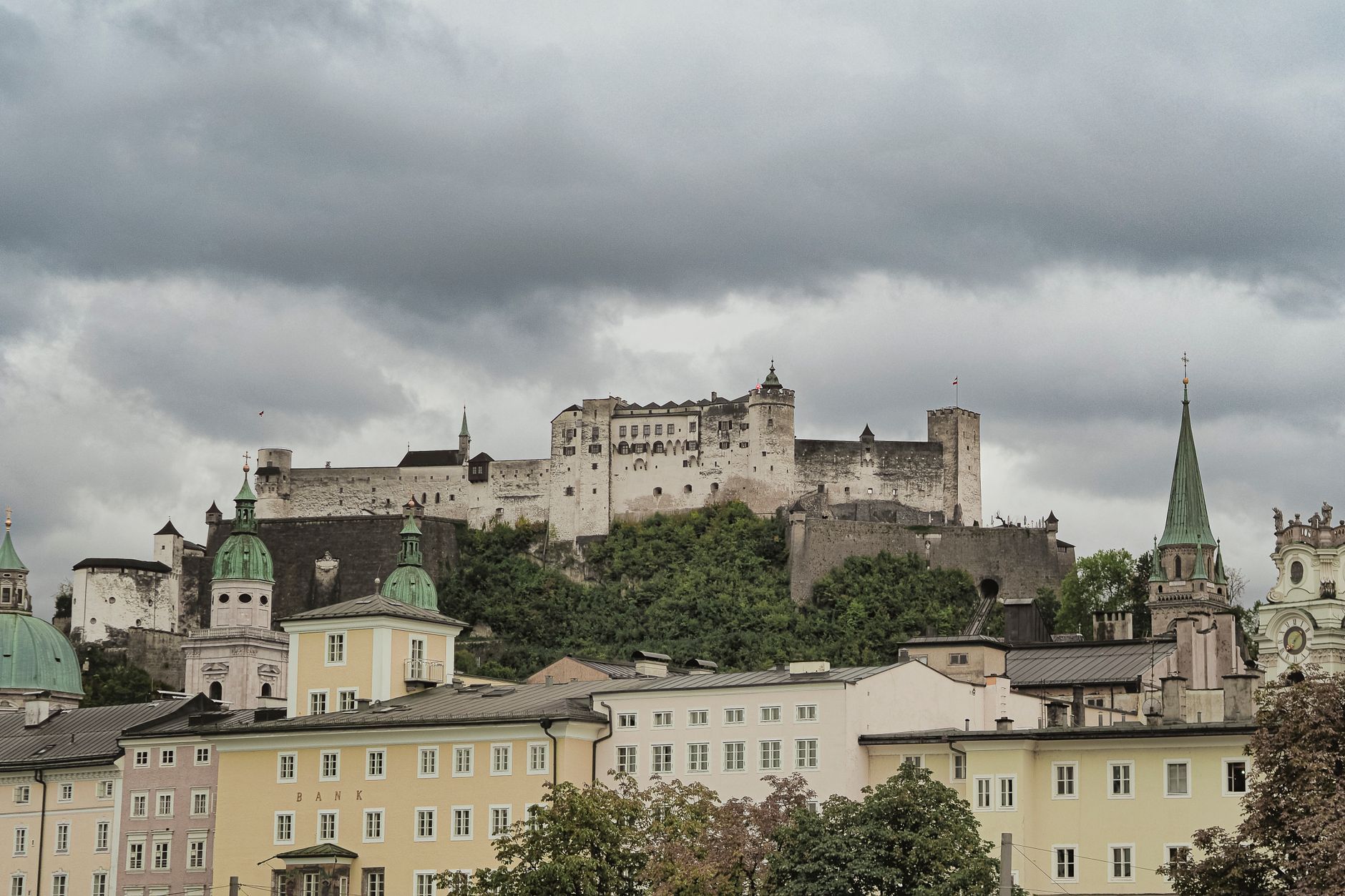 Photo: Laura Chouette / Pexels
- Attractions
- 10
- Trip length
- 2-3 days
- Best season
- Late spring to early fall (May-September)
Why Salzburg
Built from cited sources · see the method · How we make our guides →
Salzburg makes sense once you stop treating it as a museum and start reading it as a power statement. For centuries the prince-archbishops ran this place like a small ecclesiastical state, and the stone still shows it: Santino Solari's cathedral front, the ceremonious sweep of Residenzplatz, the long shadow of Hohensalzburg Fortress, first begun in 1077, holding the whole composition in place.
But the city isn't all staged grandeur. Getreidegasse narrows above your head like a medieval funnel, iron guild signs creak over the lane, and a quick turn into a courtyard can bring you to a locksmith's workshop or a café that smells of butter, coffee, and wet coats in winter. Cross the Salzach and the mood shifts again: less ceremony, more lived-in rhythm, with steep lanes, beer halls, and forested hills that start almost at the edge of the pavement.
What moves people here isn't just beauty. It's the tension between Italian theatricality and German restraint, between monastery silence and festival spectacle, between the polished Old Town and the rougher edges on streets like Steingasse after dark. Salzburg looks perfectly composed from afar; at walking pace, it feels stranger, funnier, and much more alive.
Fortress Over Everything
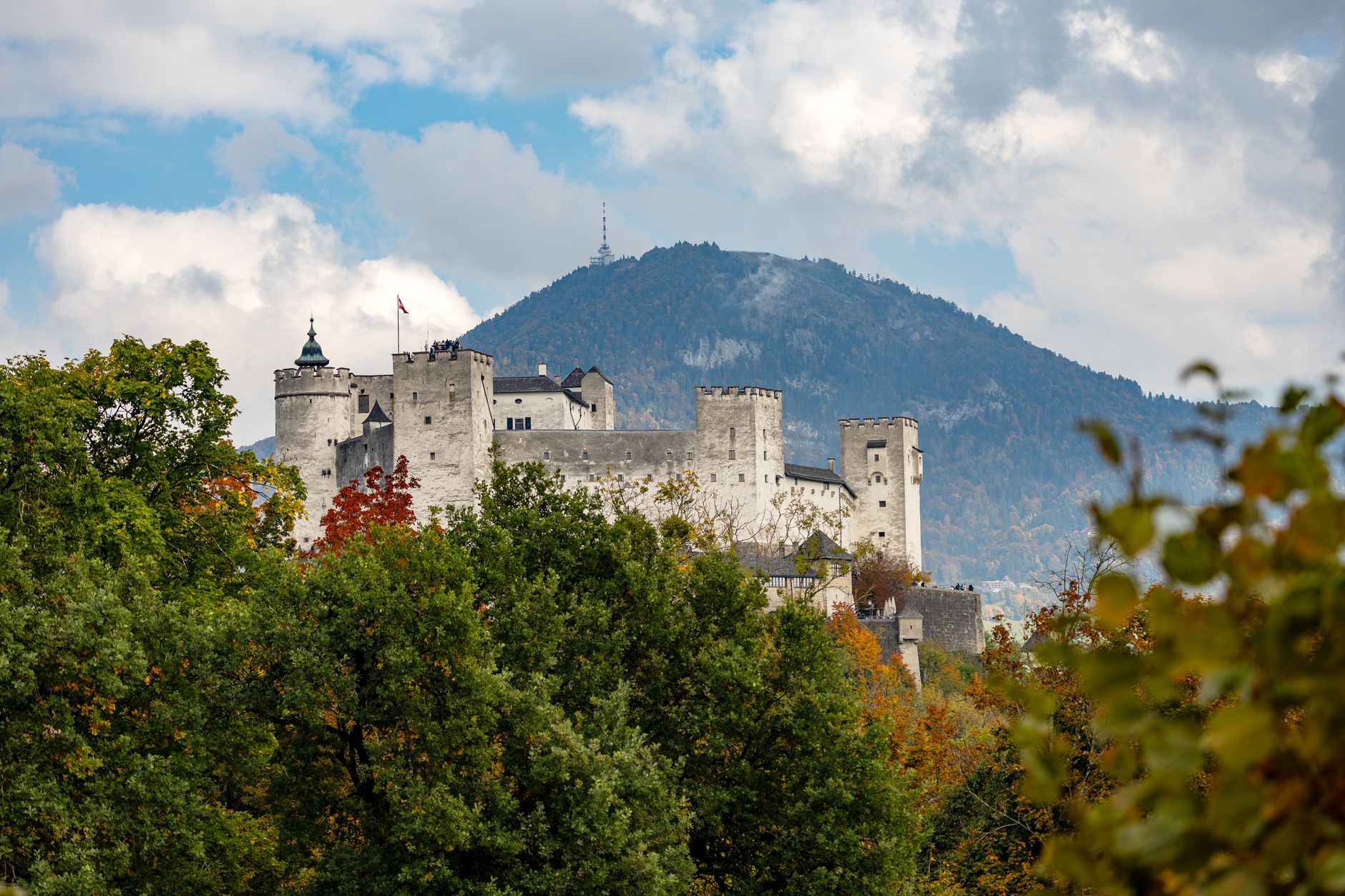
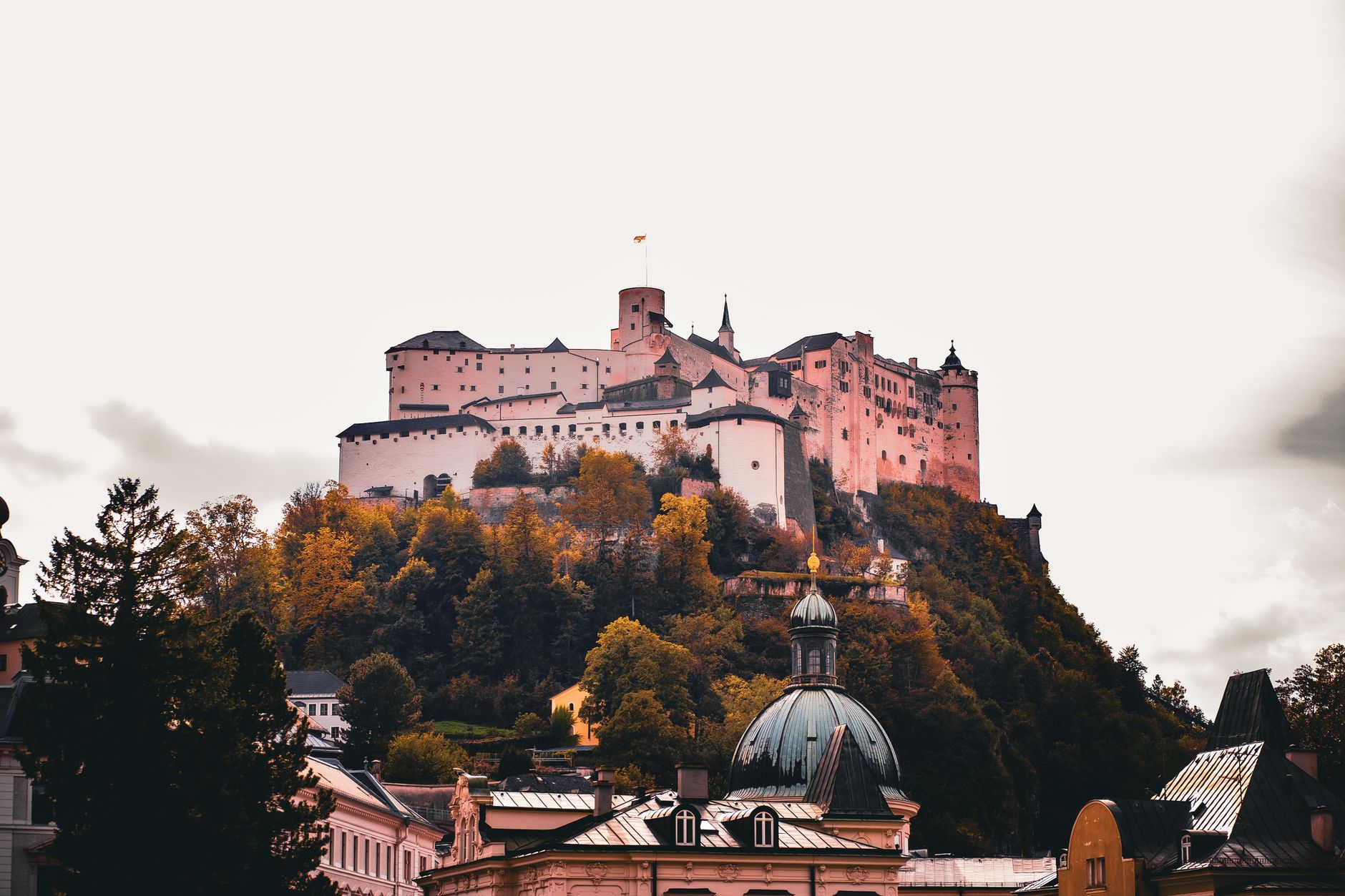
Hohensalzburg Fortress has watched the city since 1077, less a ruin than a stone statement of princely power. Take the 1892 funicular or walk up; either way, the reward is the same sharp shock of red roofs, green domes, and Alpine walls closing the horizon.A Baroque City-State
Salzburg makes more sense once you see it as a former church-run state, not a pretty backdrop for Mozart souvenirs. DomQuartier, the cathedral terraces, and the tight old burghers' streets show how Italian Baroque ambition collided with German town planning and somehow came out graceful.Hills, Not Just Squares
The secret is vertical: Mönchsberg for big-picture views, Kapuzinerberg for forest paths and a quieter mood, Untersberg when you want the city to fall away completely. Even the riverbanks feel staged by geography, with the Salzach carrying light straight through the center.Beer With Local Gravity
Augustiner Bräu in Mülln tells you more about present-day Salzburg than another Mozart trinket shop. Stone mugs, wooden barrels, chestnut trees, and long shared tables turn a beer hall into a social ritual.
Neighborhoods
Where to wander, by quarter — each with its own rhythm.
Altstadt
Salzburg's Old Town is the city at full volume: cathedral domes, palace courtyards, church facades, and the crush of Getreidegasse under its wrought-iron signs. This is where you'll find Mozart's Birthplace at Getreidegasse 9, Domplatz, Residenzplatz, St. Peter's precinct, and the lanes that reward anyone willing to step away from the main current and poke through a passageway.Kaiviertel
South of the cathedral axis, the Kaiviertel feels slightly less ceremonial and more intimate, with quiet streets pressed between the cliff and the river. Nonnberg Abbey rises above it, and the walk here carries the smell of damp stone after rain, plus some of the best glimpses of fortress walls looming overhead.Steingasse
Steingasse is one of the oldest streets in Salzburg and one of the few that still keeps a medieval roughness under the polished surface. Vaulted taverns, old facades, and the slope toward Kapuzinerberg give it a darker, more local mood than the parade routes across the river; come at dusk, when the street finally stops posing.Mulln
Mulln is worth your evening more than another overpriced dinner in the center. The Augustiner Brau monastery brewery sets the tone: stone mugs, chestnut-shaded tables, wooden barrels, and a social rhythm that feels local rather than performed, with Mönchsberg rising behind the roofs like a wall of green.Andraviertel
Around Mirabell Palace and the lanes toward Linzergasse, Andraviertel shows Salzburg's lighter side: Belle Epoque facades, cafés, boutiques, concert halls, and a city that still dresses up for music. The gardens draw the cameras, but the neighborhood works best once you push beyond them into the streets where office workers, students, and concertgoers overlap.Riedenburg
West of the Old Town, Riedenburg trades postcard perfection for a residential calm that many visitors miss. Its appeal is practical and atmospheric at once: quieter streets, good access to Mönchsberg walks, and old-school places to eat below the fortress without paying for a view you've already seen all day.Nonntal
Nonntal sits just south of the historic core and feels like the city exhaling. Students, residents, convent walls, and everyday traffic share the space, and the district makes a good base if you want Salzburg with less ornament and easier access to Hellbrunn or the Almkanal surf wave.
Plan your trip
Before you go
- Getting There
- In 2026, Salzburg Airport (SZG) sits about 4 km from the center; Obus line 10 reaches the Old Town in roughly 15 minutes and line 2 reaches Salzburg Hauptbahnhof in about 23. Main rail arrivals use Salzburg Hauptbahnhof, with direct long-distance links including Vienna Airport (VIE) in just under 3 hours and Munich Airport (MUC) connections via Munich Ostbahnhof in about 2.5 hours. Drivers usually arrive via the A1 West Autobahn, the A10 Tauern Autobahn, or the German A8.
- Getting Around
- Salzburg has no metro in 2026; the city runs on Obus trolleybuses, city buses, and S-Bahn lines including S1, S2, S3, S4, and S11. From Salzburg Hauptbahnhof, Obus lines 1, 2, 3, 5, and 6 reach the Old Town in about 10 minutes, while the center itself is easy on foot. A 24-hour core-zone ticket costs EUR 5.20 in advance, the Salzburg Card includes public transport and starts at EUR 35 for 24 hours, and overnight guests in Salzburg province can use the Guest Mobility Ticket for the duration of their stay.
- Climate & Best Time
- Spring runs roughly 3 to 13 C, summer 17 to 18 C on average, autumn 4 to 14 C, and winter about -2 to 0 C. Rain is part of the deal: May through August are the wettest months, with July both the warmest and rainiest, while February is the driest. Late May to June brings long days and festival energy, but September to early October is the smarter pick if you want mild weather and fewer elbows in the Old Town; December is atmospheric and cold, with Christmas-market crowds.
- Language & Currency
- German is the working language, though Salzburg's tourist infrastructure functions comfortably in English, from station services to museum desks. Austria uses the euro, cards are widely accepted, and carrying some cash still helps in smaller cafes, market stalls, and older beer halls. Free public Wi-Fi under the 'Salzburg surft!' network covers spots such as Mozartplatz, Kapitelplatz, Mirabell Gardens, and parts of Getreidegasse.
- Safety
- Salzburg feels orderly, but 2026 common sense still applies around Salzburg Hauptbahnhof, airport bus stops, packed festival nights, and Christmas markets. Watch for pickpocketing and for anyone posing as an official; real police do not need theatrical urgency. Emergency numbers in Austria are 112 for EU-wide emergency, 133 for police, 144 for ambulance, 122 for fire, and 140 for mountain rescue.
Salt, Saints, and Stage Lights
From Celtic salt hill to baroque church-state to festival city
- c. 750 BCE
Salt Makes a Settlement
Most scholars date Salzburg's first fortified hill settlements to around 750 BCE, when Celtic communities held the Mönchsberg, Rainberg, and the Dürrnberg above the valley. Salt paid for the whole thing. White crystals cut from the mountain moved along trade routes like hard currency, and the future city already smelled less of romance than of sweat, wet timber, and mineral dust.
- 15 BCE
Rome Arrives in the Valley
Roman conquest folded the region into Noricum and shifted life from the defensive hills down into the Salzach valley. A town called Iuvavum began to take shape on straighter lines, with baths, shrines, workshops, and the hard geometry Rome liked to stamp onto conquered ground.
- 45
Iuvavum Becomes a Municipium
Under Emperor Claudius, Iuvavum received municipium status and joined the Roman urban club in full legal dress. That meant local self-government, public building, and prestige. Fragments of mosaics and heated rooms later found under the old town hint at a place that liked comfort as much as order.
- 170
Frontier War Burns the City
Marcomannic attacks in 170 and 171 hit Iuvavum hard, leaving parts of the town broken and burned. The Roman frontier no longer felt far away. Smoke, ash, and hurried repairs became part of urban life.
- 488
Rome Pulls Back
After the collapse of Roman power in the region, Odoacer ordered the evacuation of much of Noricum. Many inhabitants left, and urban life shrank to a stubborn remnant around the Festungsberg and Nonnberg. Salzburg did not die, but it went quiet for a while.
- c. 696
Rupert Refounds Salzburg
Duke Theodo of Bavaria handed the ruined site to Bishop Rupert, who saw more than rubble. Rupert restored St. Peter's and laid the foundations of a missionary center that would turn a faded Roman town into a church city with an appetite for land, salt, and influence.
Show the full timeline (30 moments)
- c. 715
Nonnberg Opens Its Doors
Nonnberg Abbey rose above the city as a women's convent tied to Rupert's refoundation. The place still matters because continuity matters: prayers, bells, enclosure, and female religious authority stayed rooted here while dynasties, styles, and borders changed below.
- 774
A Vast Early Cathedral
The first great cathedral was consecrated in 774 under Virgil, a five-aisled church of a scale that startled the north of the Alps. This was Salzburg announcing itself in stone. You can almost hear the echo such a building was meant to produce: liturgy as acoustics, authority as architecture.
- 798
Archbishopric of the Alps
On 20 April 798, Pope Leo III raised Salzburg to an archbishopric at Charlemagne's request. The city stopped being merely local. From here, church power radiated east and south, and Salzburg began its long career as an ecclesiastical capital dressed in incense and politics.
- 1077
Fortress on the Festungsberg
Archbishop Gebhard began Hohensalzburg Fortress during the Investiture Controversy, when bishops had good reason to fear emperors and the reverse. The stronghold still explains the city at a glance. Power in Salzburg was never shy; it put walls on a mountain and made everyone look up.
- 1168
Barbarossa's Punishment Fire
After Salzburg backed the wrong pope in a bitter imperial dispute, allies of Emperor Frederick Barbarossa burned the city. The cathedral and several churches went with it. Medieval Salzburg learned an old lesson then: theology could get you killed, and masonry was political.
- c. 1200
A Prince-Archbishopric Hardens
Under Archbishop Eberhard II, between about 1200 and 1246, Salzburg tightened into a territorial state with real independence inside the Holy Roman Empire. Clergy here did not stay in choir stalls. They taxed, negotiated, built, and ruled like princes because that is what they were.
- 1525
Peasants Besiege Their Prince
During the German Peasants' War, miners, townspeople, and peasants rose against heavy burdens and cornered Archbishop Matthaus Lang in Hohensalzburg. The fortress held. The revolt failed by 1526, but the siege left a sharp memory of how thin the line could be between piety and fury in a church-run state.
- 1541
Paracelsus Dies in Salzburg
Paracelsus spent his final stretch in Salzburg and died here in 1541, leaving behind a reputation equal parts physician, alchemist, and troublemaker. Linzergasse still keeps his ghost better than many cities keep their archives. He fits Salzburg well: learned, theatrical, and unwilling to behave.
- 1587
Wolf Dietrich Reimagines the City
When Wolf Dietrich von Raitenau took power in 1587, Salzburg began turning from a medieval clerical town into a planned baroque capital. Wider spaces, Italian ideas, and courtly ambition pushed against the old fabric. He wanted a stage set for authority, and he mostly got one.
- 1614
The Baroque Cathedral Rises
Construction of the present cathedral began in 1614 under Santino Solari, following plans shaped by Italian architecture and local ambition. Its dome, marble, and controlled theatrical light changed the city's center forever. Stand on Domplatz and you feel the point: Salzburg wanted faith to look expensive.
- 1619
Hellbrunn's Tricks and Power
By 1619, Hellbrunn Palace and its trick fountains were largely complete, built for Archbishop Markus Sittikus as a pleasure ground south of the city. The jokes are hydraulic. Water shoots from hidden jets, benches turn treacherous, and courtly amusement becomes a reminder that someone else controlled the pipes.
- 1756
Mozart Is Born Upstairs
Wolfgang Amadeus Mozart was born on 27 January 1756 in the yellow house at Getreidegasse 9. Salzburg gave him church music, court discipline, and a father determined to exhibit the child to Europe. It also gave him limits, which may have mattered just as much.
- 1803
Church Rule Comes to an End
The secularization of 1803 dissolved the prince-archbishopric after roughly a millennium of clerical rule. One constitutional stroke changed the city's entire grammar. Salzburg did not stop looking ecclesiastical, of course, but bishops no longer ran it like a state.
- 1803
Christian Doppler Enters the Story
Christian Doppler was born in Salzburg in 1803, the son of a stonemason family. The city of domes and resonant church interiors produced a physicist who taught the world how motion changes what we hear and see. Sound behaves differently when bodies move. Salzburg, with its bells and echoes, is a good place to remember that.
- 1816
Salzburg Becomes Austrian Again
After the Napoleonic shuffling of borders, the Treaty of Munich in 1816 fixed Salzburg within the Austrian Empire, though not with every old territory intact. The city had been passed around enough by then. This settlement gave it political stability, if not much sentiment.
- 1860
Railway Opens the Gates
The Westbahn reached Salzburg in 1860 and changed the city's pace from hoofbeat to timetable. Trade moved faster, visitors arrived in greater numbers, and the old ecclesiastical capital began learning the habits of a modern transport node. Steam has its own smell. Coal, oil, and wet iron.
- 1887
Georg Trakl's Dark Salzburg
Poet Georg Trakl was born in Salzburg in 1887 and grew up around Waagplatz and Linzergasse, where the old town could feel close and airless. His writing carries that mood: narrow streets, inward weather, beauty with bruises on it. Salzburg was never only postcard-pretty, and Trakl knew it.
- 1919
Stefan Zweig on Kapuzinerberg
Stefan Zweig settled at the Paschinger Schlossl on the Kapuzinerberg in 1919 and wrote some of his best-known work there. From that height, Salzburg looked composed and civilized, almost too civilized for the century closing in. Exile would break that illusion later.
- 1920
The Festival Finds Its Voice
The Salzburg Festival began in 1920 with Hofmannsthal's "Jedermann" staged on Cathedral Square. Few cities understand so clearly how to use their own stone as scenery. Baroque facades became a theater wall, and Salzburg turned public space into ritual performance.
- 1938
Anschluss and the Broken City
Nazi annexation in 1938 brought persecution, expulsions, and the destruction of Salzburg's synagogue during the November pogroms. The elegant facades remained, but moral ruin rarely announces itself with ugly architecture. Cities can look composed while falling apart inside.
- 1945
Bombs, Then American Liberation
Between 1944 and 1945, Allied raids dropped thousands of bombs on Salzburg, killing hundreds and wrecking the station district and other targets while much of the old town escaped total loss. On 4 May 1945, U.S. forces entered the city. After smoke, rubble, and fear, Salzburg began again under occupation and repair.
- 1996
UNESCO Names the Old Center
UNESCO inscribed Salzburg's historic center in 1996, recognizing the city as an outstanding ecclesiastical capital shaped by German and Italian traditions. The label mattered, but the harder work came after: preserving a living city without turning it into a wax museum for other people's cameras.
- 2013
DomQuartier Reconnects the Court
The DomQuartier opened in 2013, linking palace rooms, cathedral terraces, and monastic collections into the ceremonial world the prince-archbishops once moved through without stepping outside. The route explains Salzburg better than any slogan could. Religion, art, and government shared the same corridors here.
- 2026
Thirty Years of World Heritage
In 2026, Salzburg marks 30 years since UNESCO inscription while the Neue Residenz pushes through renovation toward its next life. That anniversary is less a victory lap than a test. A city this polished has to keep proving it is still a city, not a stage set left behind after the applause.
Who lived here
-
Composer · 1756–1791
Wolfgang Amadeus Mozart
Born here
Mozart entered the world at Getreidegasse 9 on 27 January 1756, in a house that still catches visitors off guard with how narrow it feels for such a giant of music. He spent his childhood under Salzburg's church-and-court discipline, then pushed against it so hard that the city became both cradle and cage. He'd probably still recognize the bells, and still complain about the provincialism.
-
Conductor · 1908–1989
Herbert von Karajan
Born here
Karajan was born in Salzburg, studied at the Mozarteum, and later bent the city's musical calendar to his will by founding the Salzburg Easter Festival in 1967. His Salzburg was never quaint; it was polished, exacting, a place where prestige had to sound flawless. He would approve of the acoustics and have opinions about almost everything else.
-
Physicist · 1803–1853
Christian Doppler
Born here
Doppler was born in Salzburg into a stonemason family, which suits a city built on mass, angle, and measurement. The man who explained why sound shifts with motion came from streets where bells, hooves, and river noise once bounced off stone all day. Walk Salzburg with that in mind and the place starts sounding different.
-
Poet · 1887–1914
Georg Trakl
Born here
Trakl grew up around Waagplatz and later worked in the Engel-Apotheke on Linzergasse, carrying Salzburg's beauty in one hand and its shadows in the other. His poems make the city feel colder, stranger, more bruised than the postcard version. He would look at the lit shopfronts today and still find the dark corners first.
-
Writer · 1881–1942
Stefan Zweig
Lived here 1919–1934
Zweig spent some of his richest working years at Paschinger Schlössl on the Kapuzinerberg, writing from above a city that seemed stable until history proved otherwise. Salzburg gave him calm, distance, and the illusion that European culture might hold. He'd admire the skyline, then ask whether anyone has learned enough from what followed.
-
Priest and lyricist · 1792–1848
Joseph Mohr
Born here
Mohr was born in Salzburg and grew up in Steingasse before writing the words to "Silent Night" in 1816. That carol later traveled farther than almost anything else born in the city, which is a quiet triumph for someone from one of Salzburg's oldest streets. He might smile at the Advent crowds, then slip away before the souvenir stalls got too loud.
-
Theatre director · 1873–1943
Max Reinhardt
Lived here; co-founded the Salzburg Festival
Reinhardt bought Schloss Leopoldskron in 1918 and helped turn Salzburg into a festival city that performs itself every summer. When Jedermann first took over Cathedral Square in 1920, he understood something lasting: these facades were built for spectacle. He would see today's festival crowds as proof that he read the stage correctly.
Where to Eat
Where locals actually book dinner — not the tourist menus.
-
Salzburger Nockerl
This absurdly airy dessert arrives like three sugared peaks, a nod to the hills around the city. Order it when you have company; it is more theatrical than subtle, but the browned top and warm vanilla center earn the drama.
-
Mozartkugel
Salzburg's most famous sweet is a small, precise collision of pistachio marzipan, nougat, and dark chocolate. Buy one from a proper confectioner rather than the generic souvenir boxes if you want to know why locals still defend it.
-
Bosna
Bosna is Salzburg street food at its most direct: grilled sausages in white bread with onions, curry powder, mustard, and a bite of sharp heat. It is fast, messy, and far more useful after a cold evening than another sit-down schnitzel.
-
Augustiner Bräu Mülln
Come for the monastery-brewed Märzen, stay for the ritual of rinsing a heavy stone mug and carrying it to long communal tables. The food stalls keep things grounded: roast meats, pretzels, spreads, and the sort of salty snacks that make another half-liter seem reasonable.
-
Stiegl Beer
Salzburg's best-known brewery pours a cleaner, more polished side of the city's beer culture than Augustiner's rough-edged charm. If you want to taste local brewing without the beer-hall crush, start here.
-
Kasnocken
These small Alpine dumplings, slick with melted cheese and topped with crisp fried onions, make sense the moment the plate lands. Cold weather improves them. So does a beer.
Insider tips
Small things that change how the city treats you.
Airport Bus Hack
Skip the taxi unless you're loaded with luggage. Bus line 10 reaches the Old Town in about 15 minutes, while line 2 heads to Salzburg Hauptbahnhof in about 23 minutes; buy tickets at the airport stop machine or through Salzburg Verkehr.Use Free Viewpoints
Mirabell Gardens cost nothing, and Mönchsberg gives you repeated city views without a fortress ticket. Save the paid entry for places with real interior substance, like DomQuartier or Hohensalzburg.Go Early, Late
Getreidegasse and Mozart's Birthplace clog up fast, especially in summer and during festival periods. Walk them before 9 a.m. or after dinner, when the iron guild signs creak above you and the street feels like a real city again.Drink Beer Locally
For an evening meal, Augustiner Bräu in Mulln often gives you more Salzburg than a polished square-side restaurant. Bring cash, choose a stone mug, and eat from the food stalls under the chestnut trees.Pick One Hill
Don't cram Mönchsberg, Kapuzinerberg, Gaisberg, and Untersberg into one short stay. Mönchsberg works best for easy views and museum time; Kapuzinerberg feels wilder; Untersberg is the half-day mountain escape.Hellbrunn Warning
The trick fountains at Hellbrunn were designed to soak guests, and they still do the job. Wear shoes you don't mind splashing through and keep your phone zipped away before the water jets start their little act of revenge.
Gallery
The city, as it actually looks.




Frequently asked
Is Salzburg worth visiting?
Yes, especially if you want a compact city with real historical weight and easy mountain access. Salzburg gives you a UNESCO-listed old town, fortress views, Mozart, monastery districts, and day trips like Untersberg without the scale or stress of Vienna.
How many days in Salzburg?
Two to three days works well for most travelers. Give one day to the Old Town and fortress, one to Mirabell, St. Peter's, and a hill walk, then add a third day if you want Hellbrunn, museums, or a mountain excursion.
How do I get from Salzburg Airport to the city center?
The cheapest easy option is the bus. Line 10 reaches the Old Town in about 15 minutes and line 2 goes to the main station in about 23 minutes; a taxi to the center is around EUR 12 depending on traffic.
Can you walk everywhere in Salzburg?
Yes, for the core sights. The Old Town, Mirabell, Getreidegasse, the cathedral area, and the fortress funicular are all manageable on foot, though Hellbrunn and outer neighborhoods are easier by bus.
Is Salzburg expensive to visit?
Usually yes, though you can keep costs under control. Free places like Mirabell Gardens, Steingasse, and hill walks help, and public buses from the airport cost far less than taxis; the pressure points are central hotels, concert tickets, and museum stacking.
Is Salzburg safe for tourists?
Yes, Salzburg is generally considered a safe city for visitors. Use normal city caution around the station, crowded shopping streets, and late-night transport, but the bigger risk for most travelers is overpaying in the most obvious restaurant zones.
What is the best time to visit Salzburg?
Late spring and early autumn are the sweet spots. May, June, and September usually give you long light, garden color, and hill-walking weather without the full summer crush or Christmas market hotel prices.
Do I need the Salzburg Card?
It can pay off if you plan a museum-heavy day with the fortress, Mozart sites, and public transport. If you're mostly walking, using free viewpoints, and choosing one or two paid sights carefully, do the math first.
Pick up where you left off
Saved and recently read places — kept on this device only.
Photo credits (12)
- Laura Chouette — Pexels License (https://www.pexels.com/license/) — Source: https://www.pexels.com/photo/34190253/
- Mirabellgarten (8407353851) — Steve Collis from Melbourne, Australia — CC BY 2.0 (https://creativecommons.org/licenses/by/2.0/) — Source: https://commons.wikimedia.org/wiki/File:Mirabellgarten_(8407353851).jpg
- Laura Chouette — Pexels License (https://www.pexels.com/license/) — Source: https://www.pexels.com/photo/34190265/
- YL Lew — Pexels License (https://www.pexels.com/license/) — Source: https://www.pexels.com/photo/36146860/
- Alan Kabeš — Pexels License (https://www.pexels.com/license/) — Source: https://www.pexels.com/photo/36499952/
- Laura Chouette — Pexels License (https://www.pexels.com/license/) — Source: https://www.pexels.com/photo/34190237/
- Jyothish Atheendran — Pexels License (https://www.pexels.com/license/) — Source: https://www.pexels.com/photo/35586814/
- mohamed kheir haj ali — Pexels License (https://www.pexels.com/license/) — Source: https://www.pexels.com/photo/18649263/
- Alvin Xue — Pexels License (https://www.pexels.com/license/) — Source: https://www.pexels.com/photo/10126207/
- Heinz Klier — Pexels License (https://www.pexels.com/license/) — Source: https://www.pexels.com/photo/5155546/
- Laura Chouette — Pexels License (https://www.pexels.com/license/) — Source: https://www.pexels.com/photo/34190245/
- Laura Chouette — Pexels License (https://www.pexels.com/license/) — Source: https://www.pexels.com/photo/34190238/
Photos may have been resized or cropped.