
Liechtenstein Castle
Maria EnzersdorfAustria 48° N · 16° E Updated Aug 2026
Built on the “bright stone” that named a dynasty, Liechtenstein Castle rises above the Vienna Woods with Romanesque roots, Romantic rebuilding, and guided tours.
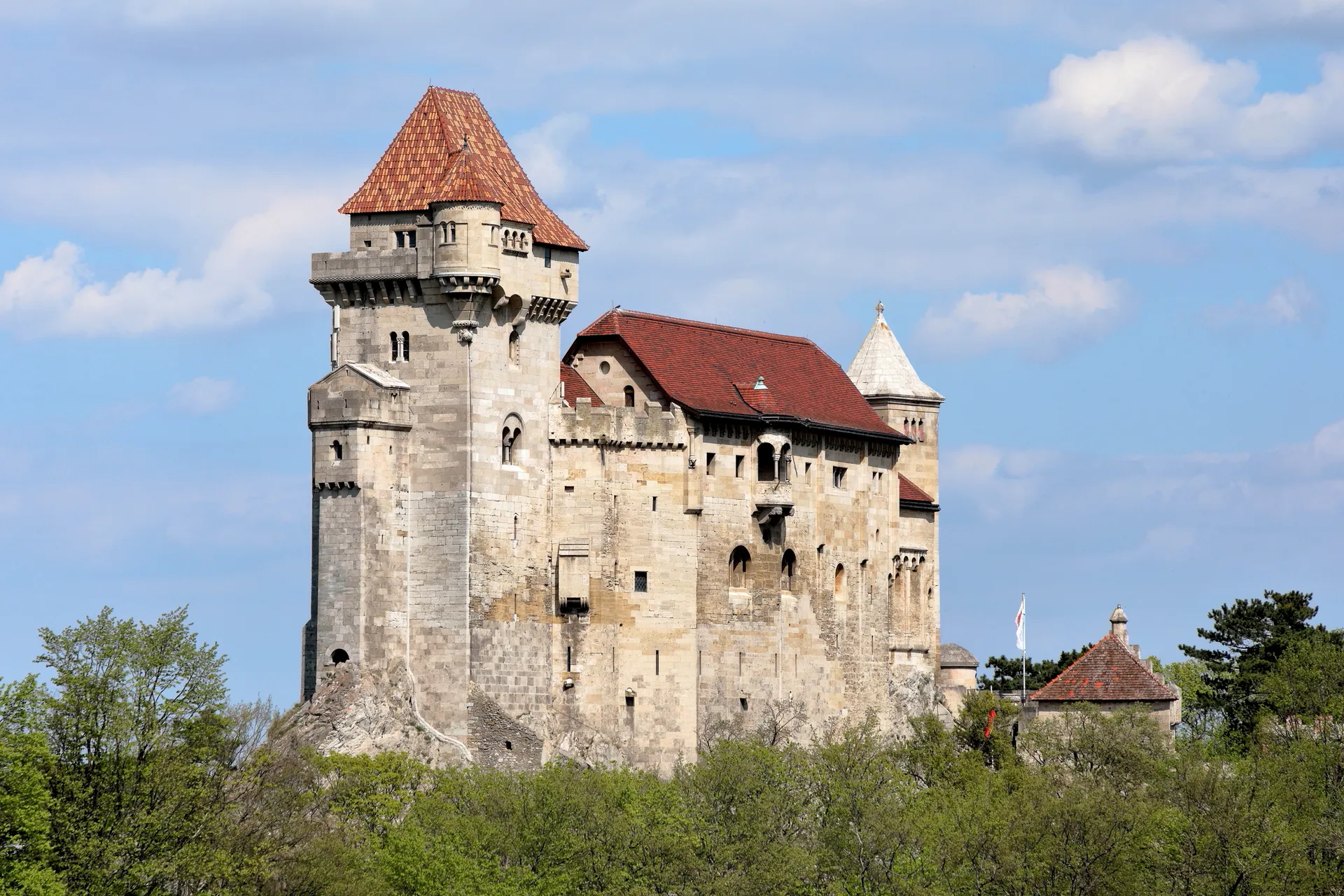 Photo: C.Stadler/Bwag · CC BY-SA 4.0
- Access
- Uneven medieval stairs and narrow walkways
- Best season
- Spring to autumn
A dynasty's ancestral castle spent 512 years in other hands. Liechtenstein Castle, perched above Maria Enzersdorf on Vienna's southern edge in Austria, is where the family took its name—not where the modern country began. Visit for Romanesque stone, a chapel bearing a 13th-century red-chalk drawing, and views across the Vienna Basin that turn a day trip from Vienna into a lesson in power, ruin, and reinvention.
The castle sits on a pale limestone ridge at the edge of the Vienna Woods, close enough to Vienna for an easy escape and high enough for the valley to open beneath its walls. Records show that Hugo of Petronell began the stone complex around 1122–1136, creating a fortified seat whose cool chapel and heavy masonry still feel older than its skyline.
Visitors often mistake the present silhouette for a perfectly preserved medieval fortress. In fact, scholars identify a substantial Romanesque core beneath the later work, while the tall keep and romantic battlements largely belong to the Historicist reconstruction of 1884–1903.
The pleasure lies in that tension. A tour moves from an integrated 12th-century chapel to rooms shaped by Joseph Hardtmuth, the future pencil magnate, then out toward a park filled with military memorials and theatrical ruins.
What to see
-
St. Pancras Chapel
Surprise comes in the dimensions: St. Pancras Chapel measures only 4.86 by 3.48 metres, roughly the floor area of a generous bedroom, yet its cross-ribbed Romanesque vault gives each footstep a clean, lingering echo. Built around 1130, the chapel holds a 13th-century red-chalk Crucifixion, a 15th-century Venetian relief of the Man of Sorrows, and a thorn relic identified by the castle as part of the Crown of Thorns. Stay a moment. In the dim light, with pale plaster and worn stone close around you, Liechtenstein Castle stops feeling like a grand residence and starts speaking in the small, private scale of medieval devotion. -
The Great Hall and Heinrich Tower
Then the castle turns theatrical: the Great Hall gathers dark timber beams, iron weapons, tapestries, and a Romanesque sleeping niche cut directly into the thick stone wall—Austria's oldest surviving bed alcove, according to the castle. The live guided tour continues up the 45-metre Heinrich Tower, about the height of a 14-storey building, where a tight spiral stair opens onto the Vienna Basin and, on clear days, views stretching roughly 70 kilometres across the Vienna Woods. Look back at the rough 12th-century limestone beneath the later neo-Romanesque battlements; the building reveals itself as a stack of ambitions, rebuilt after war, fashion, and dynastic pride had each taken a turn. -
Castle, Amphitheatre, and Kalenderberg Walk
For the best half-day outing, begin at the ruined semi-round bastion, where ragged masonry still records the 1683 Ottoman breach, then follow the Kalenderberg path for about five minutes to Joseph Hardtmuth's artificial Roman Amphitheatre, built in 1810–1811 with 16 round arches and Doric columns. Stand beneath the central arches and frame the pale keep against black pines; continue toward the Pfefferbüchsel or Black Tower if your legs are willing. The walk exposes a delicious contradiction: a 12th-century fortress beside a Romantic ruin made to look ancient, each one teaching you that history can be inherited—or carefully invented.
Plan your visit
- Getting There
- Burg Liechtenstein stands at Am Hausberg 2 in Maria Enzersdorf, Lower Austria, about 15 km south of Vienna—not in the principality. From central Vienna, take S1, S2, S3, or CJX9 to Mödling Bahnhof in 15–20 minutes, then bus 262 toward Gießhübl Föhrenberge to Maria Enzersdorf Siedlungsstraße; the marked uphill trail takes another 7–10 minutes. By car, use the A21 and exit at Hinterbrühl or Gießhübl; free parking sits below the hill, followed by a paved 5–10-minute climb.
- Opening Hours
- As of 2026, guided interior tours generally run from April 1 through late autumn, usually 10:00–16:00, with departures roughly hourly on Thursday through Tuesday and broader opening during peak summer. The castle interior can be entered only with a guide. From November through March, regular daily opening pauses or becomes limited to weekends, pre-booked groups, and special events; the courtyard and surrounding grounds remain accessible free during daylight.
- Time Needed
- Allow 45–60 minutes for the exterior, enough for one unhurried circuit of the walls, the Vienna Basin viewpoint, and nearby paths. A standard visit takes 1.5–2 hours, including the 50-minute guided tour, courtyard check-in, and walks from parking or the bus stop. Pairing the castle with Seegrotte Hinterbrühl and Naturpark Föhrenberge turns it into a 3.5–5-hour Vienna Woods outing.
- Accessibility
- The interior is not wheelchair accessible: no elevators or ramps serve its uneven stone steps, narrow spiral staircases, raised thresholds, and dim passages. The 45-metre Heinrichturm keep—about as tall as a 14-storey building—requires a steep, tight stair climb and is unsuitable for visitors with mobility limitations or severe vertigo. Exterior paths from the parking area are paved or gravel with a moderate incline; strollers work outdoors but must be left in the courtyard for the tour.
- Cost & Tickets
- As of 2026, the regular guided tour costs €18 for adults, €15 at the reduced rate, €10 for children aged 6 and over, and nothing for children under 6; the free courtyard and grounds need no ticket. A castle–Naturpark Sparbach combination ticket costs €20 for adults and €13 for children and remains valid throughout the season. Book online for peak weekends so you are not waiting for the next departure.
Photo Gallery


History
The Castle That Changed Hands—and Then Changed Its Face
Scholars date the first stone fortress on this light-colored ridge to roughly 1122–1136, when Hugo of Petronell adopted the name Liechtenstein from the rock itself. The 1136 Klosterneuburg record naming him "huc de lihtensteine" is the firmest early clue, and it quietly reverses the usual assumption: the Austrian castle came first; the principality came much later.
Records show a history shaped by marriage, royal pledges, invasion, fire, and taste. The chapel and gatehouse preserve an unusually large portion of the Romanesque fabric, while the battlements visitors photograph today belong largely to later campaigns of reconstruction.
The turning point
Johann I and the Ruin That Became a Dynastic Mirror
Field Marshal Prince Johann I Josef von Liechtenstein had spent his adult life fighting for the Habsburg monarchy, including at Austerlitz, Aspern-Essling, and Wagram. When the Napoleonic upheavals dissolved the Holy Roman Empire in 1806, the old feudal order that had supported princely identity was collapsing around him; personally, Johann faced the problem of how a dynasty could make its legitimacy visible in a newly reordered Europe.
The turning point came in 1807/1808, when documented transactions show Johann repurchased the ruined ancestral castle from Prince Stanislaus Poniatowski. He did not simply repair a decaying property. According to the castle's historical record, he joined the ruin to an English-style park on the Kalenderberg, turning a family absence of more than five centuries into a physical statement of continuity.
Between 1808 and 1816, architect Joseph Hardtmuth shaped surviving Romanesque remains into theatrical interiors, including the Knight's Hall and dungeon; records also identify a castle museum opened in 1812. The result is wonderfully double-faced: medieval stone carries a Romantic performance of the Middle Ages, while Johann's personal act of recovery gave the Liechtenstein name an ancestral anchor again.
A Romanesque Fortress on the Vienna Woods Frontier
Records show Hugo of Petronell building a stone tower house with a chapel between about 1122 and 1136, above routes leading toward the southern approaches to Vienna. Modern architectural analysis indicates that the chapel apse and gatehouse walls were built in direct bond, correcting the older theory that the chapel once stood separately. The original complex was therefore planned as a connected fortified residence, not a lonely watchtower with a devotional add-on.
Fire, Ruin, and the Castle Visitors See
According to documented castle histories, the fortress suffered damage in 1529, was rebuilt under Georg Freisleben in 1533–1537, and burned during the Ottoman campaign of July 1683. It remained an abandoned shell until Romantic interventions began in the late 18th century, then received its most dramatic makeover under Carl Gangolf Kayser, Humbert Walcher von Molthein, and Egon Rheinberger between 1884 and 1903. The castle reopened for regular public tours in 2010 after major structural work in 2007–2009.
Tips for visitors
Mind The Chapel
The Romanesque St. Pancras Chapel remains a consecrated historical site: remove your hat and keep voices low. Castle interiors stay cool behind their thick limestone walls, so a light jacket helps even on a warm July afternoon.Keep Cameras Quiet
Personal handheld photography is generally allowed inside without flash, but tripods and selfie sticks can obstruct the guided group. Commercial filming and drone flights require written permission from castle management, with drone operations also subject to Austro Control approval.Watch The Ridge
Scams and street theft are not a local concern, but marked trails around Kalenderberg include steep limestone edges. Tall grass in the Föhrenberge can carry ticks, so check socks and trouser hems after hiking.Eat Downhill
Hotel-Restaurant Hotwagner on Hausbergstraße is the traditional mid-range choice, around a five-minute walk downhill, with schnitzel, game, and regional wine. For coffee, pastries, or brunch, try habs*gut at Johannesstraße 33 (€–€€); Waldmeierei Liechtenstein near the grounds is handy for strudel and a garden table.Choose The Edges
Arrive near the 10:00 opening or on a weekday for a quieter tour; summer weekends fill with local walkers and families. Spring through early autumn gives the best combination of open tour schedules and clear Vienna Basin views, while winter requires checking special-event dates.Make A Half-Day
Combine the castle with Seegrotte Hinterbrühl, roughly a 20–25-minute walk or short bus ride away, then continue into Naturpark Föhrenberge. The nearby Schwarzer Turm and Roman Amphitheater follies add a distinctly 19th-century romantic aftertaste to the outing.Use The Grounds
You can enjoy the exterior walls, viewpoints, and daylight paths without paying for an interior tour. Families save with the €20 castle–Sparbach combination ticket for adults and €13 for children, while under-six visitors enter the guided tour free.Pack Lightly
Bring a small daypack rather than a suitcase or large trekking backpack: the medieval passages have no large-luggage lockers. Leave bulky bags at Wien Hauptbahnhof or Wien Meidling, and remember that pets cannot join the interior tour except certified service dogs.
Watch & Explore Liechtenstein Castle.

Frequently asked
Is Liechtenstein Castle worth visiting?
Yes, especially if you like castles whose stones argue with their restorers. The Romanesque core and St. Pancras Chapel date to about 1130, while the dramatic upper skyline was rebuilt between 1884 and 1903; a guided visit also reveals the 45-metre keep, roughly as tall as a 14-storey building, and views across the Vienna Basin.
How long do you need at Liechtenstein Castle?
Allow 1.5 to 2 hours for the castle tour, courtyard, viewpoints, and the walk from the parking area or bus stop. The guided interior visit lasts about 50 minutes—roughly a feature film without the trailers—while an exterior-only stop takes around 45 to 60 minutes.
How do I get to Liechtenstein Castle from Vienna?
Take an S-Bahn from Vienna to Mödling, then bus 262 toward Gießhübl Föhrenberge and get off at Maria Enzersdorf Siedlungsstraße. The train takes about 15 to 20 minutes, followed by the bus and a marked 7-to-10-minute uphill walk through the park; driving from Vienna, use the A21 and exit at Hinterbrühl.
What is the best time to visit Liechtenstein Castle?
Late April to May and September to October offer the best balance of open tours, softer light, and fewer summer crowds. The grounds are especially good in autumn, when russet Vienna Woods frame the pale limestone, while the regular visiting season generally runs from April 1 into late autumn; check the official calendar before travelling.
Can you visit Liechtenstein Castle for free?
Yes, you can visit the exterior grounds, courtyard viewing areas, and surrounding paths free of charge during daylight hours, but the interior requires a guided-tour ticket. Standard admission is €18 for adults, €15 reduced, and €10 for children aged 6 and over; children under 6 enter free.
What should I not miss at Liechtenstein Castle?
Don’t miss St. Pancras Chapel, the Romanesque sleeping niche in the Great Castle Hall, and the battered semi-round tower where the 1683 Ottoman breach remains visible. Look closely for the faded 13th-century red-chalk Crucifixion in the chapel; if your legs are happy with tight spiral stairs, the special Grand Tour adds the treasury, Fireplace Room, and 45-metre Heinrich Tower.
Sources & attribution 60
- Wikidata — Identifies Liechtenstein Castle and provides its Wikidata record.
- Protected Monuments in Maria Enzersdorf — Provides the protected-monument listing for the castle.
- Liechtenstein Castle Official Website — Provides the castle’s official identity, history, ownership, and visitor information.
- Liechtenstein Castle Owners and History — Provides the early construction date, Hugo von Liechtenstein, and ownership chronology.
- Burg Liechtenstein — Provides historical dates, documentary references, and a general chronology.
- Maria Enzersdorf Municipal Castle Information — Confirms the castle’s local setting and early history.
- Hugo von Liechtenstein — Provides information about Hugo’s role and the first recorded use of the Liechtenstein name.
- Wienerwald: Liechtenstein Castle — Provides regional tourism information, historical ownership details, access context, and viewpoints.
- Burgen-Austria Castle Archive — Provides a detailed chronology of destruction, ownership, Ottoman attacks, and reconstruction.
- Liechtenstein Castle: The Castle — Provides official historical information about the castle’s architecture and wartime damage.
- Liechtenstein Castle: 19th-Century Restoration Research — Provides research on the 1884–1903 Historicist reconstruction and its architects.
- Liechtenstein Castle Architectural History — Provides official architectural, historical, and wartime information.
- OTS Press Portal: Liechtenstein Castle Public Tours — Provides information about the 2010 reopening and historical interpretation at the castle.
- Gedächtnis des Landes: Burg Liechtenstein — Provides art-historical information about Joseph Hardtmuth, reconstruction, and the castle’s interiors.
- Architektenlexikon: Carl Gangolf Kayser — Provides biographical and architectural information about Carl Gangolf Kayser.
- Wienerwald: Burgverwaltung Liechtenstein — Provides visitor, historical, and regional excursion information.
- Liechtenstein Castle Official Opening Hours — Provides seasonal opening schedules and closure information.
- 365 Austria: Liechtenstein Castle — Provides practical information on access, tours, height, accessibility, and the castle’s setting.
- Lower Austria Info: Castles and Ruins — Provides regional visitor information about castles and ruins in Lower Austria.
- Liechtenstein Castle Official Admission Information — Provides official admission, guided-tour, and visitor details.
- Liechtenstein Castle Online Ticket Shop — Provides the official online ticketing link.
- Liechtenstein Castle Special Tours — Provides information about the Grand Tour, night tours, New Year’s Eve tour, treasury, and tower access.
- Liechtenstein Castle Combination Ticket — Provides combination-ticket information for Liechtenstein Castle and Naturpark Sparbach.
- Liechtenstein Castle Official Directions — Provides official driving and public-transport directions.
- Wiener Linien — Provides public-transport information for travel from Vienna.
- Rome2Rio: Vienna to Liechtenstein Castle — Provides route-planning information between Vienna and the castle.
- Komoot: Liechtenstein Castle Walking Route — Provides walking-route and terrain information near the castle.
- Hotwagner Excursion Destinations — Provides information about nearby traditional dining and excursion facilities.
- Der Burgwirt at Liechtenstein Castle — Provides official information about the nearby castle restaurant.
- habs*gut — Provides information about the nearby café and event venue.
- Liechtenstein Castle Sights — Provides official details about the chapel, halls, artworks, relic, ruined tower, and architectural features.
- Castles in the World: Liechtenstein Castle — Provides supplementary historical and architectural information.
- Vienna PASS: Liechtenstein Castle — Provides admission, tour-language, and Vienna PASS information.
- Liechtenstein Castle Chapel — Provides the chapel’s dimensions and architectural details.
- Liechtenstein Castle Surroundings — Provides information about the landscape park, artificial ruins, and Roman Amphitheatre.
- Kalenderberg Tour — Provides information about the Kalenderberg paths and Romantic follies.
- Artificial Ruins around Vorderbrühl — Provides information about the Black Tower and nearby artificial ruins.
- TravelTips: Liechtenstein Castle Maria Enzersdorf — Provides practical information about tours, history, and public access.
- Liechtenstein Castle Official Tours — Provides official tour duration, access rules, group sizes, photography, and accessibility information.
- Liechtenstein Castle Themed Tours — Provides information about special and themed guided tours.
- Liechtenstein Castle Visitor Rules — Provides official visitor regulations, including photography and drone restrictions.
- Austrian Federal Monuments Authority Document — Provides monument and art-historical reference material used for the castle’s furnishings and altar history.
- Carl Gangolf Kayser — Provides supplementary biographical information about the restoration architect.
- Castlopedia: Burg Kreuzenstein — Provides comparative architectural context for Historicist castle restoration in the region.
- Komoot: Hiking around Maria Enzersdorf — Provides local hiking, neighborhood, meadow, and nearby-attraction information.
- Austria-Forum: Nestroy-Spiele Liechtenstein — Provides the history of the Nestroy theatre festival at the castle from 1983 to 2012.
- Nestroy-Spiele Liechtenstein — Provides supplementary information about the castle’s theatre history.
- Der Standard: Nestroy Festival Report — Provides reporting on the later difficulties and closure of the Nestroy festival.
- Maria Enzersdorf Events Venue — Provides information about local cultural and seasonal events.
- Tripadvisor: Liechtenstein Castle Review — Provides visitor context for the castle and nearby attractions.
- Vienna Wine Taverns — Provides information about Thermenregion wines and the Heuriger tradition.
- Farmholidays: Heuriger Wine Taverns — Provides background on Heuriger customs and traditional food.
- Liechtenstein Castle in Maria Enzersdorf — Provides supplementary general information about the castle.
- Burg Liechtenstein on Facebook — Provides current administrative and public-programming context.
- Liechtenstein Castle Official Opening Hours — Provides the English-language opening-hours page.
- Reddit: Liechtenstein Castle Discussion — Provides informal visitor discussion about the castle’s reconstructed appearance.
- Liechtenstein Castle No-Drones Policy — Provides the official drone restriction and authorization information.
- Tripadvisor: Restaurants near Liechtenstein Castle — Provides nearby restaurant and café listings.
- Yelp: Restaurants near Liechtenstein Castle — Provides supplementary nearby dining listings.
- Falstaff Restaurant Guide — Provides regional restaurant and dining context.
Built from cited sources · see the method · How we make our guides →
Pick up where you left off
Saved and recently read places — kept on this device only.
Photo credits (14)
- Maria Enzersdorf - Burg Liechtenstein (5) — C.Stadler/Bwag — CC BY-SA 4.0 (https://creativecommons.org/licenses/by-sa/4.0/) — Source: https://commons.wikimedia.org/wiki/File:Maria_Enzersdorf_-_Burg_Liechtenstein_(5).JPG
- Maria Enzersdorf - Burg Liechtenstein (4) — C.Stadler/Bwag — CC BY-SA 4.0 (https://creativecommons.org/licenses/by-sa/4.0/) — Source: https://commons.wikimedia.org/wiki/File:Maria_Enzersdorf_-_Burg_Liechtenstein_(4).JPG
- Maria Enzersdorf - Burg Liechtenstein (1) — C.Stadler/Bwag — CC BY-SA 4.0 (https://creativecommons.org/licenses/by-sa/4.0/) — Source: https://commons.wikimedia.org/wiki/File:Maria_Enzersdorf_-_Burg_Liechtenstein_(1).JPG
- Burg Liechtenstein 2203 — Karl Gruber — CC BY-SA 4.0 (https://creativecommons.org/licenses/by-sa/4.0/) — Source: https://commons.wikimedia.org/wiki/File:Burg_Liechtenstein_2203.JPG
- Burg Liechtenstein 031 (51118601154) — János Korom Dr. >17 Million views from Wien, Austria — CC BY-SA 2.0 (https://creativecommons.org/licenses/by-sa/2.0/) — Source: https://commons.wikimedia.org/wiki/File:Burg_Liechtenstein_031_(51118601154).jpg
- Burg Liechtenstein 2201 — Karl Gruber — CC BY-SA 4.0 (https://creativecommons.org/licenses/by-sa/4.0/) — Source: https://commons.wikimedia.org/wiki/File:Burg_Liechtenstein_2201.JPG
- Burg Liechtenstein Bild 1 — Anna Saini — CC BY-SA 4.0 (https://creativecommons.org/licenses/by-sa/4.0/) — Source: https://commons.wikimedia.org/wiki/File:Burg_Liechtenstein_Bild_1.jpg
- Burg Liechtenstein Bild 10 — Anna Saini — CC BY-SA 4.0 (https://creativecommons.org/licenses/by-sa/4.0/) — Source: https://commons.wikimedia.org/wiki/File:Burg_Liechtenstein_Bild_10.jpg
- Burg Liechtenstein Bild 11 — Anna Saini — CC BY-SA 4.0 (https://creativecommons.org/licenses/by-sa/4.0/) — Source: https://commons.wikimedia.org/wiki/File:Burg_Liechtenstein_Bild_11.jpg
- Burg Liechtenstein Bild 12 — Anna Saini — CC BY-SA 4.0 (https://creativecommons.org/licenses/by-sa/4.0/) — Source: https://commons.wikimedia.org/wiki/File:Burg_Liechtenstein_Bild_12.jpg
- Burg Liechtenstein Bild 13 — Anna Saini — CC BY-SA 4.0 (https://creativecommons.org/licenses/by-sa/4.0/) — Source: https://commons.wikimedia.org/wiki/File:Burg_Liechtenstein_Bild_13.jpg
- Burg Liechtenstein Bild 14 — Anna Saini — CC BY-SA 4.0 (https://creativecommons.org/licenses/by-sa/4.0/) — Source: https://commons.wikimedia.org/wiki/File:Burg_Liechtenstein_Bild_14.jpg
- Burg Liechtenstein 2199 — Karl Gruber — CC BY-SA 4.0 (https://creativecommons.org/licenses/by-sa/4.0/) — Source: https://commons.wikimedia.org/wiki/File:Burg_Liechtenstein_2199.JPG
- Burg Liechtenstein 2201 pagebanner — Karl Gruber — CC BY-SA 4.0 (https://creativecommons.org/licenses/by-sa/4.0/) — Source: https://commons.wikimedia.org/wiki/File:Burg_Liechtenstein_2201_pagebanner.JPG
Photos may have been resized or cropped.