Type 2+ letters to search all countries, cities, and places
/Ctrl KEsc
travel_explore
Type 2+ letters to search all countries, cities, and places
Press Enter to open the top result
National Library of Australia
Canberra·Australia·35° S · 149° E·Updated Jul 2026
Australia's national library holds about 10 million items, yet the surprise is the hush: lake views, mid-century grandeur, and voices of a country in storage.
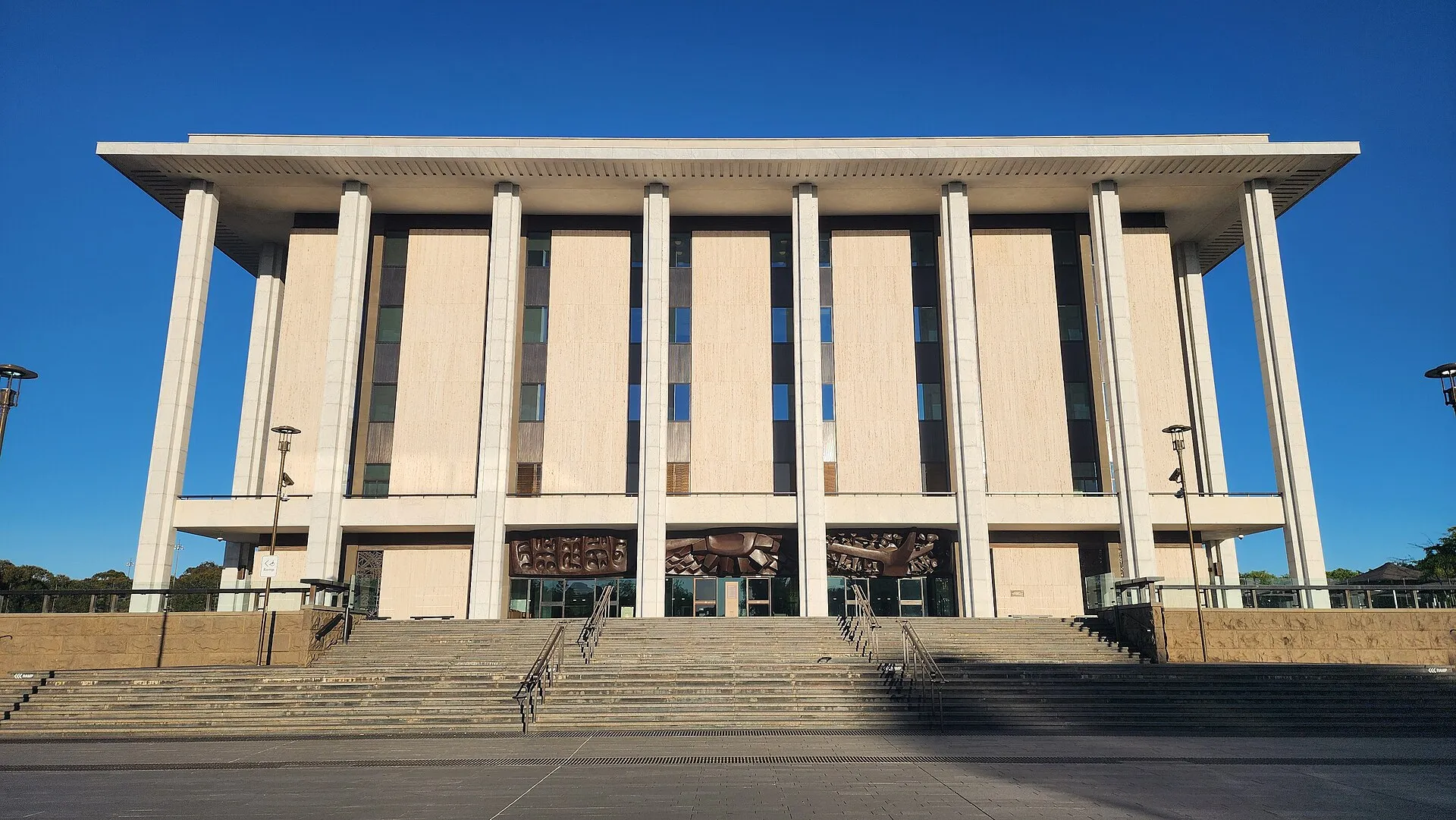
Why does a building that looks so calm hold one of the fiercest arguments in Australian public life: who gets remembered, who gets heard, and who controls the record? Visit the National Library of Australia in Canberra, Australia, because this is where the country keeps its paper trail, its voices, and some of its hardest questions under one roof. Today you cross a broad travertine forecourt, hear shoes click in the marble hush, and watch winter light slide off bronze, glass, and the pale stone of a modernist facade facing Lake Burley Griffin.
Most first-time visitors expect a dutiful reading room. They get that, yes, but they also get exhibitions, manuscripts, oral histories, maps, newspapers, and the faint thrill of standing above roughly 10 million items stored in the building and its repositories, a national memory bank with the temperament of a vault and the reach of a continent.
The surprise is continuity. Records show the institution began in 1901 as the Commonwealth Parliamentary Library, moved to Canberra in 1927, and became independent under the National Library Act in 1960, yet its deepest habit has stayed the same: gather the evidence of Australian life before it disappears. Printed pamphlet, bush ballad, family recording, political poster, website. In they come.
That makes the place worth more than a quick architectural glance. Come for the clean modernist lines if you like, then stay for the unsettling idea underneath them: nations are built from stories, but someone has to decide which stories survive long enough to argue back.
Researched by the Audiala editorial team from historical records, architectural archives, and local expertise.
What to see
The Foyer and Leonard French Windows
The surprise comes early: Walter Bunning gave Australia’s national library the bones of a marble temple, then Leonard French flooded its 1967 foyer with stained glass that changes temperament by the hour. Come in the morning if you can. The light turns honey-warm across travertine, the room carries a soft echo like a station built for scholars, and the real insider move is to go upstairs to the mezzanine, where the three 1968 tapestries finally make sense at full scale instead of reading as decorative giants from below.
Treasures Gallery and the Main Reading Room
Most national libraries make you admire their holdings in theory; this one puts the evidence in front of you, then lets the building lower its voice. Start in the Treasures Gallery, where the collection’s showpieces remind you that the institution began in 1901 as the Commonwealth Parliamentary Library, then drift toward the Main Reading Room, where desks spread under a calm wash of light and embroidered panels soften the formality of the stone, so the place stops feeling like a monument and starts feeling like a machine for memory.
Forecourt to Lake Walk
Skip the urge to rush inside and circle the building first, from the entrance lintel with its winged-sun symbolism to the lakeside wall with the copper Knowledge panels, where most people miss artisan Z. S. Vesely’s name scratched into the center like a private signature on a public work. Then end at the Bookplate terrace facing Lake Burley Griffin and Patrick White Lawns, where the marble mass loosens, the air smells faintly of coffee and cut grass, and the library stops posing as a state building and shows its better side: a place made for lingering.
Plan your visit
Getting There
The Library sits at Parkes Place West in the Parliamentary Triangle, a 20-minute walk from Parliament House and an easy stroll from Questacon, Old Parliament House, the National Gallery and the Portrait Gallery along King Edward Terrace. By bus, aim for stops on King Edward Terrace or Commonwealth Avenue; routes including R2, R6, 56 and 57 are the most useful in 2026, and taxis or rideshares can drop you at the front entrance.
Opening Hours
As of 2026, the main building opens Mon-Thu 8am-8pm, Fri 8am-5pm, and Sat-Sun plus most public holidays 9am-5pm. The Exhibition Gallery and Treasures Gallery run daily 9am-5pm, but both close on Good Friday and Christmas Day, and building works may bring noise or occasional area closures.
Time Needed
Give it 30-45 minutes for a quick pass through the foyer, bookshop and one gallery; 60-90 minutes feels right if you want the Treasures Gallery and a coffee with lake views. The free daily building tour starts at 11am and lasts 45 minutes, so a fuller visit usually lands at 1.5-2 hours, while readers and exhibition lingerers can easily spend 2-3 hours here.
Accessibility
The grand front stairs look forbidding, but the useful entrance is the south-side ramp beside the public car park, which leads to the podium near the main doors. As of 2026, lifts behind the information desk reach all public levels, automatic doors serve the foyer and galleries, eight accessible parking bays sit off Parkes Place West, and free wheelchairs are available from the foyer desk.
Cost & Tickets
As of 2026, general entry is free, the Treasures Gallery is free, and the current Wangka Wakaṉutja exhibition is also free with no booking required. The daily guided building tour is free too, but online bookings get priority over walk-ins; if you drive, parking costs A$4.20 per hour on weekdays or A$17.50 for the day in long-stay areas.
History
A House That Keeps Listening
Records show the National Library of Australia has changed its name, legal status, address, and building, while its central function has barely budged: collect the record of Australian life and keep it available for the next reader. That continuity matters more than the marble. It is the reason a federation-era parliamentary collection could grow into a public institution with legal deposit powers, oral history booths, and shelves that now extend far beyond print.
You can feel that continuity in the way sound behaves here. The public rooms are soft with carpet and paper, but below them sit climate-controlled stacks engineered like a bunker, built to preserve everything from maps to magnetic tape; the contrast is the point, a civic welcome upstairs and a memory machine underneath.
The turning point
Menzies Wanted a Monument. The Library Kept the Mission.
At first glance, the building tells a tidy story: Australia grew up, built a grand national library, and opened it in Canberra in August 1968. Tourists often accept the facade as the whole argument, a handsome modernist shell for books and scholars.
But one detail refuses to sit quietly. Sir Robert Menzies fought for the Library's independence, backed the 1960 legislation that separated it from parliamentary control, and personally tied his reputation to the project; then, after he was pushed from office in January 1968, Prime Minister John Gorton opened the finished building instead. The turning point was political, not architectural.
That changes the scene. Records show Menzies saw the Library as proof that Australia deserved a sovereign cultural institution, not merely a reference service for legislators, and what was at stake for him was personal legacy as much as policy. The surface story celebrates a building; the deeper one is about a man who nearly got his monument yet, in losing the ceremony, accidentally revealed the larger truth: the institution outlasted its patron because the work of collecting national memory had already become bigger than any one prime minister.
Look at the forecourt after knowing that, and the place reads differently. The columns feel less like decoration and more like a claim that memory should survive party spills, budget moods, and official embarrassment; inside, every oral history and odd little pamphlet carries the same stubborn message. Keep it anyway.
What Changed
A lot changed, and fast. Records show the collection began in 1901 inside the Commonwealth Parliamentary Library, moved from Melbourne to Canberra in 1927, gained independent legal identity through the National Library Act on 7 December 1960, and entered its current Parkes Place building in August 1968. The media changed too: books were joined by photographs, recordings, manuscripts, websites, and more than 57,000 hours of oral history and folklore, a body of sound that would run longer than six straight years if played without stopping.
What Endured
The enduring practice is simpler than the technology around it: Australians keep depositing evidence of themselves here, and librarians keep preserving it for strangers not yet born. That continuity now includes family memory workshops, folklore recordings, Indigenous language material, and new oral histories added each year, so the Library still serves the same civic purpose it always did, only with a wider definition of what counts as the national record. Paper, tape, voice, code. Same instinct.
Tips for visitors
Library Manners
This is still a working library, not a lobby with books as decoration. Keep your phone on silent, wear shoes, and save snacks for the foyer, cafes, podium or Lower Ground 1 because food and drink are not allowed in reading rooms or galleries.
Photo Rules
Handheld photography is the safe bet, and flash must stay off when copying or photographing collection material. If you want tripods, stands or any serious filming setup, ask first; the Library manages permissions tightly in its heritage-listed building, and drones are a bad idea in the National Triangle no-fly area.
Use The Lockers
Large bags over 30 x 30 x 30 cm need to go into the free self-service lockers on Lower Ground 1, and tour staff expect you to stash them before the 11am building tour. The lockers top out at 870mm high, so this is fine for backpacks and cabin-size bags, less good for the suitcase you dragged off a bus.
Best Visiting Time
Arrive before 11am if you want the free tour, then stay for the galleries while the light spreads across Lake Burley Griffin outside Bookplate's windows. Weekends feel calmer in the car park too, since the Library lists paid parking only from 8:30am to 5pm on weekdays, excluding ACT public holidays.
Eat Nearby
Bookplate inside the Library is the best mid-range stop at about A$20-30, with a stained-glass interior and terrace facing the lake; Paperplate downstairs is the cheaper under-A$20 option when you want coffee and a fast lunch. If you want to keep walking, Portrait Cafe at the National Portrait Gallery is a reliable mid-range choice, while Water's Edge nearby is the splurge table for a longer meal.
Pair It Well
The smart move is to treat the Library as part of a Parkes circuit, not a standalone errand: combine it with Questacon, Old Parliament House, the National Portrait Gallery or the National Gallery, all within walking distance. Canberra's secret here is pace; the building makes more sense after a gallery, a lakeside walk and one quiet hour under that high 1968 foyer ceiling.
Where to Eat
local_dining
Don't Leave Without Trying
Modern Australian brunch (fresh, seasonal, often with eggs or smoked meats)Sausage rolls and meat pies (standard Australian counter-savories)Regional cool-climate produce (Canberra region is known for fresh vegetables and seasonal ingredients)
Such and Such Restaurant
fine dining
Modern Australian€€star4.6(272)
Order: Chef's choice tasting menu ($110 pp) — diners rave about the variety of entrees and unique desserts; duck is meaty but rich, so pace it with the lighter courses.
Only proper dinner spot in this cluster, with inventive cooking and an extensive wine list. Staff are notably attentive and excited about the food — feels like they actually care.
Order: Baked eggs or the breakfast salad with salmon and beans. Panacotta with strawberries is the standout dessert. Fair-trade espresso is top-tier.
Stylish, retro-chic spot where locals actually hang. High volume of reviews (846) signals it's a genuine community favorite. Open kitchen, great coffee, inventive food cooked with care.
Order: The East Roll (bacon, spinach, hash brown, egg, melted cheese on milk bun) or the custom stack with halloumi, miso mushroom, avocado, and egg. Single origin coffee is excellent.
Located at the city bus interchange and run with visible intelligence and care. Staff proactively notice when you move tables in the sun. High review count (547) shows locals return often.
Order: Chicken burger with melted cheese, fresh greens, and crispy fries, or Eggs Benedict. Coffee gets consistent praise.
Highest-rated cafe (4.7) in this group, with a cozy, welcoming vibe. Small layout fills up fast, especially weekends. Staff are attentive and the food is fresh and beautifully plated.
checkThe National Library of Australia has two cafes: Bookplate (8:30am–4pm, terrace over Lake Burley Griffin) and Paperplate (9am–3pm, closed weekends and public holidays). Both close before the library does.
checkWeekday closures are common — check ahead for Monday or Tuesday closures at smaller venues.
checkCapital Region Farmers Market runs Saturdays 7:00–11:30am at Exhibition Park (EPIC), north of the city — arrive early, stalls pack up by lunch.
checkACT-only public holidays (Canberra Day, Reconciliation Day) can affect restaurant hours — verify before visiting on these dates.
checkMost reviewed cafes close by 2–2:30pm — plan accordingly if you want a late brunch.
Food districts:Civic/CBD (city centre) — multiple cafes within walking distance of the National Library across Lake Burley GriffinBraddon (north of Civic) — local favorite cafe corridor, ~2 km from NLAKingston/Manuka (Inner South) — broader dining district, ~2 km from NLA
Restaurant data powered by Google
Watch & Explore National Library of Australia.
Explore Canberra
Top 10 Things to do in Canberra 2026 | Australia Travel Guide
TRIP XTREME13 min33K
Explore Canberra
Canberra Australia: 11 BEST Things to do in Canberra City
Before You Go9 min63K
Frequently asked
Is National Library of Australia worth visiting?
Yes, especially if you want Canberra at its most revealing rather than its loudest. The building opened in August 1968 and feels like a marble civic temple beside Lake Burley Griffin, softened by 16 Leonard French stained-glass windows that shift from warm morning glow to cooler afternoon light. Go for the Treasures Gallery, stay for the hush of the reading rooms and the lake-facing terrace.
How long do you need at National Library of Australia?
Give it 60 to 90 minutes for a satisfying first visit. That covers the free Treasures Gallery, the foyer, the bookshop, and a coffee under stained glass; if you add the free 45-minute 11am tour, plan on 1.5 to 2 hours. Researchers or anyone who likes to linger could easily spend half a day here.
How do I get to National Library of Australia from Canberra?
From central Canberra, the easiest route is bus plus a short walk, or just a walk if you already plan to be in the Parliamentary Triangle. The official address is Parkes Place West, Canberra ACT 2600, and the Library points visitors toward stops on King Edward Terrace and Commonwealth Avenue. If you are coming from Parliament House, the trip is about 1.7 kilometers on foot, roughly the length of a 20-minute lakeside stroll.
What is the best time to visit National Library of Australia?
Morning is best. The stained glass is warmer then, the free daily tour leaves at 11am, and you get the building before the day settles into a busier museum rhythm. Autumn adds extra atmosphere outside, with the lake edge and Patrick White Lawns framed by red and gold leaves rather than plain summer glare.
Can you visit National Library of Australia for free?
Yes, general entry is free. The Treasures Gallery is free, the current Wangka Wakaṉutja exhibition is listed as free, and the daily building tour is also free if you book or grab a walk-up place. You only need to budget for parking on weekdays, food, or paid special events.
What should I not miss at National Library of Australia?
Don't miss the foyer from both levels. Most people notice the marble and keep moving, but the secret is upstairs: the tapestries were designed to be read properly from the mezzanine, and the copper lintel over the entrance is packed with symbols that reward a slower look. After that, head to the Treasures Gallery, then finish on the Bookplate terrace facing the lake.
Sources & attribution12
Researched and written by the Audiala editorial team from historical records, architectural archives, and local expertise. Last updated July 2026.
Saved and recently read places — kept on this device only.
Photo credits (8)
Building of the National Library of Australia, Canberra, 2022, 12 — Kgbo — CC BY-SA 4.0 (https://creativecommons.org/licenses/by-sa/4.0/) — Source: https://commons.wikimedia.org/wiki/File:Building_of_the_National_Library_of_Australia,_Canberra,_2022,_12.jpg
Entrance to the Main Reading Room at the NLA March 2023 — Nick-D — CC BY-SA 4.0 (https://creativecommons.org/licenses/by-sa/4.0/) — Source: https://commons.wikimedia.org/wiki/File:Entrance_to_the_Main_Reading_Room_at_the_NLA_March_2023.jpg
Building of the National Library of Australia, Canberra, 2022, 05 — Kgbo — CC BY-SA 4.0 (https://creativecommons.org/licenses/by-sa/4.0/) — Source: https://commons.wikimedia.org/wiki/File:Building_of_the_National_Library_of_Australia,_Canberra,_2022,_05.jpg
Henry Moore's sculpture outside the National Library of Australia — Shkuru Afshar — CC BY-SA 4.0 (https://creativecommons.org/licenses/by-sa/4.0/) — Source: https://commons.wikimedia.org/wiki/File:Henry_Moore's_sculpture_outside_the_National_Library_of_Australia.jpg
Library pneumatic tube system — AlphaLemur — CC BY 4.0 (https://creativecommons.org/licenses/by/4.0/) — Source: https://commons.wikimedia.org/wiki/File:Library_pneumatic_tube_system.jpg
Reconciliation Place-View from the National Library of Australia — Shkuru Afshar — CC BY-SA 4.0 (https://creativecommons.org/licenses/by-sa/4.0/) — Source: https://commons.wikimedia.org/wiki/File:Reconciliation_Place-View_from_the_National_Library_of_Australia.jpg
Australian National Library view from Reconciliation Place — KTWPhotography — CC BY-SA 4.0 (https://creativecommons.org/licenses/by-sa/4.0/) — Source: https://commons.wikimedia.org/wiki/File:Australian_National_Library_view_from_Reconciliation_Place.jpg
National Library of Australia-East side entrance — Shkuru Afshar — CC BY-SA 4.0 (https://creativecommons.org/licenses/by-sa/4.0/) — Source: https://commons.wikimedia.org/wiki/File:National_Library_of_Australia-East_side_entrance.jpg
Strictly necessary cookies keep the site working. Analytics (PostHog, Google Analytics) measures how each visitor uses our pages. Marketing loads YouTube videos and walking-route maps without a tap and lets Google Analytics set advertising cookies. We never sell your data. You can change this any time from the footer.
Analytics and marketing cookies are optional and only load if you agree. Details under Customize.
Privacy
Cookie preferences
Pick what you're okay with. You can change this any time from the footer.
Strictly necessary
Always on
Sign-in, language, navigation. Always on.
Product analytics
PostHog (EU) and Google Analytics record which pages you view and how you use them, under a random identifier stored in your browser. Helps us see which pages work and which need fixing. Google's ad personalisation stays off. No selling.
Marketing
Loads YouTube videos and the walking-route maps (OpenFreeMap) without a tap; without it, they load only when you tap them. If analytics is also on, Google Analytics may set advertising cookies. Ad personalisation stays off.