An introduction.
Researched by the Audiala editorial team from historical records, architectural archives, and local expertise.
WWomen who stepped off provincial trains into Buenos Aires with no money and nowhere to sleep were once received under Venetian chandeliers, in a Palermo mansion whose stained glass celebrates Columbus and Magellan. That contradiction is the real exhibit at Museo Evita, Argentina's museum to Eva Duarte de Perón, at Lafinur 2988. Come for the dresses and the campaign recordings if you want. Stay for the house, which sheltered single mothers until the army shut it down in 1955 and the state made saying her name a crime.
Most visitors arrive expecting glamour, and the museum does deliver it — the tailored suits, the newsreels, the voice that could hold a plaza of half a million people. But the strongest object here is the floor you're standing on. Records show this was Hogar de Tránsito N° 2, one of three transit homes run by the Fundación Eva Perón, where women arriving in the capital could get a bed, a doctor, help with paperwork, and a route to work.
Curator Gabriel Miramont has described Evita's brief plainly: she didn't want the coldness of an institution, she wanted curtains at the windows and tablecloths on the tables. Read that against the address. Palermo in 1948 meant large private residences, a zoo, and old money — not welfare architecture. Installing poor women inside patrician rooms was the whole political argument, made in furniture.
Give it ninety minutes. The permanent rooms run chronologically from Los Toldos to the 1952 funeral, and the restaurant occupies what the museum says was the original kitchen of the Hogar — a rare case of eating lunch inside the exhibit. It sits a ten-minute walk from the Buenos Aires Botanical Garden, and about twenty from Plazoleta Julio Cortázar, so it pairs easily with a slow Palermo afternoon in Buenos Aires.
01 What to see.
Casa Carabassa — the house that outshines its own museum
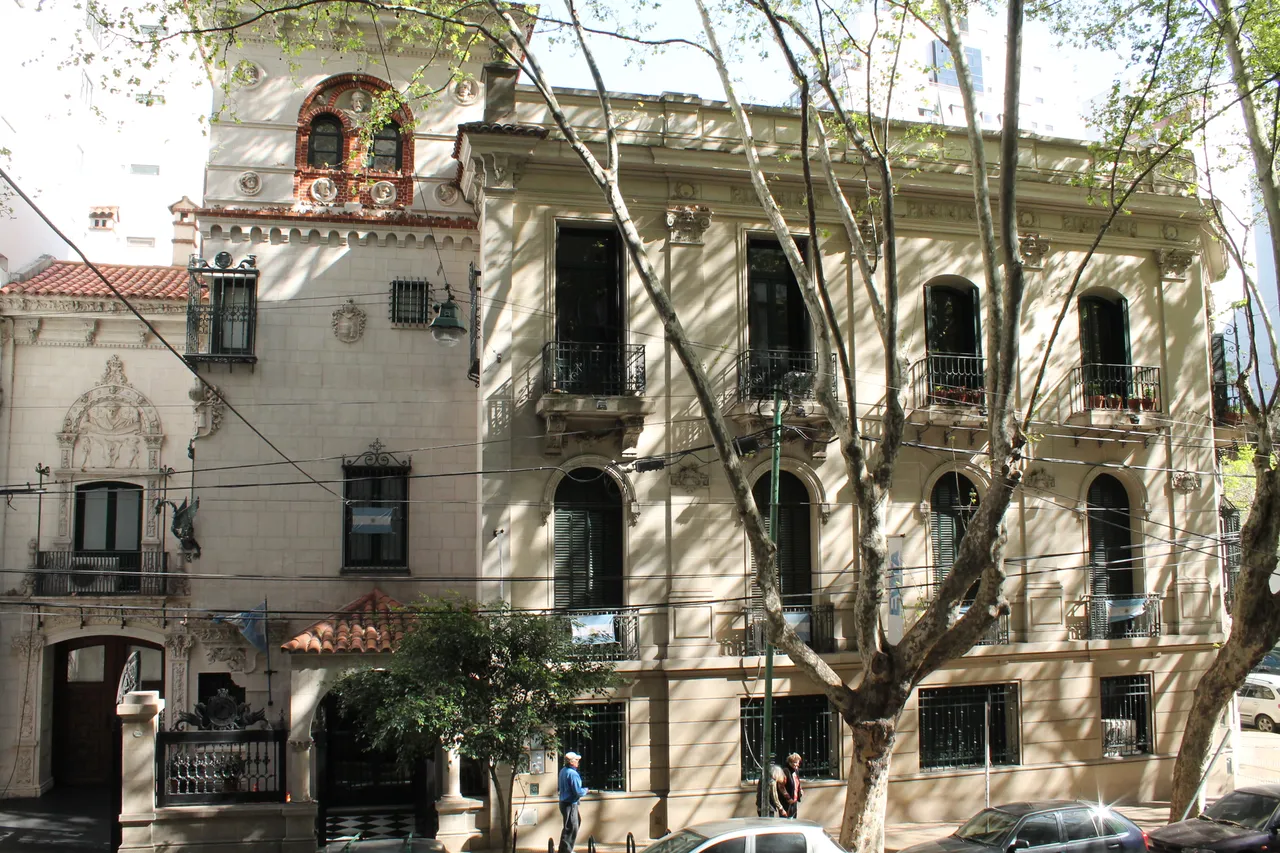
Run your hand along the façade at Lafinur 2988. Those tidy stone blocks aren't stone at all — it's stucco, tooled block by block to fake ashlar masonry, and once you've noticed you can't unnotice it. Estanislao Pirovano built the place in 1923 for the Carabassa family and re-skinned it in 1926 in the neoplateresque manner, the Spanish-revival branch of Argentina's neocolonial movement, crowning it with a square tower under colonial tile.
Inside, the first thirty seconds do the work: black-and-white tile underfoot, a great wrought-iron chandelier overhead, Spanish-forged rejería on the doors so heavy that one Argentine design magazine compared the technique to Arequipan silverwork. Look up at the stained glass. Lighthouses, towers, and the faces of Columbus, Magellan and Vasco da Gama — a Basque merchant family's seafaring self-mythology, still catching afternoon sun inside a building everyone enters thinking only about Eva.
And almost nobody finds the Arabic salon, where the ceiling is sapphire blue and studded with small embedded white lights, a 1920s living-room imitation of a Turkish night sky. There's a 1920s elevator too, near-unheard-of in a private house of the period.
The marble staircase and the 400 objects
The permanent circuit runs chronologically through twelve to thirteen halls, and the marble stair is where the story turns. Downstairs is Los Toldos, the arrival in Buenos Aires at fifteen, the acting years, the meeting with Perón. You climb, and you're in the First Lady rooms. The building makes you walk the transformation rather than read about it.
Roughly 400 original pieces sit under low, temperature-controlled light: tailored suits, gala dresses, a Christian Dior cape from the 1947 Rainbow Tour, the dress she wore in the film La pródiga. Most visitors stop hardest at the shoes, which are startlingly small. Don't miss libreta cívica N° 1 — her voter ID, literally numbered one, the whole suffrage law compressed into a card the size of a passport. Textiles rotate every three months, so March's dresses aren't September's.
Then the volume changes. The Renunciamiento and funeral rooms play documentary footage on screens scaled to swallow you into the crowd of 22 August 1951 on Avenida 9 de Julio, and the roar carries down the hall into the silent vitrine rooms behind you. Records show the Fundación de Ayuda Social bought this house in 1948 and ran it as Hogar de Tránsito N° 2, a shelter where women arriving from the provinces stayed eight to ten days; the original kitchen survives, pots and serving-ware and all, and it's the least-visited room in the building.
Walk the block: two faces, one building
Pirovano designed two entrances that read as two different houses, and comparing them costs nothing. Start on Lafinur, shooting upward through the small semi-covered atrium — the only angle that stacks tower, tile roof and ironwork in one frame. Do the museum. Then walk around to J. M. Gutiérrez 3926, the garden face, where the restaurant patio has a chequerboard floor, creepers on antique grilles, and a palo borracho throwing half-shade with lanterns hung in its branches. The patio is heated, so winter works too.
Time it for late afternoon: the 16:00 guided tour runs about 45 minutes in Spanish, the audio guide (Spanish, English, Portuguese) is included and arrives by QR code to your own phone — bring headphones, and expect patchy Wi-Fi indoors. Doors close at 19:00, Tuesday to Sunday, so a winter visit ends with the lanterns already lit. Ten minutes' walk away, the Buenos Aires Botanical Garden makes the obvious second half of the afternoon.
Plan and listen to Museo Evita with Audiala.
Audio guide in your pocket, itinerary in your browser. Built for the way you actually visit.
03 Visitor logistics.
The practical scaffolding for a good visit — kept short.
Getting There
Lafinur 2988, Palermo Botánico. Subte Línea D drops you at Scalabrini Ortiz (7 min walk) or Plaza Italia (8 min, and the better landmark exit); you'll need a SUBE card to ride. Buses run along Av. Santa Fe (12, 29, 36, 39, 55, 68, 111, 152) and Av. Las Heras (10, 15, 41, 59, 60, 64, 93, 95, 110, 118, 128, 141, 160, 188). It sits off the usual tourist circuit — plan it as a deliberate stop, not a walk-past.
Opening Hours
As of 2026: Tuesday to Sunday, 11:00 to 19:00. Closed Mondays, and reportedly closed 1 January, 24 and 25 May, and 31 December — check museoevita.org.ar before a holiday visit. No last-admission time is published, but arriving after 18:00 leaves you rushing the upstairs rooms.
Time Needed
It's a small museum and better for it. Forty minutes gets you through at a clip, an hour is typical with the audio guide, and 90 minutes lets you linger in the clothing rooms. Add another hour if you sit down at the café — that's where the operator's two-hour estimate comes from.
Cost & Tickets
Admission was ARS 11,000 in January 2026, up from ARS 9,000 the previous August — Argentine inflation means the 2026 number will be higher again, so treat any printed price as a floor. The audio guide in Spanish, English and Portuguese is included and runs on your own phone. Argentine nationals and students should buy at the desk, not online: resident and student rates exist that resellers can't apply.
Accessibility
The official ticketing operator lists the museum as not wheelchair accessible. It occupies an early-1900s mansion with a chronological route that runs across floors, and no source confirms an elevator. Call the museum directly before making the trip rather than trusting third-party listings, which contradict each other on this.
04 Tips for visitors.
Small things that change the day.
Bring Your Own Earphones
The audio guide plays through your phone over the museum Wi-Fi, and headphones aren't supplied with any ticket. Visitors who forget them play the narration on speaker, which turns quiet rooms into a chorus of competing Evitas — don't be that person.
Expect Wi-Fi Trouble
Connecting to the museum network takes a few attempts, and some visitors in January 2026 couldn't get usable audio at all. Arrive with a charged phone and a backup plan: the wall texts carry the story on their own if the narration dies.
No Flash, Camera Welcome
Handheld photography is fine, flash is not — the 1940s gowns, hats and shoes are textile and light-sensitive. The black-and-white tiled foyer and its iron chandelier photograph better than anything upstairs anyway.
Read The Room
This is a site of memory maintained by people who venerate the subject, not a neutral gallery — the collection includes objects ordinary Argentines hid at home when Decreto Ley 4161 made owning her photograph punishable by up to six years in prison. Save the Madonna and "Don't Cry for Me Argentina" jokes for the taxi.
Skip The Reseller
Third-party audio-guided tour packages add a fee for a guide the museum already gives you free on your phone, and one such product sits unavailable in any case. There's no queue to skip here — a Saturday morning visitor in December 2025 had the place nearly to themselves. Buy at the door.
The Café Is Contested
The on-site restaurant has indoor seating and a heated patio that works in July, and porteños treat it as a Palermo brunch address independent of the museum. Recent reviews have turned sharply — "bad and expensive" as of May 2026 — so budget mid-range prices and manage expectations, or take the coffee and skip the meal.
Pair It With Palermo Green
The Buenos Aires Botanical Garden and the Jardín Japonés are minutes away by Plaza Italia, which makes a natural half-day. The other half of the Evita circuit is her tomb in the Duarte family vault at Recoleta Cemetery — the most visited grave in the place, and the coda to the funeral footage looping in the museum's film room.
The Archive Is Open
The building also houses the Instituto Nacional de Investigaciones Históricas Eva Perón, with a library and archive open to the public — almost nobody visiting the galleries knows it's there. Permanent displays get reworked yearly and temporary shows rotate every two or three months, so a return visit isn't wasted.
05 Three Regimes, One Address
The building's official name is Casa Carabassa, and it entered its best-documented phase in 1923, when architect Estanislao Pirovano worked for a wealthy family with Basque maritime pretensions. Historian Carolina Barry argues the family bought an existing French-style house that year and had Pirovano rebuild it — so 1923 is secure, but whether it marks construction or transformation is still contested. Either way, the result advertised lineage: family shields, Carrara marble, imported Spanish ironwork.
Then the house changed hands, and purpose, repeatedly. The Carabassas sold in 1941; Barry names the buyers as Berlin-born property investors Luis Goetz and Flora Igersheimer, and says the rooms were leased to the Patronato Nacional de Ciegos, serving blind children. The Fundación Eva Perón took over in 1948. After 1955 the state reclaimed it, and by 1958 it housed a school for blind girls again. A private trophy became a welfare institution became a political embarrassment became a monument.
The Nurse Who Didn't Come Home
In late September 1949, a Fundación nurse named Luisa Komel boarded a return flight from Ecuador. Argentina had sent a medical mission after the earthquake that flattened Ambato and killed thousands, and the Foundation's relief work was Evita's proof that Peronist social aid could travel — that it wasn't only a domestic electoral instrument. Komel was staff, not spectacle. She flew because the mission needed hands.
The aircraft carrying the returning mission went down; sources differ on whether the crash fell on 26 or 27 September 1949. She was not famous, and she would have stayed anonymous. Instead the Hogar de Tránsito N° 2 on Lafinur was given her name in commemoration, which turned a Palermo doorway into a memorial for a woman who died on someone else's disaster.
That's the turning point worth holding onto. Before, the building was where Evita's theory of dignified charity was performed for visitors and photographers. After, it also carried a death — the cost of exporting that theory. The museum tells the story quietly, and most visitors walk past it looking for the white gown.
A Messy Founding, June 1948
Erasure, and What Survived It
Listen to the full story in the app
The whole Museo Evita,
told well.
Listen to sourced travel stories with local history and practical context — ready offline.
06 Frequently asked.
The questions travellers send us most about Museo Evita.
Is Museo Evita worth visiting?
Yes, though maybe not for the reason you expect — the 1923 Carabassa mansion is the strongest exhibit in it. Visitors regularly arrive for the Dior cape and the tiny shoes and leave talking about the marble staircase, the Spanish ironwork and the stained glass full of lighthouses and explorers. Go in knowing it's a devotional museum rather than a balanced academic one; the framing is warmly pro-Evita and recent reviewers have called it thin on counter-argument.
How long do you need at Museo Evita?
About an hour is the honest answer for most people. Rushing the twelve-to-thirteen rooms takes 30-40 minutes; going slow with the audio guide runs to roughly 90. Add another hour if you're eating on the restaurant patio, which is what the operator's two-hour estimate is quietly counting.
How do I get to Museo Evita from central Buenos Aires?
Take Subte Línea D to Plaza Italia (about 8 minutes' walk) or Scalabrini Ortiz (about 7). Plenty of colectivos run along Av. Santa Fe and Av. Las Heras a few blocks away — check comollego.buenosaires.gob.ar for current lines, since ramales shift. The museum door is Lafinur 2988; the restaurant has its own entrance round the block at J. M. Gutiérrez 3926.
What is the best time to visit Museo Evita?
Weekday mornings just after the 11:00 opening, or early Saturday — recent visitors report the rooms nearly empty then. The museum runs Tuesday to Sunday, 11:00 to 19:00, closed Mondays. One quirk worth planning around: the textiles rotate every three months under controlled light, so the gowns you see in March aren't the gowns in September.
How much does Museo Evita cost and can you visit for free?
Foreign visitors paid ARS 11,000 in January 2026, up from 9,000 the previous August — Argentine inflation makes any peso figure stale within months, so check museoevita.org.ar before you go. Argentine nationals and students should buy at the door rather than online; resident and student rates exist that resellers can't apply. Public-school groups visit free, and the restaurant patio is open to anyone without a museum ticket.
What should I not miss at Museo Evita?
The original kitchen of Hogar de Tránsito N° 2, where the pots and serving-ware survive from the years this was a shelter for women arriving in the city with nothing. Then look up: the stained glass carries the Carabassa family's own mythology — lighthouses, towers, Columbus, Magellan, Vasco da Gama — and the Arabic salon ceiling is sapphire blue, pricked with small white lights standing in for a Turkish night sky. Downstairs, find Evita's libreta cívica numbered 1, the voter ID from the suffrage law she pushed through in 1947.
Is Museo Evita wheelchair accessible?
Call the museum before you commit, because the sources disagree. The main ticketing operator lists it as not wheelchair accessible, and the building is a converted mansion with stairs between floors, but the museum itself runs an unusually broad programme including Argentine Sign Language tours, tours for blind and low-vision visitors and cognitively accessible visits. Group and specialised tours book on 4807-0306.
Do you need to book Museo Evita in advance?
No — nobody reports queues, and the free audio guide already runs on your own phone in Spanish, English and Portuguese via QR code. Bring headphones, because they aren't supplied and other visitors playing narration on speaker is a documented annoyance. The museum Wi-Fi that carries the audio is patchy, so load it at the entrance before you climb the stairs.
Verified, and shown.
Researched and written by the Audiala editorial team from historical records, architectural archives, and local expertise.
Opening hours (Tue-Sun 11:00-19:00), address at Lafinur 2988, and the museum's current statement of its own history.
1923 construction by Estanislao Pirovano, 26 July 2002 museum opening on the 50th anniversary of Eva Perón's death, and the recovery-of-hidden-objects narrative.
19 June 1948 opening of the transit home and the 8 July 1948 decree creating the Fundación Eva Perón; end of the Hogar after the 1955 coup.
Audio guide languages and QR/Wi-Fi delivery, 16:00 daily Spanish guided tour, group booking phone number, and the accessibility programme (LSA, blind and low-vision, cognitively accessible tours).
Official heritage register: neoplateresque/neocolonial style, stucco façade tooled to imitate ashlar, imported Spanish ironwork, square tower and the two-entrance plan.
Declares the former Hogar de Tránsito N° 2 a Monumento Histórico Nacional and confirms the 19 June 1948 opening date.
15 April 1999 heritage designation of the building under its original family name.
The 5 March 1956 ban on Peronist names, images and symbols — the legal backdrop to why so much of the collection was hidden in private homes for decades.
Roughly 400 original objects, thirteen permanent halls, the chronological ground-floor-to-first-floor route, libreta cívica N° 1 and the Foundation sewing machine.
Three-month textile rotation under controlled light, the 1947 Dior Rainbow Tour cape, the La pródiga dress, and the preserved original kitchen of the Hogar.
The maritime stained glass with Columbus, Magellan and Vasco da Gama, the sapphire-blue Arabic salon ceiling, Carrara marble stair, Venetian chandeliers, 1920s elevator and the Andalusian patio.
Official city listing: private mansion converted after the 1948 Foundation purchase, 2002 museum opening, and the on-site café with outdoor seating.
Subte Línea D to Plaza Italia plus bus lines on Av. Santa Fe and Av. Las Heras, no-flash photography rule, the white myth / black myth framing, and the heated restaurant patio.
Packaged ticket with English audioguide and restaurant breakfast or merienda, timed entry rules, the roughly two-hour visit estimate, and the not-wheelchair-accessible statement.
Observed gate prices of ARS 9,000 (Aug 2025) and ARS 11,000 (Jan 2026), walking times from both Subte stations, patchy Wi-Fi complaints, bring-your-own-headphones tips, and the advice for Argentine nationals and students to buy at the door.
The restaurant patio with its chequerboard floor, palo borracho tree and hanging lanterns, and its separate entrance at J. M. Gutiérrez 3926.
Why locals say Evita rather than Eva, the 2002 inauguration by grand-niece Cristina Álvarez Rodríguez, and the foyer's black-and-white tile, iron chandelier and carved pillars.
The contested 1923 build-versus-remodel question, the 1941 sale by the Carabassa family, the building's use by an institution for blind children, and the 9 September 1948 Foundation purchase date.
Built from cited sources · see the method · How we make our guides →