Colonial Origins
swords
1536
Pedro de Mendoza's Doomed First Founding
Spanish conquistador Pedro de Mendoza sailed into the Río de la Plata with 2,500 settlers and established Santa María del Buen Ayre on its muddy western bank. The Querandí people, initially curious, turned hostile after Spanish demands for food became extortion. Starvation and siege reduced the colony to desperation — survivors reportedly resorted to cannibalism. Within five years the settlement was abandoned and burned.
castle
1580
Juan de Garay Refounds the City
Juan de Garay marched south from Asunción with 65 settlers and founded Ciudad de la Trinidad y Puerto de Santa María de los Buenos Ayres — the name alone longer than most of the buildings. This time the settlement held. Garay laid out the grid that still defines the microcentro: a main plaza, straight streets, lots parcelled for a cathedral and a fort. He was killed by indigenous warriors three years later, but the city he planted survived him.
Late Colonial Period
gavel
1776
Capital of the New Viceroyalty
Spain carved the Viceroyalty of the Río de la Plata from the bloated Viceroyalty of Peru, and Buenos Aires — until then a provincial smuggling port — became a capital overnight. The move acknowledged geography: silver from Potosí flowed more naturally down the rivers to the Atlantic than overland to Lima. The city's population surged past 24,000 as bureaucrats, merchants, and ambition arrived in equal measure.
swords
1806–1807
Buenos Aires Repels the British Twice
A British expeditionary force under General Beresford seized Buenos Aires in June 1806, expecting gratitude from colonists chafing under Spain. Instead, local militias under Santiago de Liniers retook the city in 46 days. When Britain sent 12,000 troops the following year, porteño fighters poured boiling oil and water from rooftops in street-by-street combat. The double victory planted a radical thought: if we can defeat the British Empire without Spain's help, why do we need Spain at all?
Independence Era
gavel
1810
The May Revolution
On May 25, a crowd gathered in the rain at Plaza de Mayo and demanded the Spanish viceroy's removal. A junta of criollos took power — not yet declaring independence, but no longer obeying Madrid. The moment was less storming-the-Bastille than corporate takeover: legalistic, deliberate, wrapped in the fiction of loyalty to the deposed Ferdinand VII. But nobody was fooled. Buenos Aires had become the engine of South American liberation, and the wars that followed would radiate outward from this square for fifteen years.
gavel
1816
Argentina Declares Independence
The Congress of Tucumán formally declared independence from Spain on July 9, ending six years of ambiguity. Buenos Aires had been functionally autonomous since 1810, but the declaration unified the fractious provinces — at least on paper. The city celebrated, though the harder question of who would govern and how would fuel civil wars for decades. The Casa Rosada did not yet exist; the pink palace would come later, built on the ruins of the old fortress.
National Consolidation
local_fire_department
1871
Yellow Fever Devastates the City
Between January and June, yellow fever killed an estimated 14,000 people in a city of 180,000 — nearly 8% of the population. The wealthy fled north from San Telmo to what would become Recoleta and Palermo, a migration that permanently rearranged the city's social geography. Chacarita Cemetery was opened because Recoleta ran out of space. The epidemic exposed Buenos Aires's lethal sanitation — open sewers, overcrowded conventillos — and triggered the massive public works that would remake the city over the next forty years.
gavel
1880
Buenos Aires Becomes Federal Capital
After decades of civil war between Buenos Aires and the interior provinces, President Nicolás Avellaneda federalized the city, severing it from Buenos Aires Province. The move required a brief military confrontation — 3,000 casualties in skirmishes along the city's edge. But the settlement ended Argentina's foundational political conflict: the port city's customs revenue would now belong to the nation, not the province. The new federal district began building with a confidence bordering on mania.
Belle Époque
person
1899
Borges Is Born in Palermo
Jorge Luis Borges arrived on August 24 at a house on Calle Tucumán, in a Palermo that was still semi-rural — knife fighters on the edge of town, not the boutique hotels of today. He would spend his life transmuting Buenos Aires into literature: the labyrinths were the city's grid, the mirrors its obsession with Europe, the infinite library its bookshops. He walked the streets compulsively even after going blind in the 1950s, and Buenos Aires repaid him by becoming inseparable from his imagination.
music_note
1908
Teatro Colón Opens Its Doors
After nearly twenty years of construction, the Teatro Colón opened on May 25 with Verdi's Aida. The building seats 2,500 with standing room for another 1,000, and its acoustics are still considered among the finest on earth. Italian architect Victor Meano was murdered before completion; his successors finished a horseshoe auditorium sheathed in gold leaf and red velvet that announced Buenos Aires as a cultural capital with the subtlety of a full orchestra. Caruso, Stravinsky, Callas — they all came.
flight
1913
South America's First Subway Opens
On December 1, Línea A of the Subte began running beneath Avenida de Mayo from Plaza de Mayo to Plaza Miserere — 4.5 kilometers, six stations. Buenos Aires became the first city in the Southern Hemisphere and the thirteenth in the world to have a metro system, beating Madrid by six years. The original Belgian La Brugeoise wooden carriages ran until 2013, a century of service that was either charming or terrifying depending on your relationship with vintage electrical systems.
music_note
c. 1917
Gardel and Tango Conquer the City
Carlos Gardel recorded "Mi noche triste" in 1917, and tango crossed from the brothels and port dives into mainstream respectability. The music had been born in the 1880s among immigrants in La Boca's conventillos — a hybrid of Uruguayan candombe, Italian melodies, and Spanish lyrics sung by men who missed home. Gardel gave it a voice, a face, and a pomaded hairstyle. By the 1920s tango was in Paris, but it never stopped belonging to Buenos Aires, where every taxi driver still has an opinion about phrasing.
swords
1919
The Tragic Week
In January, a metalworkers' strike at the Vasena factory escalated into a week of violence that left between 700 and 1,300 dead — the numbers still disputed. Police and right-wing vigilantes attacked workers, and in a grimmer turn, targeted the Jewish immigrant community in Once in Argentina's worst pogrom. The Semana Trágica exposed the tensions beneath Buenos Aires's gilded surface: the same port that imported opera and Haussmann boulevards had imported desperate workers who lived ten to a room.
Modern Buenos Aires
music_note
1921
Piazzolla Is Born in Mar del Plata
Astor Piazzolla grew up in New York's Little Italy, but Buenos Aires pulled him back. By the 1950s he was tearing tango apart and rebuilding it with jazz harmonics, classical counterpoint, and a bandoneón that sounded like it was arguing with God. The tango establishment hated him — death threats, protests, a fistfight after a concert. But his "Adiós Nonino" and "Libertango" became the sound of Buenos Aires's own restlessness, and today his music plays in every milonga that considers itself serious.
castle
1936
The Obelisco Rises on 9 de Julio
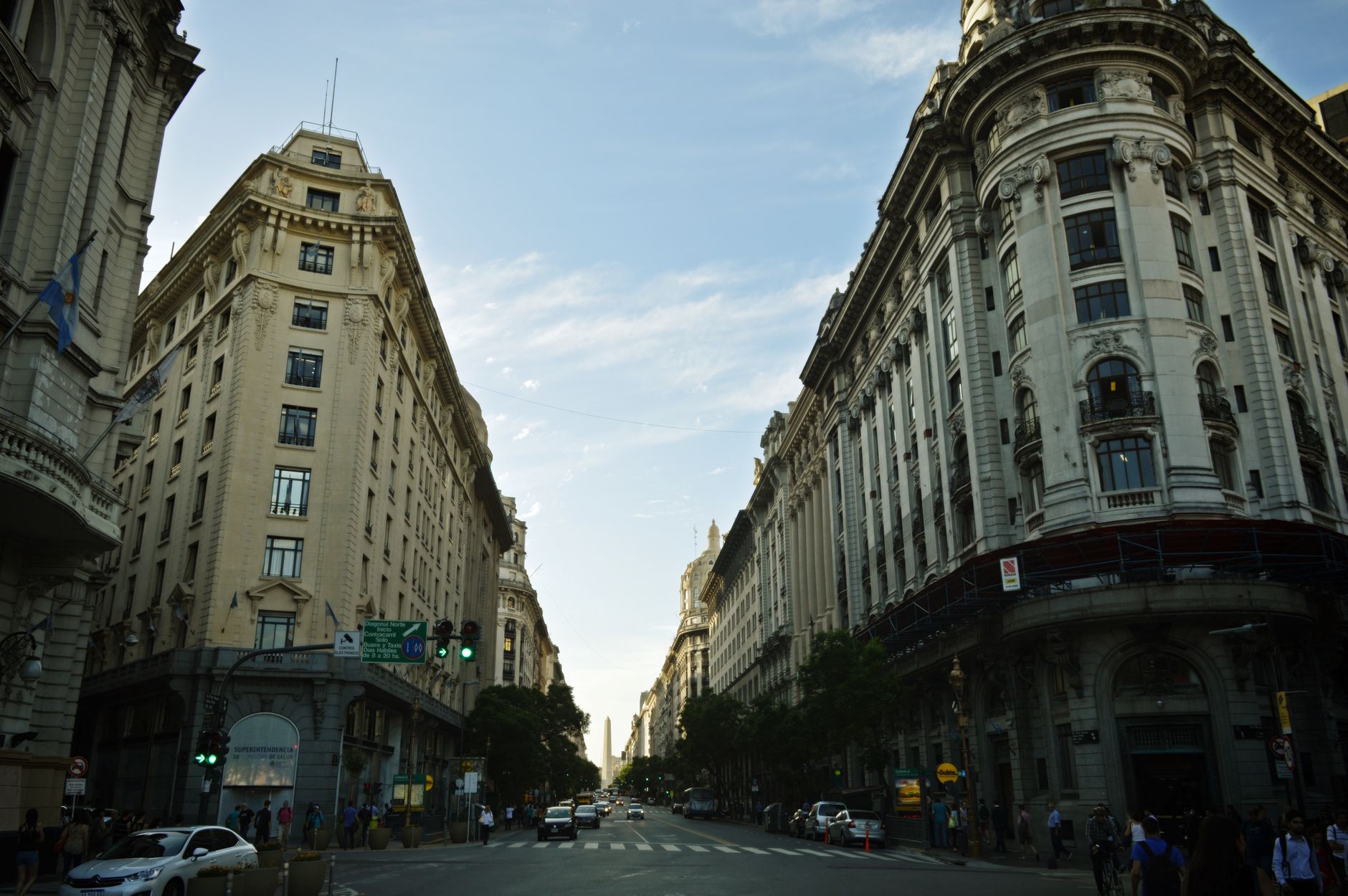
Built in just 31 days to mark the 400th anniversary of the first founding, the 67.5-meter Obelisco was immediately controversial. The city council voted to demolish it in 1939; the Senate refused. Porteños who had mocked it discovered they couldn't imagine the skyline without it. It stands at the intersection of Corrientes and 9 de Julio — the world's widest avenue at 140 meters — and has become the city's default gathering point for celebrations, protests, and World Cup victories.
gavel
1946
Perón and Evita Transform Argentina
Juan Domingo Perón won the presidency in February 1946, but the defining moment had come the previous October 17: a mass mobilization of workers — the descamisados, the shirtless ones — flooded Plaza de Mayo to demand the imprisoned Perón's release. His wife Eva became the emotional core of the movement, channeling fury and charity in equal measure from the balcony of the Casa Rosada. She died of cancer in 1952 at age 33; the nation stopped. Her embalmed body would travel a stranger road than she ever did alive.
science
1947
Houssay Wins Latin America's First Science Nobel
Bernardo Houssay, born in Buenos Aires and educated at the University of Buenos Aires medical school — which he entered at age 14 — received the Nobel Prize in Physiology or Medicine for his work on pituitary hormones and sugar metabolism. He had been fired from his university post in 1943 for opposing the military government, and continued his research in a private lab funded by colleagues. The prize was vindication, and it established Buenos Aires as a city that produced not just writers and tango dancers but serious science.
swords
1955
Navy Bombs Plaza de Mayo
On June 16, Argentine Navy planes bombed and strafed Plaza de Mayo in a failed attempt to assassinate Perón, killing over 300 civilians. The attack — on the symbolic heart of the nation, against the people who happened to be there — remains one of the most shocking acts of political violence in Argentine history. Perón survived but was overthrown three months later by a military coup. His exile would last eighteen years, but Peronism, hardened by persecution, only grew.
person
1960
Maradona Is Born in Lanús
Diego Armando Maradona grew up in Villa Fiorito, a shantytown in Greater Buenos Aires where the streets were dirt and the football was everything. He debuted professionally at 15 for Argentinos Juniors, and by 1981 he was at Boca Juniors, where La Bombonera shook in ways that registered on seismographs. He left for Europe, but Buenos Aires never left him — his murals cover San Telmo and La Boca, and his death in 2020 brought three million people into the streets.
public
1976–1983
The Dirty War and the Disappeared
The military junta that seized power in March 1976 launched a campaign of state terror that killed an estimated 30,000 people — los desaparecidos, the disappeared. In Buenos Aires, the ESMA (Navy Mechanics School) in Núñez became the most notorious of 340 clandestine detention centers. In 1977, the Mothers of the Plaza de Mayo began their silent Thursday marches around the plaza's pyramid, white headscarves marking absence. They still march today. The ESMA is now a Memory and Human Rights museum.
swords
1982
Falklands Defeat Ends the Dictatorship
The junta's disastrous invasion of the Falkland Islands — a nationalist gamble to distract from economic collapse — ended in military humiliation after 74 days and 649 Argentine dead. The same Plaza de Mayo that had cheered the invasion in April erupted in rage by June. The dictatorship collapsed within a year. Democratic elections in October 1983 brought Raúl Alfonsín to power, and Buenos Aires breathed freely for the first time in seven years. The trials of the junta commanders followed — unprecedented in Latin America.
Contemporary Era
local_fire_department
1992
The Israeli Embassy Bombing
On March 17, a truck bomb destroyed the Israeli Embassy on Calle Arroyo, killing 29 people and wounding 242. Two years later, the AMIA Jewish community center in Once was bombed, killing 85 — the deadliest terrorist attack in Argentine history. The investigations were marred by cover-ups and judicial incompetence. The AMIA site bears a memorial; prosecutor Alberto Nisman, who accused the government of covering up Iranian involvement, was found dead in 2015 the night before he was to present evidence to Congress.
gavel
2001
Economic Collapse and the Cacerolazo
In December, Argentina defaulted on $93 billion in sovereign debt — the largest default in history at the time. Banks froze savings accounts. Buenos Aires erupted: the cacerolazo, in which thousands banged pots and pans in the streets, drove President de la Rúa from the Casa Rosada by helicopter. Argentina burned through five presidents in ten days. The crisis hollowed out the middle class, filled the streets with cartoneros picking through trash, and left a scar on porteño psychology that still shapes how people think about banks and the peso.
music_note
2009
Tango Receives UNESCO Heritage Status
UNESCO inscribed tango on its Representative List of Intangible Cultural Heritage, recognizing the music, dance, poetry, and philosophy born in the Río de la Plata region. For Buenos Aires, this was less revelation than confirmation — the city had been exporting tango culture for a century. But the designation spurred new investment in milongas, tango schools, and the annual Festival y Mundial de Tango, which draws dancers from 40 countries to compete in the city where every cobblestone seems to have a compás.
castle
2015
Puerto Madero's Transformation Complete
What had been four kilometers of derelict 19th-century grain docks east of the microcentro became Buenos Aires's most dramatic urban renewal project. Begun in the 1990s, Puerto Madero filled the old brick warehouses with restaurants and lofts, added Santiago Calatrava's Puente de la Mujer — a rotating footbridge shaped like a couple in tango — and preserved the 350-hectare Reserva Ecológica, where herons and coypus live within sight of glass towers. Critics call it sterile and expensive. The Sunday joggers seem unbothered.
public
2022
World Cup Victory Floods the Streets
On December 18, Argentina defeated France in what many call the greatest World Cup final ever played, and Buenos Aires lost its mind. An estimated five million people filled the streets — more than the city's population — as the team paraded from Ezeiza airport toward the Obelisco. The bus never arrived; the crowd was so dense the players had to be evacuated by helicopter. Messi lifted the trophy into the summer air, and for one day the peso, the inflation, the political feuds — none of it existed. Only football.