Introduction
This Antigua and Barbuda travel guide starts with a surprise: the country is dry, reef-ringed, and shaped by harbors, shipyards, and 365 beaches rather than rainforest fantasy.
Antigua works best when you stop thinking of it as one resort island and start reading its coast. Saint John's is the practical entry point: cruise piers, produce stalls, churches, and the loose traffic of a capital that still feels small enough to cross in minutes. From there the island opens fast. English Harbour and Falmouth hold the old maritime power, with Nelson's Dockyard still functioning inside a Georgian basin built for war and now filled with masts. Up at Shirley Heights, the view explains the map in one sweep. Then places like Dickenson Bay, Jolly Harbour, and Half Moon Bay show how different one beach island can feel from cove to cove.
Barbuda changes the mood completely. Codrington sits behind a lagoon famous for frigatebirds, while Barbuda's Pink Sand Beach looks less manicured than nearly abandoned, which is the point. Antigua and Barbuda also carries a harder history than the brochures admit. Betty's Hope preserves the machinery of the sugar economy that financed colonial wealth, and the silence there does not feel accidental. Food pulls the story back into the present: fungee with pepperpot, saltfish with ducana, black pineapple sold cold, rum poured with confidence. Come for the sea if you like. You stay interested because the country has texture, memory, and enough sharp edges to avoid becoming wallpaper.
A History Told Through Its Eras
Wadadli Before the Empire Flags
First Peoples, c. 2400 BCE-1493
Morning begins with shell and salt. Along the coast near what is now Jolly Harbour, the earliest inhabitants left mounds of conch, whelk, and crab shell so large that archaeologists can still read a shoreline meal from four thousand years ago. They left no palace, no carved king list, no written boast. The sea kept their archive.
Around 400 CE, farming communities linked to the Arawak world arrived from the Orinoco basin and gave the island a name that still lives in Antiguan mouths: Wadadli. At Indian Creek on the eastern coast, they planted cassava, spun cotton, and shaped red-and-white pottery whose patterns tied Antigua to a wider Caribbean world. Ce que l'on ignore souvent, c'est que this was never an isolated speck in warm water. It was part of a moving, trading, marrying archipelago.
Then came the Caribs, harder fighters, feared sailors, raiders from the south who absorbed and displaced what came before. By the time Christopher Columbus passed in November 1493 on his second voyage, the island was no empty paradise waiting for a European christening. It had defenders, reefs sharp enough to tear a hull, and almost no obvious fresh water from the sea. He named it Santa Maria de la Antigua after a Marian image in Seville and sailed on without landing.
That detail matters. Antigua entered European maps before Europeans truly entered Antigua. The old name survived in memory while the new one settled into paperwork, and that split between what a place calls itself and what empire calls it would haunt the islands for centuries.
The emblematic figures of this era are the unnamed potters and navigators of Indian Creek, whose hands shaped Antigua long before any admiral claimed to discover it.
The name Wadadli, still used affectionately for Antigua today, likely reaches back to the island's pre-Columbian past rather than to any colonial invention.
The Planters, the Windmills, and the Price of Sweetness
Sugar and Empire, 1632-1735
Picture a dry island under a hard white sky in 1632: little surface water, excellent harbors, scrubland that did not look grand but could be made profitable. English settlers from St. Kitts arrived, planted tobacco and indigo, and then sugar changed the scale of everything. Once cane entered the story, Antigua stopped being a marginal colony and became a machine.
The most powerful family in that machine was the Codrington clan. At Betty's Hope, named after Christopher Codrington's wife with a tenderness that history does not permit us to trust, enslaved labor drove one of Antigua's first great sugar estates. The two windmill towers still stand at Betty's Hope, pale and skeletal against the ridge, and they are eloquent ruins because they show exactly how wealth was made: by wind, iron, and exhaustion.
Christopher Codrington the Younger belonged to that old imperial species that could quote Latin, admire good architecture, and remain perfectly capable of barbarity. Educated at Oxford, governor of the Leeward Islands, a soldier with taste and a patron of learning, he was also one of the largest enslavers in the British Caribbean. Ce que l'on ignore souvent, c'est que refinement and cruelty were not opposites in the plantation world. They often shared the same table.
Barbuda developed differently. Leased to the Codringtons in 1685 for the almost comic rent of one fat sheep per year if demanded, it never settled neatly into Antiguan plantation logic. The island around present-day Codrington became a place of provision grounds, livestock, fishing, salvage, and a fierce local independence born from distance. That difference would matter later, when Barbudans began insisting that land belonged to the community, not to whichever distant authority claimed a title deed.
Christopher Codrington the Younger was brilliant enough to impress London and ruthless enough to leave a name that still carries the stain of forced labor.
The Codrington family's lease on Barbuda required a yearly payment of one fat sheep to the Crown, but only if the Crown asked for it.
A Ball, a Conspiracy, and the King's Harbor
Resistance and Naval Power, 1736-1834
The great Antiguan scandal of the 18th century began with a party dress and a death plan. On 11 October 1736, the planter elite prepared to celebrate the anniversary of George II's coronation with a grand ball. Prince Klaas, also called Court, an enslaved man of Akan origin who had earned unusual mobility and trust, was accused of organizing an islandwide revolt to strike that night, poison the white leadership, and seize Antigua in one terrible motion.
The plot was betrayed. What followed was judicial theater of the most savage kind: mass arrests, public terror, and executions meant to frighten every plantation on the island into silence. Prince Klaas was broken on the wheel and burned, while others were hanged or burned alive. One feels, reading the records, not only horror but panic. The slave system knew perfectly well how thin its hold really was.
Yet while fear ruled the cane fields, another Antigua was taking shape around English Harbour. The Royal Navy had grasped what the island's geography offered: one of the finest natural anchorages in the eastern Caribbean, sheltered and strategically placed. Dockyards, storehouses, workshops, rope, tar, timber, discipline, flogging, and logistics transformed the harbor into the repair yard of empire. This was not romance then. It was industry in uniform.
Horatio Nelson arrived in the 1780s as a young captain, more rigid than legendary, and not yet the one-armed icon of Trafalgar myth. He disliked colonial trade evasions, enforced the Navigation Acts with joyless zeal, and managed to irritate the island's merchants almost as much as he impressed the Admiralty. From the heights that would later be called Shirley Heights, one could watch fleets come and go and feel a brutal truth: Antigua's future would be decided as much by sea power as by sugar.
Then the imperial logic shifted again. Britain abolished the slave trade in 1807 and slavery itself in 1834, and Antigua, unlike some colonies, moved straight into emancipation without a formal apprenticeship period. Freedom came on paper in a single legal stroke. Its consequences, as always, were slower, messier, and fought over in wages, land, and dignity.
Prince Klaas stands at the center of this era not as a martyr carved in marble, but as a man who saw that the planter order could be shaken and dared to act on it.
Nelson was so unpopular with Antiguan merchants during his English Harbour years that his later glory did not erase the memory of him as a stubborn customs enforcer.
From Freed People to a Small Kingdom of Its Own
Emancipation to Nationhood, 1834-1981
Emancipation in 1834 did not bring comfort. Dawn found free people still on an island where land, mills, and credit remained in the same hands, and where the old estates did not vanish simply because the law had changed its vocabulary. At places like Betty's Hope, the machinery of sugar carried on for decades, but the social contract had cracked beyond repair.
Antigua's 19th century was marked by drought, low wages, labor disputes, and the long afterlife of plantation power. Saint John's grew as a port and political center, a place where trade, churches, rumor, and argument met in the heat. Ce que l'on ignore souvent, c'est que small Caribbean capitals can be terribly theatrical. A courthouse speech, a dockside strike, a newspaper column, a sermon on Sunday morning: each could change the mood of the island.
In the 20th century, organized labor became the engine of politics. Vere Cornwall Bird emerged from the Antigua Trades and Labour Union with the gifts that matter in island history: stamina, memory, and a feel for ordinary grievance. He spoke for workers shut out of old privilege, built a movement that outlasted colonial administrators, and turned labor unrest into statecraft.
Associated statehood came in 1967. Full independence followed on 1 November 1981, with Antigua and Barbuda remaining a constitutional monarchy within the Commonwealth, a detail Stephane Bern would appreciate because these islands never chose the noisy drama of a republic. They preferred continuity with room for self-rule. The flag went up, Saint John's became the capital of a sovereign state, and the old empire shrank to ceremony.
But Barbuda never stopped defending its difference. The communal land tradition there, shaped over centuries of relative separation, remained one of the most singular political facts in the Caribbean. Independence did not flatten the islands into one simple story. It made the argument between them more visible, which is often what freedom does.
Vere Cornwall Bird understood before most of his rivals that unions were not only about wages; they were rehearsal rooms for national power.
Antigua and Barbuda became independent in 1981 while keeping the British monarch as head of state, a constitutional compromise that mixed decolonization with inherited pageantry.
The Dockyard, the Hurricane, and the Question of Who Decides
Sovereignty, Storms, and Memory, 1981-Present
Walk through Nelson's Dockyard in English Harbour early, before the bars fill and the rigging begins to clink in the heat, and the Georgian stone looks almost indecently orderly. Yet this polished heritage site only became UNESCO-listed in 2016 because generations of Antiguans chose to preserve a naval landscape once built for imperial war. Heritage is never neutral. Someone saves it, someone funds it, someone decides what part of the past deserves varnish.
Tourism remade the economy more thoroughly than any governor. Dickenson Bay, Jolly Harbour, Half Moon Bay, and Shirley Heights became not merely pretty names but revenue systems, each beach and viewpoint threaded into the business of arrival. The old sugar island learned to sell sea light instead of cane. And still, under the brochures, the deeper history remained: slavery, labor, migration, color, class, and the sharp island instinct for spotting pretense.
Then Hurricane Irma struck Barbuda in September 2017 with historic force. Nearly every structure on the island was damaged or destroyed, and the entire population was evacuated to Antigua for a time, an event so extreme it sounded less like weather than exile. In Codrington, the question ceased to be abstract. Who owns the land, who rebuilds, who returns first, and on whose terms?
That debate is still alive. So is the argument over monarchy, constitutional reform, and what a postcolonial Caribbean state should keep from Britain besides cricket and legal stationery. Antigua and Barbuda now stands in that very modern condition: prosperous in places, vulnerable in others, elegant on the surface, and still in conversation with every century that made it. The next chapter will not be written only in cabinet rooms. It will be written on shorelines, in housing plans, and in the stubborn local memory that refuses to forget what sugar and storm both cost.
The modern emblem may be the Barbudan resident who returned after Irma to rebuild a home on contested ground and insist that survival is also a political act.
When Barbuda was evacuated after Hurricane Irma in 2017, an entire inhabited island community was displaced at once, a rare and shocking event in modern Caribbean history.
The Cultural Soul
A Tongue in Two Temperatures
In Antigua and Barbuda, English does the official work and Creole does the human work. You hear the shift in Saint John's at a shop counter, in a minibus, outside a school gate: one register for the world, another for the pulse.
Antiguan and Barbudan Creole is not decoration. It carries irony, rank, tenderness, warning. A sentence can begin in textbook English and end in raabak, and with that small turn the air changes, as if someone opened a kitchen door and let the real smell of the meal escape.
A few words behave like passports. Wadadli is one of them, old name and present password at once. Lime is another: not idleness, never that, but the serious art of staying in company long enough for gossip, rum, fried fish, and silence to become the same ritual.
The Courtesy Before the Question
The first rule is almost liturgical: say good morning before you ask for anything. In Saint John's, in Parham, in a bakery near Liberta, that greeting is the key that opens the day.
Skip it and you will not be punished. You will be cooled. The Caribbean has perfected this form of judgment: no sermon, no scene, only a slight withdrawal of warmth, which is far more educational.
Respect here is procedural, which makes it beautiful. Elders are greeted, drivers are acknowledged, clerks are not treated like furniture, and the person who understands this passes through Antigua with grace while the person who mistakes ease for informality reveals, within thirty seconds, that they were not raised properly.
What the Pot Knows
The national dish, fungee and pepperpot, tells the whole story with more honesty than a museum panel ever could. Cornmeal, okra, greens, salted meat, heat: the plate remembers West Africa, plantation economies, kitchen thrift, and the old intelligence of feeding many mouths without apology.
Ducana with saltfish and chop-up is even more persuasive because it refuses good manners in the European sense. Sweet potato and coconut wrapped in leaf, boiled until they become something between pudding and argument, then set beside salted cod and mashed greens: sweetness, brine, softness, pepper. Antigua likes contrast the way some countries like symmetry.
You understand the islands through breakfast. Sunday bread torn by hand, saltfish sauteed with onion and pepper, maybe a boiled egg, maybe plantain, and if a black pineapple appears, chilled and cut thick, it ends the debate about whether fruit can be voluptuous. It can.
Books With Salt on the Spine
Antigua produced one of the least obedient writers in the Caribbean, and the island is better for it. Jamaica Kincaid does not flatter her birthplace in A Small Place, Annie John, or Lucy; she examines it with the kind of intimacy that only love, injury, and perfect memory can produce.
That severity matters. Small islands are too often written as scenery, a blue backdrop for somebody else's revelation, whereas Antiguan writing insists on the opposite: history has weight here, language has class signals, and a street in Saint John's can carry more truth than a resort terrace with twelve cocktails on offer.
Read Joanne C. Hillhouse for the daily grammar of contemporary Antigua, and Marie-Elena John for the darker charge of inheritance and rumor. Then visit Betty's Hope. The windmill towers stop being picturesque and return, as they should, to the realm of evidence.
Steel, Bass, and the Art of Staying Out Late
Music in Antigua does not beg for your admiration. It assumes a body will answer. Steelpan, soca, reggae, gospel, and old calypso circulate through the islands not as genres in a catalog but as social instructions: dance, answer back, remember, tease, endure.
Shirley Heights on a Sunday is the example outsiders usually meet first, and for once the cliche almost deserves survival. The view over English Harbour is absurd enough, but the real event happens lower down, in the bandstand pulse, the grilled food smoke, the plastic cup in your hand, the way sunset turns a crowd of strangers into temporary accomplices.
Barbuda keeps a different tempo. In Codrington, music feels less staged and more domestic, closer to gathering than spectacle. The Caribbean understands something Europe often forgets: rhythm is a form of social order.
Stone, Wind, and Naval Obsession
Antigua built with what it had and what empire demanded. Limestone, coral, timber, cisterns, shuttered verandas, thick walls against heat, then the great imperial exception at English Harbour, where Nelson's Dockyard still stands with Georgian discipline so intact it feels less restored than stubborn.
The dockyard is impressive for an unsettling reason. It is elegant because it was useful, and useful because the British Empire intended to control trade routes, repair warships, and dominate these waters with polished efficiency. Beauty is often compromised; here it is organized.
Then you go inland to Betty's Hope and the romance collapses, correctly. Two white towers on a ridge, all bone and wind, all geometry and violence. Antigua's architecture has excellent manners, but it keeps the ledger open.
What Makes Antigua and Barbuda Unmissable
365 Distinct Beaches
The famous number is marketing, but the variety is real. Dickenson Bay, Half Moon Bay, and Barbuda's Pink Sand Beach each answer a different version of the same question: calm water, Atlantic drama, or near-total emptiness.
Harbors Built for Sail
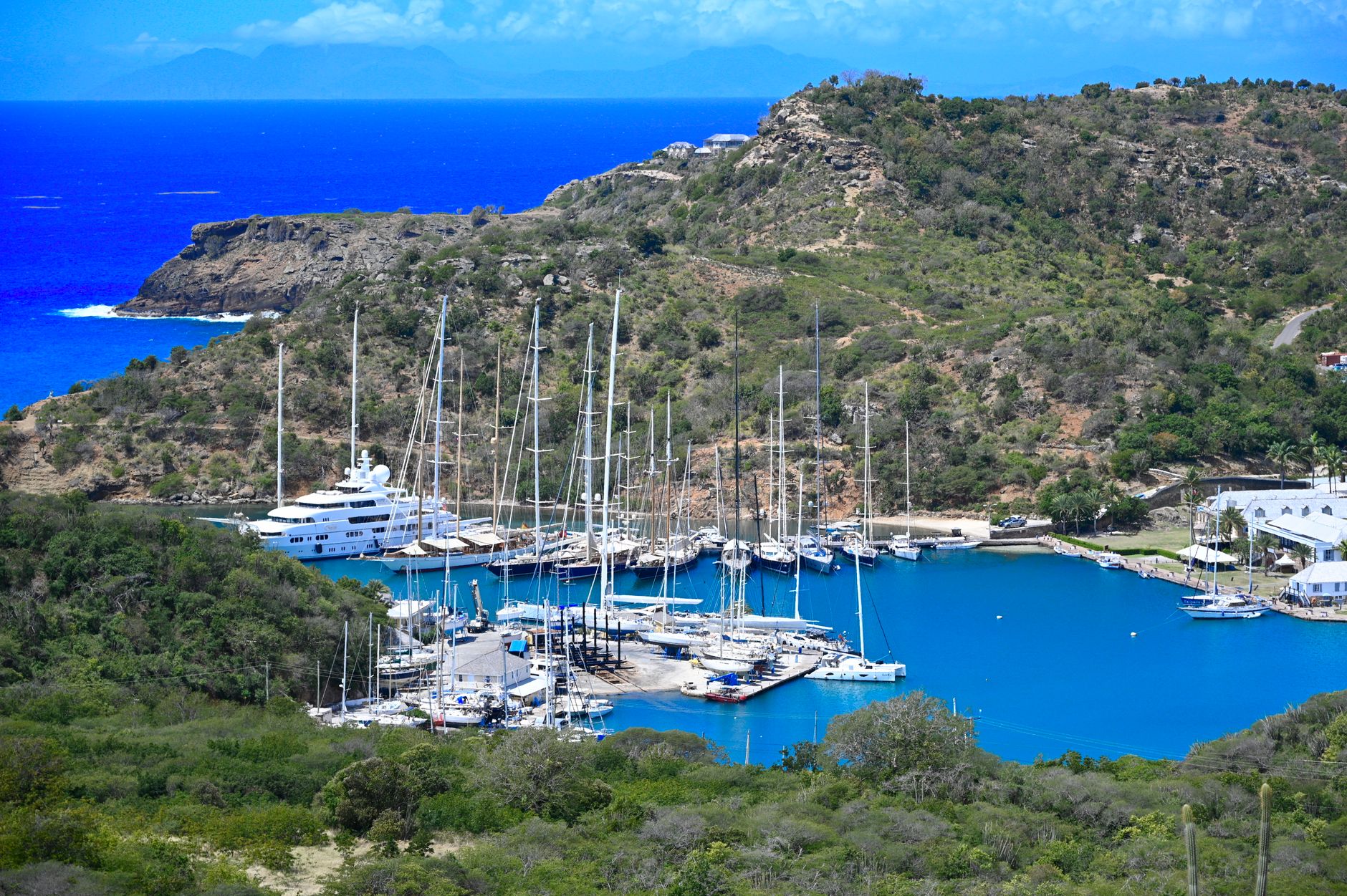
English Harbour remains one of the Caribbean's great natural anchorages, and Falmouth keeps the sailing world tied to Antigua long after regatta week ends. Even if you never board a yacht, the rigging, boatyards, and sea talk shape the place.
Colonial History, Unvarnished
Betty's Hope and Nelson's Dockyard show the wealth, violence, and engineering of the British Atlantic in plain view. Antigua's past is not tucked away in museums; it stands in windmill towers, stone storehouses, and place names that still carry weight.
Frigatebirds and Open Water
Barbuda's Codrington Lagoon holds one of the Western Hemisphere's largest magnificent frigatebird colonies. The spectacle is less about color than scale: long wings, red throat pouches, and a wetland that feels far removed from resort Antigua.
A Serious Island Table
The local food has backbone: fungee, pepperpot, saltfish, ducana, seasoned rice, lobster, and black pineapple with almost no acid bite. Antigua and Barbuda cooks from memory, trade routes, and whatever the sea gave up that morning.
Cities
Cities in Antigua and Barbuda
Saint John's
"The capital's corrugated-iron rooflines, pastel Georgian facades, and the controlled chaos of Heritage Quay on cruise days reveal a working Caribbean city that has never fully tidied itself up for tourists."
English Harbour
"Nelson's Dockyard sits inside a natural deep-water harbour so perfectly sheltered that the British Navy used it as their Caribbean repair yard for 200 years, and the capstans used to careen warships are still bolted to t"
Falmouth
"The quiet twin of English Harbour across the headland, where local fishing boats share the anchorage with superyachts and the pace drops to something close to the pre-colonial rhythm of the bay."
Shirley Heights
"The ruined 18th-century military lookout above English Harbour hosts a Sunday barbecue that starts with steel pan and ends with reggae, but the real reason to climb is the view: two harbours, Montserrat on the horizon, a"
Codrington
"Barbuda's only settlement of roughly 1,500 people sits beside the lagoon that shelters one of the Western Hemisphere's largest frigatebird colonies โ around 5,000 nesting pairs whose wing-spans shadow the mangroves at du"
Betty's Hope
"Two 17th-century windmill towers stand bone-white on a central ridge, the last legible ruins of the Codrington sugar empire that shaped the island's entire social geography for three centuries."
Jolly Harbour
"A purpose-built marina village on the southwest coast that functions as a self-contained expat and charter-boat world, useful as a base but honest about being a place Antigua built for outsiders rather than itself."
Parham
"Antigua's oldest European settlement, founded before Saint John's, where the octagonal St. Peter's Church โ mid-18th century, stucco over brick, oddly Italian in ambition โ stands in a village that time seems to have inv"
Dickenson Bay
"The island's most developed resort strip on the northwest coast, where the beach is genuinely wide and white but the density of sun-loungers and jet-ski operators tells you exactly what kind of transaction is on offer."
Half Moon Bay
"A horseshoe of pale sand on the Atlantic-facing southeast coast where the surf is rougher, the reef is close, and on most weekdays you will share the beach with almost no one."
Barbuda's Pink Sand Beach
"The seventeen-kilometre stretch on Barbuda's western shore gets its blush from crushed coral and shell; the colour is most visible in raking morning light and fades to cream by midday, which is a detail most photographs "
Liberta
"One of the first free villages established after emancipation in 1834 โ the name is not metaphor but record โ and still a residential community whose founding history is more significant than any monument it contains."
Regions
Saint John's
Northwest Gateway
Saint John's is the country's working capital, not a stage set, and that is part of its appeal. This corner of Antigua mixes ferry docks, markets, banks, rum shops, and the easiest urban access to resort beaches, so it works best for travelers who want errands, transport, and sea within the same afternoon.
English Harbour
Southern Harbours
The south is Antigua's most layered region: Georgian dockyard history, active marinas, and a social life shaped by racing calendars and sundown rituals. English Harbour and nearby Falmouth feel polished without turning bloodless, and Shirley Heights still earns its reputation because the topography does half the work.
Betty's Hope
East Coast and Plantation Belt
Eastern Antigua shows the island's harder edges: exposed Atlantic water, older sugar landscapes, and villages that are less buffered by tourism. Betty's Hope gives the historical frame, while Parham and Half Moon Bay show how quickly the island shifts from settlement to weather and open sea.
Codrington
Barbuda
Barbuda runs on a different clock from Antigua. Codrington is small, practical, and close to the lagoon, while Barbuda's Pink Sand Beach delivers the emptiness many islands promise and few still have: long sand, little build-up, and a feeling that the edge of the country is also the point of it.
Jolly Harbour
Marina West
Western Antigua is easier, calmer, and more residential in mood than the island's windy east. Jolly Harbour makes a useful base for self-drivers who want supermarkets, parking, and quick beach access, while the short hop back toward Saint John's keeps day trips practical rather than heroic.
Suggested Itineraries
3 days
3 Days: Saint John's and the West Coast
This short route keeps transfers light and makes sense if you want a first look at Antigua without spending half the trip in taxis. Base yourself near Saint John's, swim off Dickenson Bay, then finish with a slower beach-and-marina day around Jolly Harbour.
Best for: first-timers, cruise extensions, long weekends
7 days
7 Days: Sugar Estate to Sailor Country
This is the best one-week route for travelers who want history with their sea views. Start inland at Betty's Hope, pass through Liberta for everyday Antigua rather than resort Antigua, then spend the second half around English Harbour and Shirley Heights where naval history and sunset drinking still live side by side.
Best for: history-minded travelers, couples, sailors on land for a week
10 days
10 Days: Barbuda and the Windward Side
This route splits time between Antigua's rougher Atlantic edge and Barbuda's stripped-back calm. Go north to Codrington and Barbuda's Pink Sand Beach first, then return to Antigua for the older port atmosphere of Parham and the surf-and-sky drama of Half Moon Bay.
Best for: repeat Caribbean travelers, wildlife lovers, beach minimalists
14 days
14 Days: Slow Antigua by the Harbours and Headlands
Two weeks lets you stay put longer and avoid turning Antigua into a checklist. Use Falmouth as a working-harbour base, climb or drive up to Shirley Heights more than once because the light changes everything, then end on the east coast around Half Moon Bay where the island feels wilder and less managed.
Best for: slow travelers, remote workers, return visitors
Notable Figures
Prince Klaas
d. 1736 ยท Enslaved rebel leaderPrince Klaas, also recorded as Court, moved through Antigua with unusual freedom for an enslaved man and turned that access into a conspiracy that terrified the planter class. His defeat was followed by spectacular brutality, which is precisely why his name endured: the authorities tried to make him an example, and made him unforgettable instead.
Christopher Codrington the Younger
1668-1710 ยท Colonial governor and planterCodrington had the education and polish of a London man of letters, yet his fortune rested on enslaved labor in Antigua and Barbados. He embodies the old imperial contradiction in its most disturbing form: cultivated, ambitious, and perfectly at ease inside a system of organized cruelty.
Horatio Nelson
1758-1805 ยท Naval officerBefore he became Britain's naval saint, Nelson was a young officer in English Harbour, enforcing trade rules and annoying local merchants with righteous determination. Nelson's Dockyard preserves his name, but not because he built it alone; it preserves the whole naval machine that made his career possible.
Vere Cornwall Bird
1910-1999 ยท Trade unionist and first Prime MinisterBird rose from labor politics, where he learned that a wage dispute can become a constitutional question if enough people are listening. When independence arrived in 1981, he stood not as a gentleman reformer but as the political heir of decades of workers who wanted the island run by their own people.
George Walter
1928-2008 ยท Trade union leader and Prime MinisterWalter came from the same labor-grounded world as Bird but offered a different political style, more union hall than dynasty. His years in office remind you that Antiguan politics was never a neat procession toward one leader; it was a contested field shaped by strikes, personalities, and grudges that did not fade quickly.
Tim Hector
1942-2002 ยท Writer, activist, and journalistTim Hector fought with words, which in a small island can be more dangerous than fighting with money. Through journalism and activism, he pressed Antigua to look directly at power, race, corruption, and memory rather than hiding behind the easy shine of independence.
Jamaica Kincaid
born 1949 ยท WriterKincaid gave Antigua one of its sharpest literary mirrors and refused to make that mirror flattering. In books like "A Small Place," she wrote the island with affection, anger, class memory, and a precision that stripped the postcard varnish clean off the scene.
Heather Doram
born 1954 ยท Artist and designerDoram's work matters because nations are not built only by politicians and dockyard treaties. They are also dressed, staged, and imagined, and she helped give Antigua and Barbuda a visual language that could hold folklore, ceremony, and self-respect in the same frame.
Photo Gallery
Explore Antigua and Barbuda in Pictures
Stunning aerial view of a serene harbor with moored yachts, surrounded by lush hills and vibrant blue water.
Photo by Thomas Dudek on Pexels · Pexels License
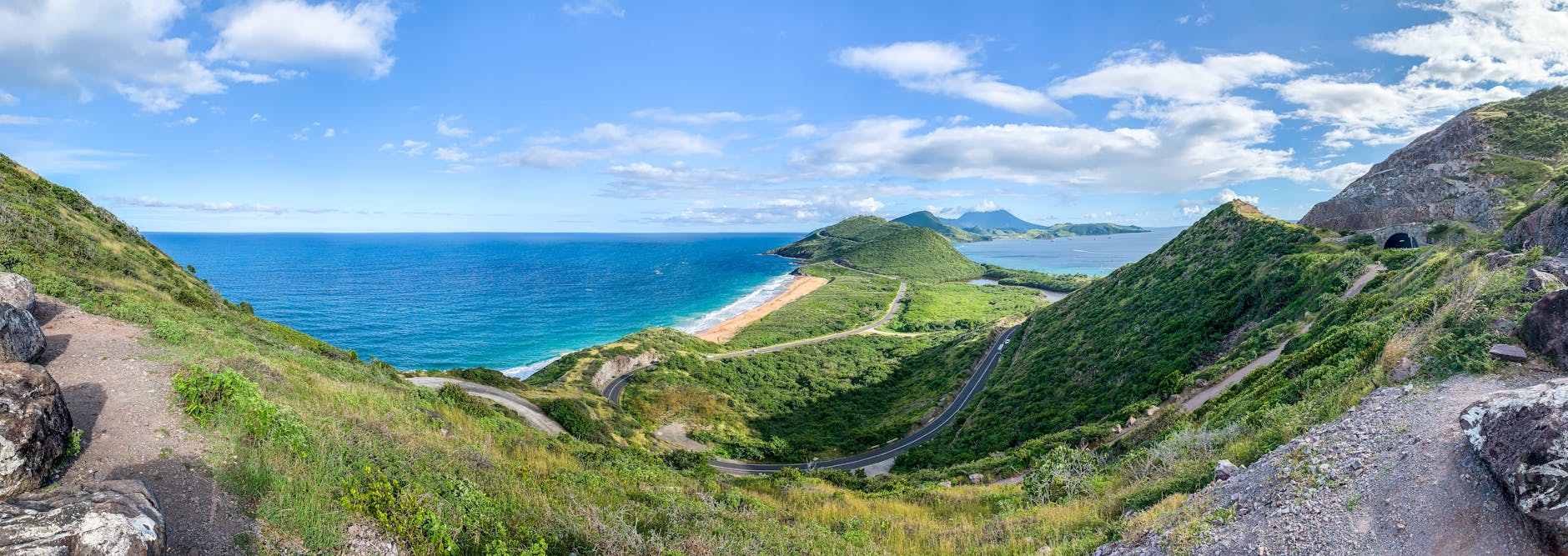
Breathtaking panoramic view of Saint Kitts lush coastline and vibrant ocean.
Photo by Justin Brinkhoff on Pexels · Pexels License
A stunning sunset with dark clouds over mountains in Antigua and Barbuda, creating a vibrant and moody scene.
Photo by Kishawnie James on Pexels · Pexels License
Practical Information
Visa
US, UK, Canadian, EU, Australian, and many other passport holders are visa-exempt for short tourist trips to Antigua and Barbuda, but the immigration officer sets the final length of stay on arrival. Bring a passport valid for at least 6 months, an onward ticket, your accommodation details, and proof you can fund the trip.
Currency
The local currency is the Eastern Caribbean dollar, written XCD or EC$, and it is pegged at EC$2.70 to US$1.00. US dollars are widely accepted in resorts and tourist restaurants, but buses, beach bars, and small shops work more smoothly with EC cash.
Getting There
Most travelers arrive through V.C. Bird International Airport on Antigua, the country's main air gateway for North America, the UK, and regional Caribbean flights. For a faster airport process, complete the free ArriveAntigua form within 72 hours before departure and keep the QR code on your phone.
Getting Around
Antigua is compact enough that most drives take 45 minutes or less, which makes a rental car the simplest way to combine beaches, viewpoints, and heritage sites in one day. Visitors drive on the left and need a temporary local permit, usually arranged by the rental company for EC$50; if you skip the car, fixed-fare taxis and daytime minibuses from Saint John's cover the basics.
Climate
Expect warm trade-wind weather all year, with daytime temperatures usually around 24 to 30C. December to April is the driest and easiest period for first-time visitors, while June to November brings lower prices, heavier showers, and real hurricane-season risk.
Connectivity
Hotels and apartments usually have usable Wi-Fi, but speeds vary sharply outside higher-end resorts. If you need reliable maps, messaging, or hotspot data for drives between English Harbour, Betty's Hope, and Half Moon Bay, buying a local Digicel SIM or eSIM is the cleanest solution.
Safety
Antigua and Barbuda is manageable for independent travelers, but petty theft and some violent crime do occur, especially in isolated places after dark. Use licensed taxis, avoid empty beaches at night, do not leave valuables visible in cars, and check the bill before adding a tip because service charges are often already included.
Taste the Country
restaurantFungee and pepperpot
Families serve it at lunch or Sunday dinner. Spoons scoop fungee, drag it through the stew, then pause for pepper and talk.
restaurantDucana with saltfish and chop-up
Cooks boil the leaf-wrapped ducana, flake the cod, mash the greens. Plates hold sweet, salt, and starch in one tight argument.
restaurantSunday bread and saltfish
Breakfast tables tear the loaf by hand and pass the pan of saltfish. Coffee, gossip, late morning, no hurry.
restaurantGoat water
Pots simmer for gatherings, wakes, and weekend meals. Bread follows the bowl and does the last work.
restaurantBlack pineapple
People chill it, slice it thick, and serve it after lunch or straight from the market. Dessert by subtraction.
restaurantBarbudan lobster
Hands split the shell, lime hits the flesh, napkins fail. Barbuda eats it with friends, sea breeze, and very little ceremony.
restaurantConch water
Vendors ladle it hot in cups or bowls near the shore. Pepper, herbs, conch, then the clean shock of brine.
Tips for Visitors
Watch the extras
Hotel bills can stack quickly once ABST, service charge, and the guest levy land on top. Compare final prices, not headline room rates.
Use buses selectively
Minibuses are cheap and useful for daytime hops from Saint John's, but they are not built for airport timing or late dinners. For English Harbour, Shirley Heights, or any return after dark, budget for a taxi or rental car.
Drive in daylight
Left-side driving is manageable, but potholes, narrow shoulders, and uneven lighting make night driving slower than the map suggests. Pick up the car in the morning and save the unfamiliar roads for daylight.
Book high season early
December to April fills fast, and Antigua Sailing Week pushes up rates around English Harbour and Falmouth in particular. If your trip touches regatta dates, lock in rooms and cars well ahead.
Check the service line
Many restaurants and hotels already add a 10 percent service charge. Read the bottom of the bill before tipping again, then round up only if service was actually good.
Buy data if it matters
Resort Wi-Fi can be fine in the room and weak by the beach, which is exactly when you need maps or banking apps. A local SIM or eSIM is cheap insurance if you plan to move around a lot.
Lead with greetings
In shops, guesthouses, and offices, say good morning or good afternoon before asking for anything. It sounds minor until you skip it.
Explore Antigua and Barbuda with a personal guide in your pocket
Your Personal Curator, in Your Pocket.
Audio guides for 1,100+ cities across 96 countries. History, stories, and local insight โ offline ready.
Audiala App
Available on iOS & Android
Join 50k+ Curators
Frequently Asked
Do US citizens need a visa for Antigua and Barbuda? add
No, US citizens do not normally need a visa for tourist visits to Antigua and Barbuda. You still need a passport with at least 6 months' validity, an onward or return ticket, accommodation details, and enough funds for the stay.
How many days do you need in Antigua and Barbuda? add
Seven days is the sweet spot for a first trip. That gives you time for Saint John's, English Harbour, Shirley Heights, one east-coast day around Half Moon Bay or Betty's Hope, and either a Barbuda day trip or a slower beach day.
Is Antigua expensive for travelers? add
Yes, it can be, mainly because accommodation drives the budget hard. A guesthouse-and-bus trip can stay moderate, but resort rates, taxis, and restaurant service charges push costs up fast.
Can you use US dollars in Antigua and Barbuda? add
Yes, in many hotels, tour desks, and tourist restaurants. But change may come back in EC dollars, and local buses, small shops, and beach bars are easier with EC cash.
Is it worth staying overnight in Barbuda or just doing a day trip? add
An overnight stay is better if Barbuda is the point of your trip rather than a box to tick. A day trip gets you to Codrington and Barbuda's Pink Sand Beach, but one night lets you feel the quiet after the boats leave.
Do I need to fill out the ArriveAntigua form before flying? add
Yes, you should complete ArriveAntigua before flying into V.C. Bird International Airport. The system opens within 72 hours of travel and gives you a QR code that speeds immigration and customs.
Is Antigua safe to drive yourself? add
Yes, if you are comfortable driving on the left and keep your expectations realistic. Roads are short rather than fast, and daylight driving is much easier than tackling rural stretches after dark.
What is the best month to visit Antigua and Barbuda? add
February is one of the safest bets for weather, sea conditions, and manageable humidity. January through April is the broader dry-season window, while May often gives good value if you can tolerate a bit more heat.
Can you get around Antigua without renting a car? add
Yes, but only if you are patient and plan around daylight. Saint John's works as the transport hub, and minibuses can get you part of the way, but beaches and heritage sites are much easier to combine with a car.
Sources
- verified Antigua and Barbuda Department of Immigration โ Official visa rules, stay conditions for visa-exempt travelers, and required documents.
- verified Countries Exempt from Visa | Immigration Antigua and Barbuda โ Official list of nationalities that do not require a visa for entry.
- verified Visit Antigua & Barbuda | Getting Around โ Tourism authority guidance on buses, taxis, rental cars, driving permit fee, and ferry timing.
- verified Eastern Caribbean Central Bank | Currency โ Official confirmation of the XCD currency and the fixed EC$2.70 to US$1.00 peg.
- verified GOV.UK Travel Advice for Antigua and Barbuda โ Current government travel advice covering entry, safety, road risks, and hurricane season.
Last reviewed: