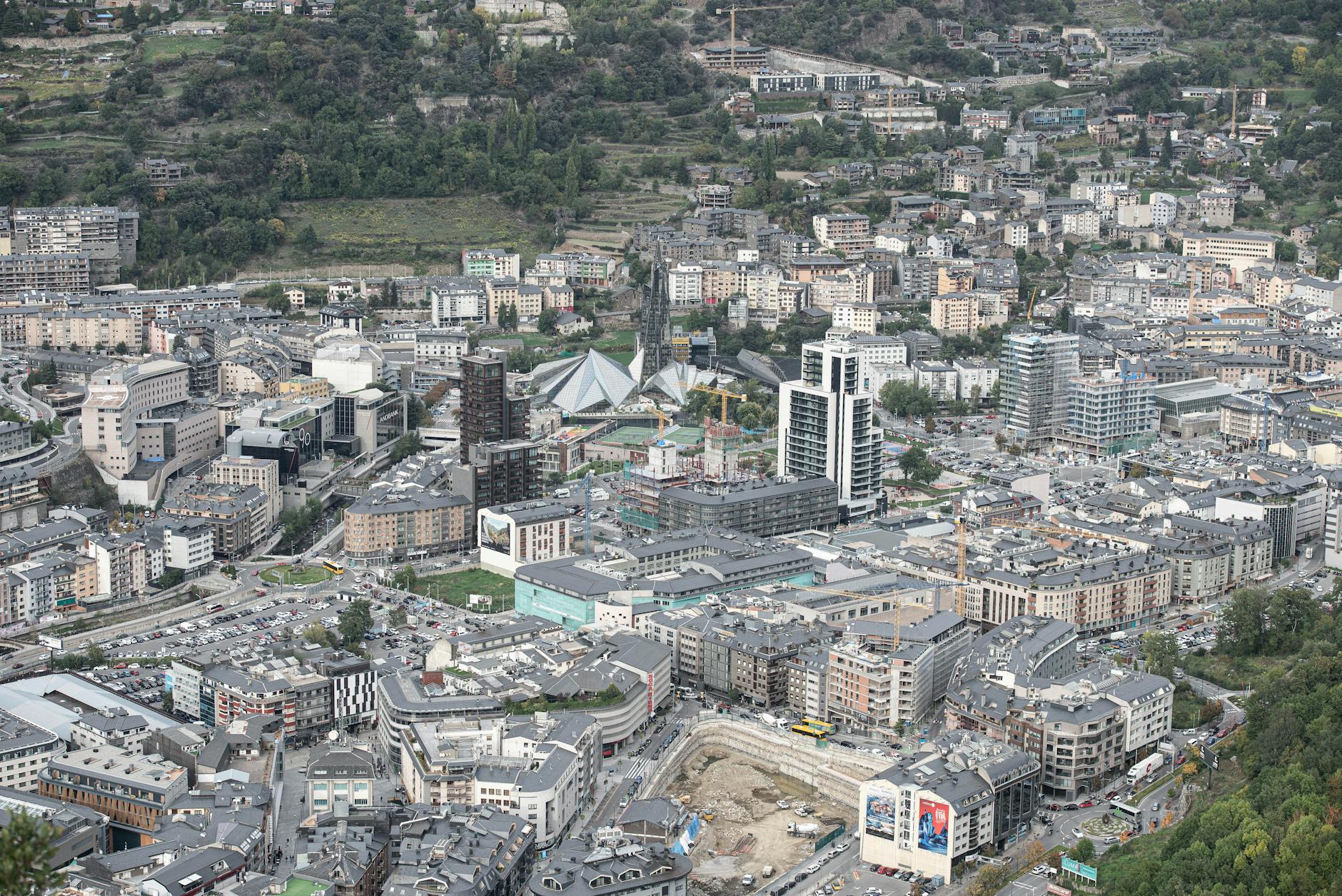
Andorra La Vella

Andorra

Andorra La Vella

Europe’s highest capital has no airport—just a 15th-century parliament, a Dalí clock and duty-free shops you can cross in twenty minutes.

location_on 12 attractions
calendar_month June–September for walking, December–March for snow-day trips
schedule 1–2 full days

Introduction

The first thing you notice is the echo: shop lights bouncing off limestone walls, the Gran Valira river hissing under stone bridges, and a Salvador Dalí clock that seems to drip rather than tick. Andorra la Vella, capital of the pocket-sized principality of Andorra, feels like someone pressed pause between France and Spain and forgot to tell the mountains.

At 1,023 m it is Europe's highest capital, yet the altitude is less startling than the contrast: fifteen-minute walk from the 1580 stone manor that once housed the world's oldest parliament you can buy a €3,000 smart-watch under neon skylights. Duty-free perfume hangs in the air beside wood-smoke from bordas—old Pyrenean barns—now turned restaurants serving trinxat, a bacon-and-cabbage hash that tastes like winter decided to comfort you personally.

Locals switch between Catalan, Spanish, French and often English within one sentence, and nobody waits for traffic lights because there are scarcely any roads longer than 400 m. The city’s real thoroughfare is footpaths: cobbled lanes in the Barri Antic, metal footbridges painted lipstick red, riverbank gravel that crunches loud enough to drown out ring-tones. When bells of Sant Esteve strike seven, their sound ricochets off glass shopfronts like history arguing with the present. Stick around; the argument becomes addictive.

What Makes This City Special

Dalí's Melting Clock

Salvador Dalí's bronze "La Noblesse du Temps" slumps across Plaça de la Rotonda like time itself has surrendered to the Pyrenean wind. Created in 1984, installed in 2010—it's the most-photographed object in the country and free to visit 24/7.

Casa de la Vall

A 1580 stone manor that served as Andorra's parliament until 2011, its council chamber still smells of centuries of candle smoke and political argument. The guided tour (€5) unlocks the seven-key closet where national archives were once guarded by each of the seven parish representatives.

Barri Antic & Sant Esteve

Narrow medieval lanes tilt toward the 12th-century Sant Esteve church, its Romanesque apse catching golden hour light against the mountainside. The quarter spans barely three blocks, yet every painted mural and timbered balcony tells the story of 800 years of mountain commerce.

Historical Timeline

Between Two Crowns, Above All Clouds

How a Pyrenean valley learned to negotiate mountains and monarchs

castle
803 CE

Charlemagne's Gift

Frankish scouts chase Moorish raiders up the Valira valley. The Emperor’s charter—carved on a walnut plank—grants the mountain hamlets tax freedom in return for guarding the passes. The first written mention of Andorra la Vella is born in gratitude and obligation.

gavel
1278

The Pareage Split

Feud parchment signed in Lleida divides the valley like a divorce settlement: the Count of Foix takes the sword, the Bishop of Urgell keeps the crozier. Andorra la Vella, already a cluster of stone houses around Sant Esteve’s modest apse, finds itself ruled by two masters who can barely agree on the spelling of its name.

gavel
1419

Council of the Land

Twenty-four heads of household meet under the lime tree by the church. They vote to send two delegates—one from each parish—to bargain with the co-princes. The General Council is Europe’s quietest revolution: power taken without a single sword drawn.

castle
c. 1580

Casa de la Vall Rises

Local notary Guillem de Riba stuffs loopholes in the valley’s peace treaty. He builds a defensive house with loopholes of another kind: narrow windows for muskets, a trapdoor above the entrance for boiling oil. The stone mansion becomes parliament hall, courtroom, and overnight jail—all three for the price of one roof.

gavel
1607

King of France Inherits Half

Henri IV signs the edict that makes the French crown co-prince. Overnight, Andorra la Vella owes allegiance to a king who has never seen snow. The village sends a delegation bearing eagles carved from boxwood; Henri sends back a silver salt-cellar shaped like a mountain. Diplomacy by cutlery.

school
1748

Manual Digest Printed

Jurist Antoni Fiter i Rossell prints the valley’s laws in Catalan, not Latin. Bound in red leather, the book travels from shepherd’s hut to bishop’s palace. For the first time, a farmer can cite chapter and verse when the tax collector knocks.

swords
July 1934

King Boris the Brief

Boris Skossyreff storms the post office in plus-fours, proclaims himself Boris I, King of Andorra. His royal decree promises casinos and passports for all. Spanish gendarmes arrest him six days later; the valley’s only monarchy lasts exactly 136 hours.

person
1935

Elidà Amigó Born

First cry in a candle-lit room behind the ironmonger’s shop. She will grow up to become the valley’s first female archivist, smuggling medieval parchments out under Franco’s nose to keep memory alive.

local_fire_department
1943

Execution at Dawn

Double-murderer Antoni Arenis faces the firing squad at the old cemetery. Six bullets for two brothers. The echo off the granite cliffs is the loudest sound the village has heard since the last thunderstorm.

palette
1951

Albert Salvadó Learns to Read

In the pharmacy’s back room, eight-year-old Albert discovers Dumas hidden behind the cough syrup. He will grow up to write spy novels set in medieval Andorra and serve as the city’s culture minister, turning bureaucracy into plot twists.

factory
1960

First Ski Lift

A retired smuggler welds chairs from scrap iron. The first lift hauls four tourists up La Serra; they pay in pesetas and wonder why the valley didn’t think of this earlier. The city’s economy tilts from sheep to selfies.

gavel
1970

Women Vote

Parliament extends the franchise to half the valley overnight. Eligible women queue outside Casa de la Vall in the same drizzle their grandmothers queued in for bread. The council chamber smells of wet wool and new ink.

palette
1984

Dalí Clocks Time

Salvador Dalí casts a bronze clock that melts over an angel’s shoulder. The sculpture sits in a Madrid foundry for decades until the city council decides Andorra deserves something more than duty-free perfume. Today it drips bronze in the central square at 1,023 meters above sea level.

gavel
1993

Constitution Day

Voters line up under the same drizzle. The new charter keeps the French president and the Catalan bishop as figureheads but hands real power to elected ministers. The valley joins the United Nations with a flag no larger than a tablecloth.

palette
2010

Dalí Returns Home

A crane lifts the six-meter clock from a flatbed truck. Children on scooters circle it like planets. The bronze is already turning green at the edges; the angel keeps pointing southward, toward Barcelona and every story the valley has borrowed.

castle
2011

Parliament Moves Out

The last session in Casa de la Vall ends with a toast of local pinot. Members walk 300 meters downhill to a glass-and-steel building that hums with elevators. The old house breathes out centuries of pipe smoke and becomes a museum where schoolchildren now ask why the desks are so small.

palette
2014

Seven Poets Light Up

Jaume Plensa installs seven translucent figures—each the height of a doorframe—in front of the new parliament. At night they glow in the colors of the seven parishes. Locals call them the silent deputies; no arguments, no amendments, just quiet light.

schedule
Present Day

Notable Figures

Salvador Dalí

1904–1989 · Surrealist artist
Created La Noblesse du Temps, installed 2010

He never lived here, but his bronze clock—originally cast in 1984—now anchors every tourist selfie. Dalí would probably laugh that his sculpture faces a perfume outlet, surrealism meeting shopping carts.

Antoni Fiter i Rossell

1677–1748 · Attorney and chronicler
Drafted the Manual Digest in Casa de la Vall, 1748

He distilled Andorra’s medieval customs into one book still quoted in parliament. Walk the council chamber and you’re treading floorboards he argued across three centuries ago.

Practical Information

flight

Getting There

No airport exists in Andorra itself. Fly into Barcelona El Prat (BCN) 225 km east or Toulouse-Blagnac (TLS) 180 km north. Direct coaches run 3 hours from both airports to Andorra la Vella's central Carrer Bonaventura Riberaygua terminal. No railway lines reach the country.

directions_transit

Getting Around

The city has no metro or tram. Six urban bus lines (1-6) operated by Cooperativa Interurbana Andorrana are free in 2026—just board without tickets. Walking is fastest in the compact center; the entire old town crosses in 12 minutes.

thermostat

Climate & Best Time

January averages 4°C, August 21°C. Snow falls December-March (-2°C to 7°C), making June and September sweet spots at 15-25°C with hiking trails open. Rain arrives year-round—pack a shell even in July.

translate

Language & Currency

Catalan is official; Spanish and French work everywhere. Euros only—ATMs on every block. No city transit cards needed since buses are free; museums still prefer cash for the €5 Casa de la Vall ticket.

Tips for Visitors

credit_card
Carry Cash

Cards work almost everywhere, but small cafés in Barri Antic sometimes take only cash—keep a €10 note folded for coffee and tiny cheese purchases.

schedule
Eat Late

Restaurants fill after 20:30; arrive at 20:00 and you’ll snag a table without a wait, plus catch the switch from day-menu to heartier evening plates.

directions_bus
Free City Buses

Local buses inside Andorra la Vella cost nothing—hop on to save the 15-minute uphill slog to Escaldes-Engordany and ride back down for free.

photo_camera
Golden Hour Clock

Dalí’s melting clock faces west; show up 45 minutes before sunset to catch the bronze glowing without the daytime tour-bus crowd in your shot.

hiking
Snow Grip Shoes

Even city pavements ice over from November to March—pack pull-on crampons or shoes with real tread so you don’t ski downhill on Carrer de la Vall.

Explore the city with a personal guide in your pocket

Your Personal Curator, in Your Pocket.

Audio guides for 1,100+ cities across 96 countries. History, stories, and local insight — offline ready.

smartphone

Audiala App

Available on iOS & Android

download Download Now

Join 50k+ Curators

Frequently Asked

Is Andorra la Vella worth visiting? add

Yes—one day gives you a Romanesque church, a 15th-century parliament-turned-museum, a Dalí sculpture and Pyrenean views in a walkable mile. Stay two days if you want tax-free shopping and a quick mountain trail.

How many days in Andorra la Vella? add

Budget one full day for the old quarter, public art and dinner. Add a second day for the Thyssen art museum, a valley hike and evening bars; three is plenty even for slow travellers.

Do I need to speak Catalan in Andorra la Vella? add

No—staff in shops and restaurants switch to Spanish, French or English without blinking. A simple ‘Bon dia’ gets a smile, but you’ll manage fine in Spanish.

Is the city safe at night? add

Centre stays busy until after midnight; pickpocket risk is low but watch bags on Meritxell’s crowded sidewalks. Stick to lit streets and you’re as safe as anywhere in Western Europe.

How do I reach Andorra la Vella without an airport? add

Daily coaches run from Barcelona (3 h) and Toulouse (3 h); book ALSA or Andorra Direct. Shared shuttles meet every major flight arrival—reserve online for winter weekends.

Are prices lower because it’s duty-free? add

Electronics and alcohol can be cheaper, but compare first—some gadgets cost the same as in Spain. Groceries and meals run only 5-10 % below Barcelona, not half-price.

Sources

Last reviewed: