Algiers
Algeria Verified Apr 2026
Algiers smells of sea salt and strong coffee at 6 a.m., when the call to prayer ricochets off apartment blocks painted the color of bone. The Algerian capital climbs a steep hill and then spills over it, white cubes sliding toward a Mediterranean so bright it hurts to look at. You arrive expecting a monument to revolution; you leave humming chaâbi songs in a taxi whose dashboard is held together with electrician’s tape.
 Photo: Yassine Boukhenifra / Pexels
- Attractions
- 12
- Trip length
- 3–4 days
- Best season
- Spring (March–May) & Autumn (Sept–Nov)
Why Algiers
Built from cited sources · see the method · How we make our guides →
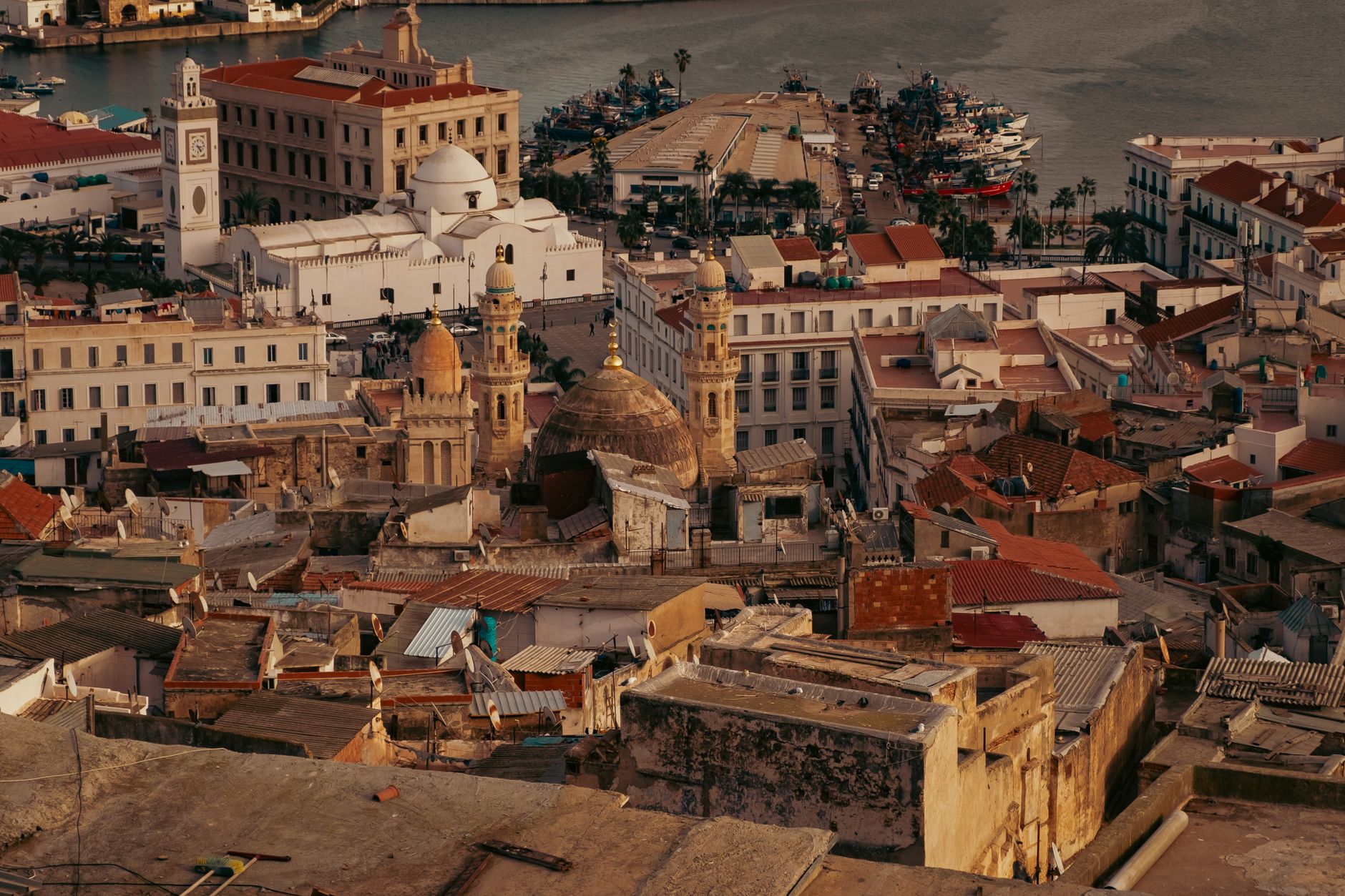
Every layer of occupation—Phoenician, Roman, Ottoman, French—left a seam you can still trace with your fingers. In the Casbah’s dark stairwells the plaster flakes like pastry, revealing Roman stones below; five minutes away, the Grande Poste wears 1910 ironwork as proudly as if it were built yesterday. The city keeps its memories close, but never polished.
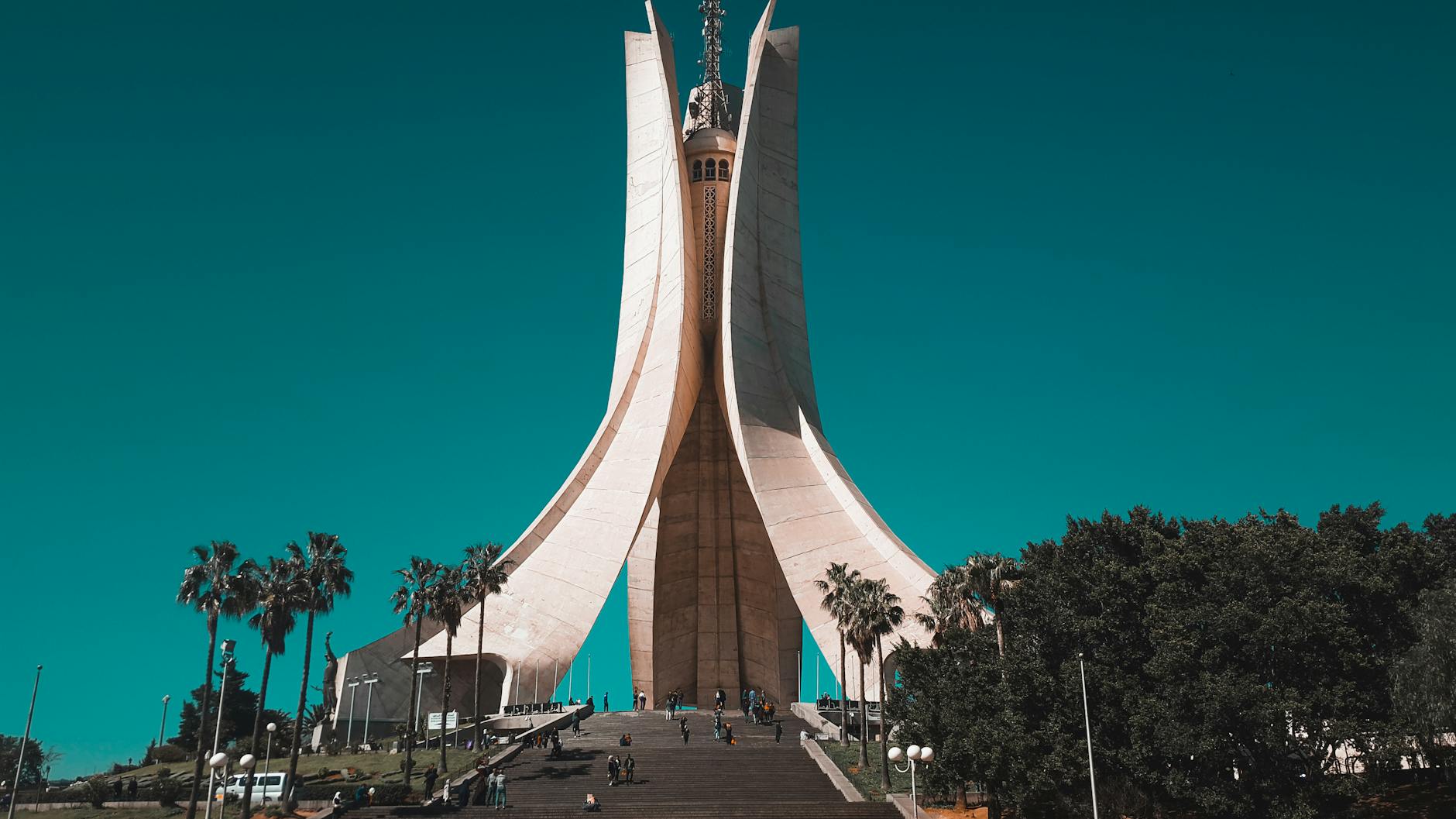
Walk timing matters. Mid-morning the light turns the harbor into hammered silver; by late afternoon the Martyrs’ Memorial throws three concrete palms 92 m into a sky that feels higher here than anywhere else on the coast. Between those hours you eat: rechta noodles in chicken broth at a lunch counter where the waiter will not hand you the bill until you ask three times, or grilled sardines at the port while men in wool caps mend nets with fingers thick as candles.
Algiers is not easy. Streets lurch uphill, museum labels stick to French, and taxi meters are decorative fiction. Yet the reward is a city still inventing itself in real time—where DJs sample raï records in basement bars, students debate Camus in cafés that remember the revolution, and every courtyard wall carries the ghost of a harem window looking out to sea.
Casbah Labyrinth
The Casbah's 1.5 km of Ottoman alleys climb 118 m above the port; every turn reveals a carved door or 17th-century palace wall that survived the 1830 bombardment. A guide costs 2,000 DZD and keeps you from stepping into a house that's been tilting since 1954.Martyrs' Museum Under Concrete Palms
Three 92-metre concrete fronds cast shadow over the National Museum of the Mujahid, where floor-to-ceiling casualty lists scroll like film credits. The cable car from Jardin d’Essai drops you at the plaza for 20 DZD—cheaper than any view in the Mediterranean.Jardin d’Essai's 1832 Ficus
One banyan trunk spans 14 m—wide enough that the 1932 Tarzan crew rigged a camera inside it. Entry is 150 DZD and the metro exit empties straight into the shade, a six-degree drop from the boulevard heat.Basilica that Prays for Muslims
Notre-Dame d’Afrique sits 124 m above the bay; the nave inscription reads 'Our Lady of Africa, pray for us and for the Muslims'. The marble floor still bears shell scars from the 1943 Allied landing—worshippers leave small coins in the deepest chip.
Neighborhoods
Where to wander, by quarter — each with its own rhythm.
Casbah
A 1.2 km² tangle of 16th-century alleys climbing 118 m above the port. Behind green-shuttered walls you’ll find Ottoman palaces turned art centers, bakeries that still stamp bread with the baker’s family seal, and kids who’ll guide you to a roof where the whole white city tilts toward the water. Go with a guide; some staircases end in air.Didouche Mourad
The 1.8 km straight line of Algiers’ conscience—bookshops, shoe repairers, cafés where poets argued independence into existence. The 1898 Grande Poste anchors the lower end; cafés serve espresso in glasses thick as jam jars. Best between 10–11 a.m. when the plane trees smell of hot dust and cologne.Hamma / Jardin d’Essai
Colonial boulevards wide enough for horse artillery now belong to joggers and botanists. The 1832 botanical garden keeps a 28 m ficus that doubled as Tarzan’s jungle in 1932. Above it, the National Museum of Fine Arts hides a top-floor room of Monets no one mentions downstairs.Val d’Hydra
Hillside suburb of embassies and experimental restaurants. Come at dusk when the call to prayer drifts over walled gardens and the temperature drops five degrees in ten minutes. Galatée does a brunch plate where the eggs arrive at exactly 63 °C—chef’s thermometer guarantee.Bab El-Oued
Working-class quarter pressed between the sea and the ridge. Laundry flaps across streets only 3 m wide; fishermen sell sardines straight off the boat for 400 DZD a kilo. Friday lunchtime the air is cumin and harissa—follow your nose to the sandwich cart with the longest queue.El Madania / Martyrs’ Hill
Elevated plateau where the 92 m memorial casts a shadow sharp enough to tell time. The cable car from Jardin d’Essai climbs 68 m in 90 seconds; at the top you see Algeria’s entire coastline curve like a blade. Sunset brings families posing for wedding photos in front of concrete palms.La Madrague / Ain Benian
Former fishing villages swallowed by the western sprawl. At Le Petit Port the terrace sits 4 m above water; order grilled sea bream and watch the sun slip behind the lighthouse. Weekends fill with Algiers kids playing raï from car stereos loud enough to rattle cutlery.Sidi Yahia
Quiet residential slope where jacarandas drop purple petals on parked Peugeots. Hidden courtyards host underground art shows—look for a handwritten paper sign taped to a blue gate. The bread here is still delivered warm at 7 a.m. balanced on the back of a bicycle.
Plan your trip
Before you go
- Getting There
- Houari Boumediene Airport (ALG) lies 20 km east; white-meter taxis charge 1,200 DZD (€8) to centre and leave from the upper deck. No rail link exists—if traffic is heavy, budget 45 min. Long-distance trains terminate at Gare d’Alger (1er Novembre) on Rue d’Angkor; the east–west A1 highway skirts the southern suburbs.
- Getting Around
- RATP El-Djazaïr metro: one line, 19 stations, 50 DZD flat fare, runs 05:00–23:00. Tram line T1 parallels the coast; same ticket. Buses cost the coin but routes are Arabic-only—stick to the metro plus walking. No city bike scheme and hills kill casual cycling; taxi downtown 200–500 DZD after haggling.
- Climate & Best Time
- Spring (Apr–May) 12–24 °C, occasional showers—shoulder crowds. Summer (Jun–Aug) 19–32 °C, rainless, but Casbah alleys bake by 11 a.m. Autumn (Sep–Oct) 16–29 °C, clear skies, warm sea. Winter (Nov–Mar) 8–16 °C and the wettest—January can dump 110 mm. Aim for late April or late September if you want museums and sea without the furnace.
- Language & Currency
- Arabic and French share street signs; English is thin outside hotels. Algerian dinar (DZD) only—euro notes won’t buy you coffee. ATMs dispense 1,000 DZD bills; carry small change for metro gates and 200-DZD espresso.
- Safety
- Violent crime is rare; pickpockets work crowded Didouche Mourad at dusk. Casbah guides double as bodyguards—solo wandering after dark is discouraged. Dress modestly away from the corniche; women report fewer comments in long sleeves.
A City Shaped by Empire and Revolution
From Phoenician anchorage to revolutionary stronghold
- 4th c. BCE
Phoenician Anchorage
Ikosim, the 'Island of the Seagulls,' appears on Mediterranean charts. A modest anchorage tucked beneath a limestone promontory, it trades Berber wax for Cypriot copper. Nothing remains above ground today, but the Casbah hill still drops straight to sea level—perfect cover for small boats avoiding Roman patrols.
- 42 CE
Rome Annexes Ikosium
Legions march in, rename the port Icosium, and lay out a standard grid. They carve an aqueduct into the cliff and build a forum where Rue Didouche Mourad now traffics in SIM cards and mint tea. You can still walk the line of the decumanus; the stones are gone, but the slope remembers.
- 960 CE
Zirids Refound Al-Jaza'ir
Buluggin ibn Ziri rebuilds the ruined port and coins the name Al-Jaza'ir, 'The Islands,' for the four chalk outcrops that guard the bay. Friday prayers echo from a new mosque on the hill; fishermen salt sardines in the shade of its walls. The Casbah’s first rampart goes up—sun-dried brick, knee-high compared to what will follow.
- 1347
Black Death Reaches the Walls
A Genoese galley flees Messina and docks anyway. Within weeks half the city is dead; corpses are lowered by rope into mass graves outside Bab Azoun. Trade halts, the madrasa closes, muezzins call to near-empty streets. The plague scars the collective memory—Algiers will distrust maritime quarantine for centuries.
- 1516 CE
Barbarossa Seizes the Port
Aruj Barbarossa sails in with six hundred Turkish musketeers and offers the Spaniards a choice: leave or drown. They leave. The Ottoman flag snaps in the sea wind above the Kasbah, and corsairs begin fitting out captured galleys for their first season of tribute-taking. Europe learns to fear the word 'Algerine.'
- 1541
Emperor Charles V Fails to Retake Algiers
A fleet of 500 Spanish ships anchors beneath a storm-black sky. Charles V lands 24,000 troops, but autumn rain turns the hills to mud and an overnight tempest smashes his galleys against the rocks. By sunrise 8,000 Spaniards are dead; the survivors wade through surf red with blood and floating playing cards.
Show the full timeline (20 moments)
- 1612
Ketchaoua Mosque Rebuilt
Janissaries raise a new minaret above the harbor gate, recycling Roman columns as balcony posts. The mosque’s prayer hall is wide enough for 600 corsairs standing shoulder to shoulder, their sabres stacked like firewood at the entrance. From its steps the city’s dey will watch French warships shell the port two centuries later.
- 1725
Earthquake Flattens the Lower Casbah
At dawn the ground heaves; houses of packed earth slide downhill like wet cake. Over 3,000 people die beneath collapsing vaults. Survivors camp in the palace courtyards, listening to aftershocks drum against the city walls. Rebuilding follows Ottoman safety codes—stone footings, pine rafters, iron cramps—many still stand today.
- 5 July 1830
French Troops Storm the Casbah
Admiral Duperré lands 34,000 soldiers at Sidi Ferruch. After three weeks of street fighting, Dey Hussein hurls the keys of the city into the sea and surrenders. French engineers plant the tricolor above Bab Azoun, then begin mapping boulevards straight through residential walls. A 132-year colonial countdown begins.
- 1872
Notre-Dame d'Afrique Rises
Bishop Lavigerie consecrates a hilltop basilica visible to every ship entering the bay. The inscription above the altar reads: 'Our Lady of Africa, pray for us and for the Muslims.' Copper domes gleam like rifle shells in the sun; inside, mosaics mix Marian blue with Maghrebi green.
- 1913
Albert Camus Born in Belcourt
In a working-class neighborhood reeking of wine warehouses and seawrack, the future Nobel laureate first hears the clash of Spanish, Arabic, and French vowels. His childhood apartment overlooks the racetrack; on payday the streets smell of anisette and coal smoke. The city will later haunt every sentence of 'The Stranger.'
- 1918
Grande Poste Opens
Neo-Moorish arches meet Art-Deco steel in a palace of stamps and telegrams. Algiers’ bourgeoisie parade beneath 22-meter ceilings painted with gold stars, sending letters stamped ‘ALGER’ across a French empire that will not last another fifty years. The clock still keeps perfect time; the empire letters are archived in the basement.
- Jan–Oct 1957
Battle of Algiers
Plastic bombs echo through the Casbah’s staircases as FLN guerrillas and French paratroopers fight block-to-block. Paratroopers torture suspects in the Villa Susini; Ali La Pointe hides behind a false wall on Rue de Thebes until the French blow up the entire house. The city learns that independence will be paid for in rubble.
- 5 July 1962
Independence Declared
A white-robed Ben Bella steps onto the balcony of the Summer Palace and shouts 'Algeria is ours!' Guns fire into the air; women ululate from balconies draped in green-and-white flags. One million Europeans pack the port, abandoning apartments, pianos, and pet dogs. The city exhales, unsure what freedom smells like without baguettes and pastis.
- 1969
Black Panthers Open Algiers Office
Eldridge Cleaver arrives with a fake Tanzanian passport and a suitcase of mimeograph machines. The Algerian government gives him a villa in El Biar; posters of Huey Newton share wall space with FLN martyrs. For two years Algiers becomes a revolving door for revolutionaries—Stokely Carmichael, Timothy Leary, even a lost delegation from North Korea.
- 1982
Maqam Echahid Inaugurated
Three 92-meter concrete palms bend together above the city, cradling an eternal flame that hisses in the sea breeze. Built with Canadian cement and Yugoslav engineering, the monument honors 1.5 million war dead. Inside the subterranean museum, dioramas of torture cells sit opposite gift shops selling keychains shaped like AK-47s.
- 1992
Civil War Ignites
The army cancels elections Islamists were poised to win. Within months masked gunmen patrol the Casbah at night; journalists are shot on their doorsteps. The city learns to dine before dusk, to avoid cafés with plate-glass windows, to recognize the difference between a car backfiring and a Kalashnikov. The decade will cost 150,000 lives.
- 21 May 2003
Boumerdès Earthquake
At 7:44 pm the ground jolts 6.8 on the Richter scale; apartment blocks in Belcourt shear like cake slices. In Algiers alone 538 people die, crushed by concrete balconies they once used to dry laundry. Aftershocks roll in from the sea for weeks, a reminder that the city sits on Africa grinding into Europe.
- 2011
Metro Opens After 28 Years
The first train slides silent as silk from Place des Martyrs to Hai El Badr, 9 km in 17 minutes. Tunneling stopped during the Black Decade when funds vanished and contractors fled. Teenagers ride for selfies, grandmothers for memories of the old tramway. A sticker inside every car still reads 'No smoking, no spitting, no politics.'
- 2020
Great Mosque Consecrated
A 265-meter minaret—tallest on earth—pierces the marine layer above Mohammedia. The prayer hall accommodates 120,000 worshippers beneath a retractable roof designed by a German firm. Critics call it the president’s vanity; worshippers call it oxygen. Either way, the city’s skyline now competes with Istanbul and Casablanca for who can reach heaven faster.
Who lived here
-
Psychiatrist & anti-colonial theorist · 1925–1961
Frantz Fanon
Lived here 1957–1961
He wrote The Wretched of the Earth in a fourth-floor apartment overlooking the port, treating torture survivors by day and drafting revolution by night. Today the building is private; the concierge will point to the balcony if you ask quietly in French.
-
Writer & Nobel laureate · 1913–1960
Albert Camus
Born in Mondovi, raised in Algiers
His Algiers notebooks describe sunlight so sharp it ‘slashes the eye’—still true at 2 p.m. on Rue de la Marine where he once waited for friends outside the now-shuttered Café Rabelais.
-
Dancer & actress · born 1982
Sofia Boutella
Born in Bab El-Oued
She learned hip-hop on the cracked basketball court outside Palais de la Culture before class fees were due. Return on Saturday evening and you’ll still find kids rehearsing under the same sodium lamp.
-
First President of Algeria · 1916–2012
Ahmed Ben Bella
Lived in Casbah during independence war
He moved safe houses nightly through the Casbah’s tunnel of stairways; guides still point to a green door where he once hid disguised as a baker. Knock and the current owner will show the flour trough, now a plant pot.
Where to Eat
Where locals actually book dinner — not the tourist menus.
-
Chtitha aux Pois-Chiches
A brick-red stew of chickpeas, tomato and ras-el-hanout thickened with egg; every Casbah household claims a hotter version than its neighbour. Sop it up with khobz baked in wood-fired communal ovens for 15 DZD a round.
-
Merquez Grillée
Lamb-and-harissa sausages charred sidewalk-side on Rue des Frères Menaï; vendor throws in a half-loaf and grilled pepper for 250 DZD. Eat standing—seats are plastic crates and the smoke keeps flies honest.
-
Chorba Bey
A velvet soup of mutton neck, vermicelli and cinnamon served from copper cauldrons at noon in the market behind Grande Poste. Locals splash in lemon and eat with the spoon they’ve carried; tourists pay 120 DZD and get a plastic spoon that melts.
-
Makroud El Kadhi
Semolina diamonds stuffed with date paste, fried until the edges blister, then dunked in orange-blossom honey. The best vendor sets up at 4 p.m. outside Palais des Raïs; 20 DZD buys you one still hot enough to burn your fingers.
-
Café Tontonville
An 1892 café on Rue Didouche Mourad serving espresso so thick it coats the glass. Regulars play dominoes under a ceiling painted with forgotten French adverts; order a café mazbout (medium sugar) and they’ll remember you tomorrow.
Insider tips
Small things that change how the city treats you.
Casbah Guide
Hire a guide at Ketchaoua Mosque; solo wandering ends at dead-end stairs or locked doors. Budget 3–4 hrs and exit before dusk—no streetlights.Friday Couscous
Shops shut 11 a.m.–2 p.m.; families eat couscous at home. Reserve a table at Le Djanina by Wednesday or you’ll get the tourist slot at 3 p.m.Martyrs’ Light
Reach Maqam Echahid before 9 a.m.; the marble reflects sunrise and the museum queue is still short. After 11 the plaza is a furnace.Cash Only
Street stalls, metro tickets and even some museums take dinars only. Change money inside the post office on Rue Didouche Mourad—no passport needed.Tea Rule
Accept three glasses of mint tea minimum; declining the second is read as polite refusal of friendship. First is sweet, second bitter, third the farewell.
Gallery
The city, as it actually looks.




Frequently asked
Is Algiers worth visiting?
Yes, if you like your history raw and your cities layered. The Casbah’s Ottoman alleys, the Martyrs’ Memorial’s brutalist fists and a botanical garden older than Tarzan films give you three centuries in one morning.
How many days in Algiers?
Three full days covers the Casbah, Martyrs’ Memorial, Bardo Museum, Basilica sunset and a day-trip to Tipasa’s Roman ruins. Add a fourth for slow coffee and spontaneous invitations to home-cooked couscous.
Is Algiers safe for tourists?
Daytime violent crime is low, but pickpockets work the metro and crowded markets. Stick to main Casbah lanes with a guide, avoid night walks in Belcourt and keep embassy numbers offline.
What’s the cheapest way from the airport to centre?
Bus 100 or 120, 50 DZD (€0.35), 45 min to Place des Martyrs. Taxis quote 2 000 DZD but drop to 1 200 if you walk past the first rank to the highway on-ramp.
Can I drink alcohol in Algiers?
Only in hotel bars and a handful of licensed restaurants like Al Bustan. Bring your passport; they log every drink. Supermarkets sell non-alcoholic beer—read labels or expect surprise malt.
Do women need to cover hair?
No, but shoulders and knees inside mosques. In the Casbab older women may mutter if hair is uncovered; a light scarf ends the discussion without debate.
Pick up where you left off
Saved and recently read places — kept on this device only.
Photo credits (12)
- Yassine Boukhenifra — Pexels License (https://www.pexels.com/license/) — Source: https://www.pexels.com/photo/11720558/
- Sami B — Pexels License (https://www.pexels.com/license/) — Source: https://www.pexels.com/photo/8826278/
- Sid Ali — Pexels License (https://www.pexels.com/license/) — Source: https://www.pexels.com/photo/12711847/
- Noreedine Maamri — Pexels License (https://www.pexels.com/license/) — Source: https://www.pexels.com/photo/695987/
- Miguel Cuenca — Pexels License (https://www.pexels.com/license/) — Source: https://www.pexels.com/photo/36640667/
- khebab salaheddine — Pexels License (https://www.pexels.com/license/) — Source: https://www.pexels.com/photo/19738955/
- Jean Marc Bonnel — Pexels License (https://www.pexels.com/license/) — Source: https://www.pexels.com/photo/36987449/
- Houssam benamara — Pexels License (https://www.pexels.com/license/) — Source: https://www.pexels.com/photo/18233267/
- Chakib Remache — Pexels License (https://www.pexels.com/license/) — Source: https://www.pexels.com/photo/27622255/
- Adem — Pexels License (https://www.pexels.com/license/) — Source: https://www.pexels.com/photo/30976818/
- Adem — Pexels License (https://www.pexels.com/license/) — Source: https://www.pexels.com/photo/30976821/
- Adem — Pexels License (https://www.pexels.com/license/) — Source: https://www.pexels.com/photo/19064118/
Photos may have been resized or cropped.